
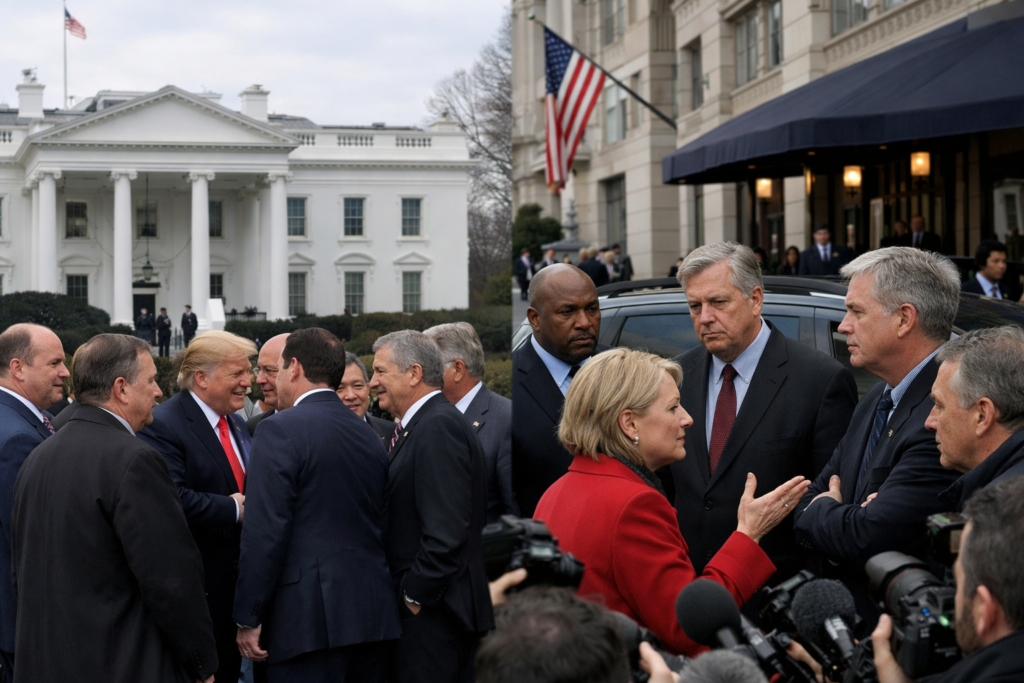
Image Credentials: Image Title: National Governors Association Cancels Trump Meeting Over GOP-Only Invites. Source: (sora.openai) Date: February 2026. Attribution: This image was created using AI-generated imagery (sora.openai) and does not depict a real-world scene.
By Open Chronicle Staff with Agencies
WASHINGTON — In a stunning break from over a century of tradition, the National Governors Association (NGA) has scrapped its official meeting with the White House after the Trump administration restricted invitations to the annual business session to Republican governors only.
The decision, announced on February 10, 2026, marks a historic nadir in the relationship between the executive branch and the bipartisan organization representing the leaders of all 50 U.S. states and five territories.
“Rising Above” the Divide
Oklahoma Governor Kevin Stitt, a Republican and current chair of the NGA, confirmed the cancellation in a letter to his colleagues. Stitt informed the group that NGA staff had been notified of the White House’s intent to exclude Democratic governors from the February 20 business meeting.
“Because NGA’s mission is to represent all 55 governors, the Association is no longer serving as the facilitator for that event, and it is no longer included in our official program,” Stitt wrote. Despite his own party affiliation, Stitt urged his fellow governors to remain unified. “We cannot allow one divisive action to achieve its goal of dividing us. The solution is not to respond in kind, but to rise above.”
The NGA refuses to attend their annual meeting with Trump.
That backfired right into his orange pedophile face. pic.twitter.com/aU79jzPCJE— CJ (@Rights4USLabor) February 10, 2026
A Tradition Dismantled
The annual meeting between the U.S. President and the nation’s governors has long been a centerpiece of federal-state cooperation, providing a rare venue for bipartisan dialogue on infrastructure, healthcare, and emergency management.
Brandon Tatum, CEO of the NGA, expressed deep disappointment, calling the tradition a “vital” part of American governance. Analysts note that while tensions have flared in the past—most notably last year when President Trump traded barbs with Maine’s then-Governor Janet Mills over transgender policies—the total exclusion of an entire political party from the official session is unprecedented.
Echoes of Last Year’s Friction
The roots of the current standoff can be traced back to the 2025 conference, where the President reportedly threatened to withhold federal funding from states that did not comply with specific administration orders. The resulting friction led several Democratic governors to stop paying their NGA dues, questioning the utility of a bipartisan group in an increasingly polarized era.
The White House has yet to offer an official comment on the decision to limit invitations, but the move aligns with the administration’s broader strategy of prioritizing “unified” Republican leadership. Last month, President Trump hosted a private dinner at Mar-a-Lago for GOP governors, where Governor Stitt remarked that the Republican wing of the association was “unified” behind the President’s agenda on border security and energy.
A Fractured Federation
With Democratic governors like California’s Gavin Newsom and Illinois’ JB Pritzker already threatening to leave the NGA over the President’s deployment of National Guard troops across state lines, the cancellation of the White House meeting may signal the end of the NGA as a truly bipartisan force.
As state leaders gather in Washington from February 19-21, they will do so without the customary sit-down at 1600 Pennsylvania Avenue, leaving a void in the “pragmatic leadership” the association has championed since its founding in 1908.
Key Developments:
-
NGA Stance: Official cancellation of the White House business meeting from the NGA program.
-
Republican Leadership: Chair Kevin Stitt (R-OK) leads the move to maintain NGA’s bipartisan integrity.
-
Excluded Parties: All Democratic and Independent governors were reportedly barred from the invitation list.
-
Broader Context: Ongoing disputes over state sovereignty and federal troop deployments continue to strain state-federal relations.