
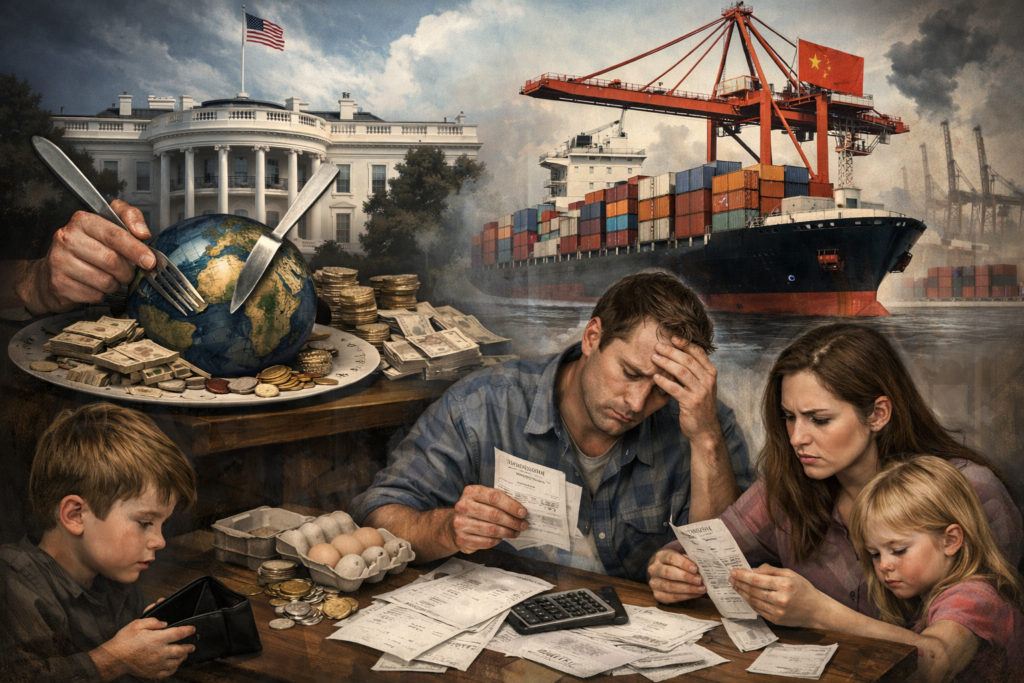
Image Credentials: Image Title: The $1,300 “Tax”: New Data Reveals Americans Footing 96% of Trump’s Tariff Bill. Source: (sora.openai) Date: February 2026. Attribution: This image was created using AI-generated imagery (sora.openai) and does not depict a real-world scene.
OPEN CHRONICLE | Serving the Truth, Shaping the Future
By Open Chronicle Staff with Agencies
WASHINGTON, D.C. — While the White House continues to insist that foreign nations are “eating” the costs of the administration’s aggressive trade policies, new nonpartisan data tells a far more expensive story for the American household.
According to a comprehensive report released this week by the Tax Foundation, the “Liberation Day” tariffs and subsequent levies have evolved into the largest U.S. tax increase as a percentage of GDP since 1993. The study finds that the average U.S. household paid an additional $1,000 in 2025—a figure projected to climb to $1,300 per household in 2026 as the trade war escalates.
The “96% Reality Check.”
The findings are bolstered by a separate investigation from the Kiel Institute for the World Economy, which analyzed over 25 million shipment records. Their conclusion is stark: American importers and consumers bore 96% of the tariff costs in 2025. Foreign exporters absorbed just 4% of the burden, choosing instead to reduce shipments or maintain prices while passing the tax directly to U.S. buyers.
“The claim that foreign countries pay these tariffs is a myth,” says Julian Hinz, Research Director at the Kiel Institute. “The data show the opposite: Americans are footing the bill. The tariffs are an own goal.”
Strategic Highlights of the Tariff Impact
-
The 2026 Hike: As of February 2026, the weighted average tariff rate on all imports has risen to 13.5%, the highest level since the end of World War II.
-
Revenue vs. Growth: While the government netted approximately $200 billion in customs revenue in 2025, the Tax Foundation warns this is being offset by a 0.5% reduction in GDP and a loss of roughly 436,000 full-time equivalent jobs.
-
Consumer Pass-Through: Disclosures from late 2025 show industry executives across the board are “protecting profits” by passing 100% of tariff costs to retail shoppers.
The Greenland Escalation
The economic pressure is expected to intensify following President Trump’s recent “Greenland Purchase” initiative. On January 17, the President announced a new 10% tariff on eight European allies—including the UK, France, and Germany, as a penalty for opposing the U.S. annexation of Greenland.
These rates are scheduled to jump to 25% on June 1, 2026, unless a “Complete and Total purchase deal” is reached. European leaders have responded by suspending trade agreements and considering retaliatory sanctions, threatening a broader global trade freeze.
The Judicial “Wild Card”
The future of these economic measures now rests with the Supreme Court. Justices are expected to issue a ruling as early as February 20, 2026, on whether the President overstepped his authority by using the International Emergency Economic Powers Act (IEEPA) to bypass Congress.
Lower courts have already ruled the tariffs illegal, and while the administration is preparing a “Plan B” using alternative trade laws, a SCOTUS defeat could trigger a chaotic scramble for $140 billion in potential duty refunds for U.S. businesses.