
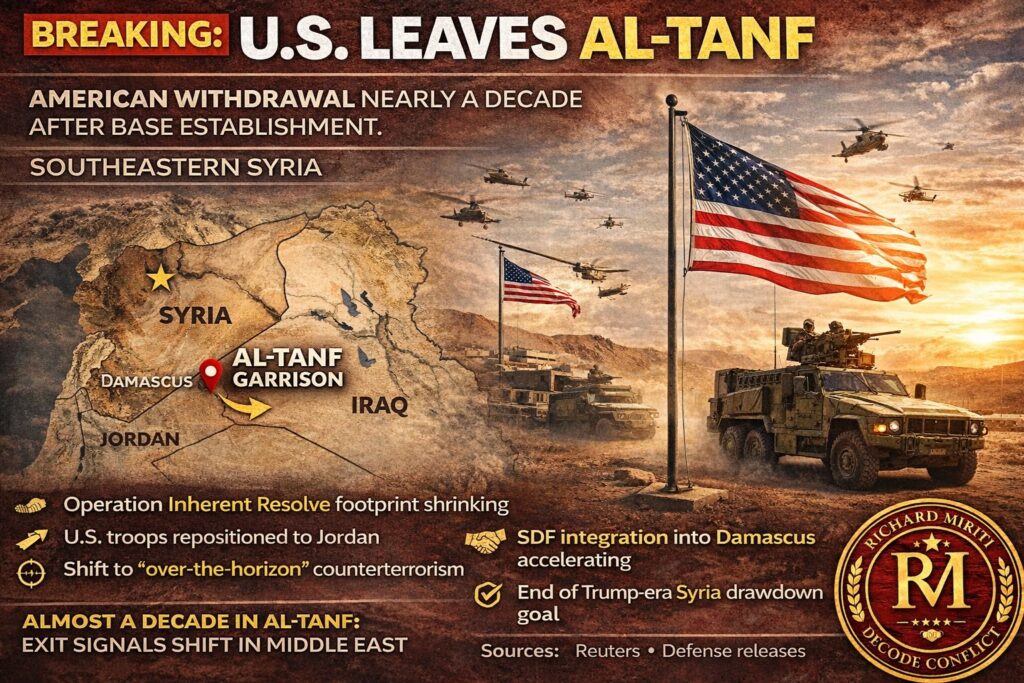
Image: from Richard Miriti X@miriti55453
By Open Chronicle Staff | Thursday, February 12, 2026
DAMASCUS – In a significant shift of the Middle Eastern military landscape, the Syrian Arab Army has taken full control of the strategic Al-Tanf garrison following the complete withdrawal of United States forces. The handover, confirmed by both Damascus and U.S. Central Command (CENTCOM) today, marks the end of a decade-long American presence at the tri-border junction of Syria, Jordan, and Iraq.
A Coordinated Transition
The departure from the Al-Tanf garrison was described by CENTCOM as a “deliberate and conditions-based transition.” Syrian defense officials stated that the takeover was the result of high-level coordination between the two nations, with Syrian border guard units already beginning deployment along the sensitive desert frontier to secure nearby transit routes.
“The orderly departure of U.S. forces from Al-Tanf was completed on February 11,” CENTCOM chief Admiral Brad Cooper said in a statement. “While we are consolidating our footprint, U.S. forces remain poised to respond to any ISIS threats that arise in the region.”
The Pivot to Damascus
A few minutes ago, the American army base at Tanf in eastern Syria was attacked by drones. pic.twitter.com/fvohSy9JH2
— Sprinter Press (@SprinterPress) April 1, 2024
The withdrawal is the latest milestone in a dramatic realignment of U.S. foreign policy toward Syria. Following the overthrow of Bashar al-Assad in December 2024, the Trump administration has steadily distanced itself from its long-term partners, the Kurdish-led Syrian Democratic Forces (SDF), in favor of the new central government led by President Ahmed al-Sharaa.
Last November, Syria officially joined the global coalition to defeat ISIS during Sharaa’s visit to the White House. Since then, Washington has brokered a deal to integrate SDF fighters into the Syrian national army, effectively removing the “main irritant” in U.S.-Turkey relations and paving the way for a total American drawdown.
Strategic Void or Sovereign Success?
For years, Al-Tanf served as a critical hub for monitoring Iran-backed militias and disrupting supply lines to Hezbollah in Lebanon. Critics of the withdrawal, including several prominent D.C. think tanks, have labeled the move an “own goal,” warning that Syrian government forces may lack the capacity to prevent a jihadist resurgence or counter Iranian influence.
“This was a low-cost, high-value mission that the United States is ending even though the threat persists,” noted David Adesnik of the Foundation for Defense of Democracies.
However, proponents of the move argue that the mission lacked legal authorization and needlessly endangered American troops. Many of the personnel previously stationed at Al-Tanf have reportedly relocated to “Tower 22,” a U.S. base located just across the border in Jordan.
The Road Ahead
With Al-Tanf now under the control of the Sharaa administration, the remaining U.S. ground forces in Syria, estimated to be fewer than 1,000, are largely concentrated at the Qasrak base in Hasakah. As the U.S. continues to transfer thousands of ISIS detainees from Syrian prisons to Iraq, analysts suggest a “complete withdrawal” from the country may be imminent, fulfilling a long-standing objective of the current administration.