
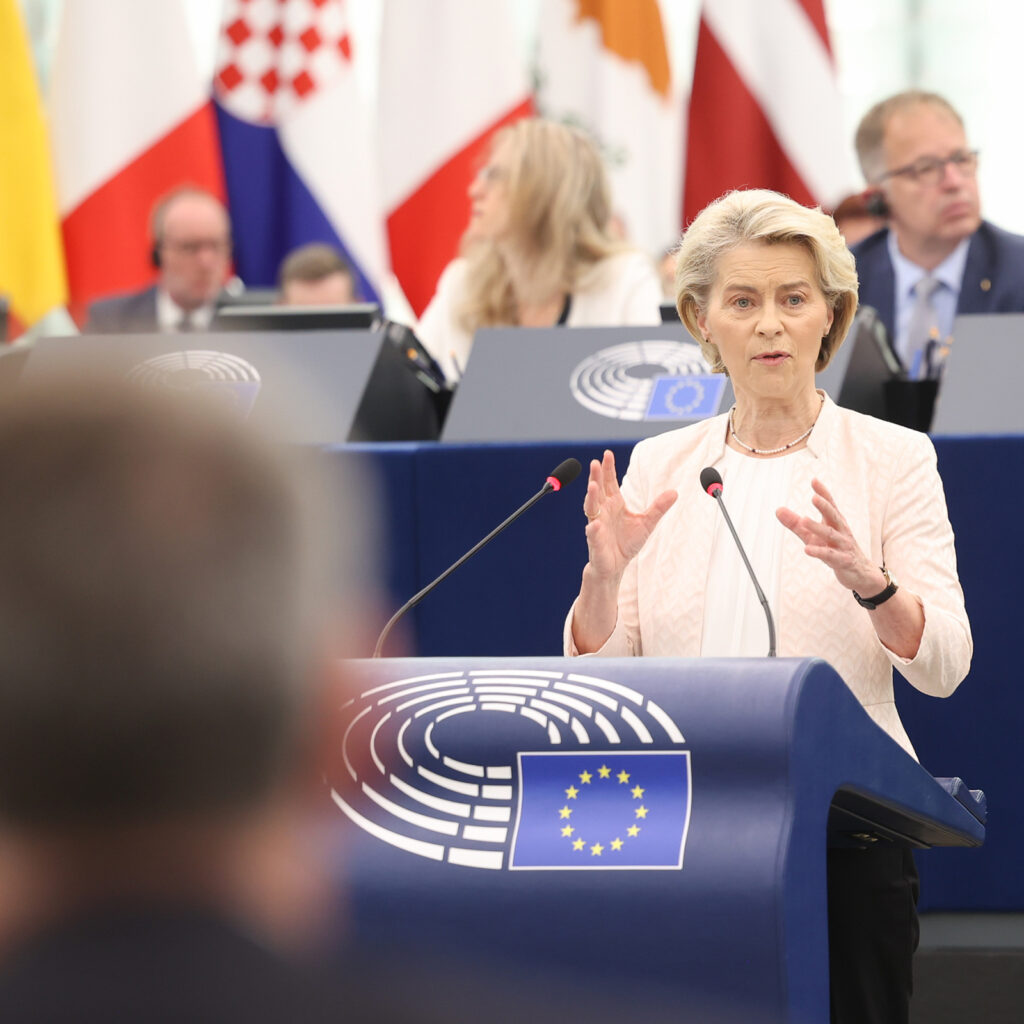
Image: from the European Parliament X@Europarl_EN
By Open Chronicle with Agencies
STRASBOURG — In a bold departure from the traditional quest for total consensus, European Commission President Ursula von der Leyen has signaled her readiness to embrace a “two-speed” European Union. Speaking ahead of a critical informal summit of EU leaders, von der Leyen argued that the bloc can no longer allow its economic competitiveness to be held hostage by the vetoes of a few member states.
The proposal, which marks a significant shift in Brussels’ strategic direction, centers on the concept of “enhanced cooperation.” This mechanism allows a core group of at least nine member states to move forward with deeper integration in specific areas, such as defense, taxation, and capital markets, without requiring the immediate participation of all 27 nations.
🇪🇺 The EU must "tear down the barriers" that prevent it from becoming a truly global economic giant, European Commission chief Ursula von der Leyen said ahead of leaders' talks on making the 27-nation bloc more competitive.
➡️ https://t.co/a6RAVO2qzI pic.twitter.com/oEn150xajT— AFP News Agency (@AFP) February 11, 2026
Breaking the Veto Deadlock
The President’s remarks come at a time of mounting pressure from global rivals, specifically the United States and China. Von der Leyen warned that “inaction risks undermining Europe’s competitiveness” and that the Union must prioritize its capacity to act over the pursuit of the “lowest common denominator.”
“Our ambition should always be to reach an agreement among all 27 member states,” von der Leyen wrote in a letter to leaders. “However, where a lack of progress or ambition risks undermining Europe’s capacity to act, we should not shy away from using the possibilities foreseen in the treaties.”
This “multi-speed” approach aims to replicate the success of the Eurozone and the Schengen Area, systems that began with a vanguard of willing nations and eventually expanded.
The “EU Inc” and Regulatory Simplification
Central to this new vision is a plan to radically simplify the European business environment. Von der Leyen announced a roadmap for a “Simplified Europe,” which includes the creation of “EU Inc”—a unified legal framework that would allow businesses to register and operate across all member states under a single set of rules within 48 hours.
The Commission is also taking aim at “gold-plating,” the practice where national governments add extra layers of bureaucracy to EU regulations. According to the President, these internal barriers act as a hidden tariff, stifling the growth of small and medium-sized enterprises (SMEs) and deterring cross-border investment.
A Competitive Push
The move aligns with recent calls from influential figures like Mario Draghi, who has urged the EU to adopt a more “pragmatic federalist” approach to survive the current “economic malaise.” By forming a “hard core” of integrated economies, Brussels hopes to unlock up to €470 billion in private investment through a more liquid and unified Savings and Investment Union.
While the proposal is expected to face resistance from countries wary of being “left behind” or losing sovereign control, the message from Strasbourg is clear: Europe’s engine must start running at a higher gear, even if not every member is ready to shift at the same time.