
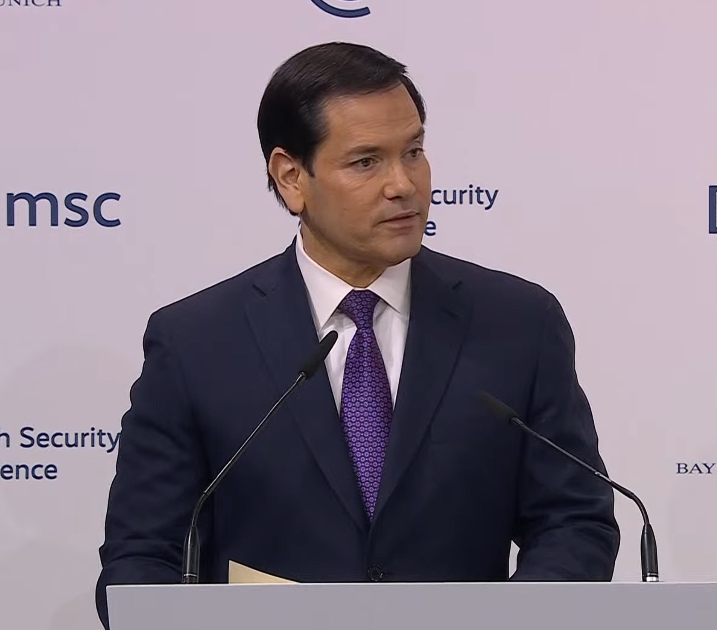
Image: from Hungarian Institute of International Affairs X @hiia_budapest
OPEN CHRONICLE | Global Perspective. Unfiltered Truth
By Open Chronicle Staff with Agencies
MUNICH — In a performance that combined cultural “love-bombing” with an uncompromising call for structural upheaval, U.S. Secretary of State Marco Rubio told European leaders on Saturday that the survival of Western civilization depends on a radical realignment with a resurgent America.
Speaking to a packed hall at the Munich Security Conference, Rubio struck a far more melodic tone than the combative rhetoric seen in previous years, yet his message was a firm warning: the West is facing a “decline by choice,” and only a return to industrial strength and shared heritage can save it.
This was an amazing speech by our
SoS Rubio, in Munich. It will have you cheering for him and for America…“We in America have NO INTEREST in being polite and orderly caretakers of the West’s managed decline…”
Here is the speech in its entirety: https://t.co/PZF5TwxCBX pic.twitter.com/AHAGxpsQrJ
— Farm Girl Carrie 👩🌾 (@FarmGirlCarrie) February 14, 2026
The “Spiritual and Cultural” Bond
Moving away from the transactional language often associated with the current Trump administration, Rubio appealed to the heart of the European-American relationship. He cited the shared cultural legacy of figures ranging from Mozart to The Beatles, describing the United States as a “child of Europe.”
“We are connected not just economically, not just militarily,” Rubio said to an uncharacteristically warm reception. “We are connected spiritually and culturally. Our destiny is, and will always be—intertwined with yours.”
A Critique of the “Postwar Delusion”
Despite the olive branch, Rubio did not hold back on the “substance” of American grievances. He labeled the postwar euphoria a “dangerous delusion,” arguing that the West had mistakenly believed trade alone would replace the necessity of nationhood and hard power.
He laid the blame for the West’s current vulnerabilities, specifically deindustrialization and energy insecurity, on what he called “conscious policy choices” by liberal elites. Rubio took direct aim at “climate cults” and open-border policies, which he claimed have “stripped our nations of their wealth and productive capacity.”
“Deindustrialization was not inevitable,” Rubio declared. “It was a choice. And decline, too, is a choice. We are here to choose renewal.”
Burden-Sharing or Burden-Shifting?
While the Secretary reassured allies that the U.S. does not wish for the “end of the transatlantic era,” he clarified that the partnership must be “revived” on new terms. He defended President Trump’s “direct and urgent” counsel as a necessary catalyst to force Europe toward self-sufficiency.
The response from European leaders was a mix of relief and resolve. While UK Prime Minister Keir Starmer agreed that “security is the currency of our times,” European Commission President Ursula von der Leyen used the moment to call for the immediate implementation of the EU’s mutual defense clause, signaling that Europe is indeed preparing to shoulder more of the “hard power” Rubio demanded.
As Rubio concluded his address to a standing ovation, the tension of the “Greenland crisis” and the “culture wars” mentioned by Chancellor Merz on Friday seemed momentarily eclipsed by a shared sense of existential urgency. Whether this “new era” leads to a strengthened alliance or a managed separation remains the defining question of the summit.