
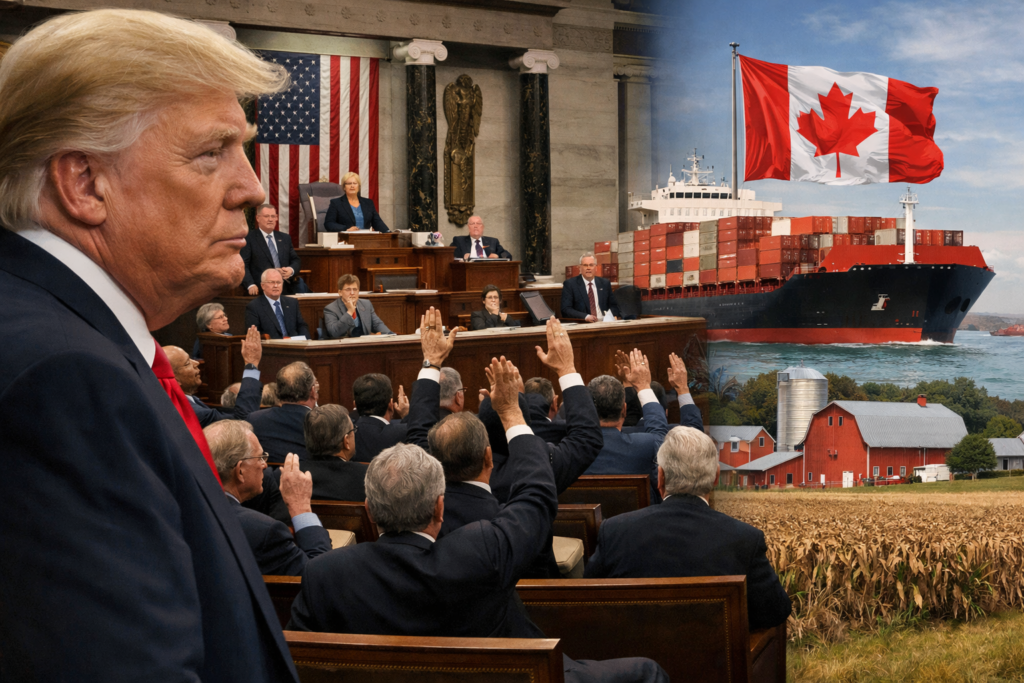
Image Credentials: Image Title: Fealty Over Farmsteads: House GOP Overwhelmingly Rejects Efforts to Block Trump’s Canada Tariffs Source: (sora.openai) Date: January 2026. Attribution: This image was created using AI-generated imagery (sora.openai) and does not depict a real-world scene.
OPEN CHRONICLE | Global Perspective. Unfiltered Truth.
By Open Chronicle Staff with Agencies
WASHINGTON D.C. — In a display of party discipline that critics are calling a surrender of Congressional authority, 97% of House Republicans voted Wednesday night to uphold President Donald Trump’s 25% tariffs on Canadian imports, despite mounting evidence of economic distress in American agricultural and manufacturing heartlands.
The vote served as a stark litmus test for the GOP’s “loyalty-first” era, with all but six Republican lawmakers choosing to support the administration’s trade levies over bipartisan efforts to provide relief to consumers and businesses struggling under the weight of a deepening trade war.
The Shadow of the Primary Threat
The lopsided vote followed a blunt warning from the White House. Posting on Truth Social, President Trump cautioned that any Republican voting against his tariffs would “suffer the consequences come Election time,” specifically mentioning the threat of primary challenges.
The pressure appeared particularly effective on “vulnerable” Republicans and those representing farming districts. Rep. Ashley Hinson (R-IA), who is currently vying for a U.S. Senate seat, voted to keep the tariffs in place despite Iowa’s soybean industry facing its steepest downturn in decades due to retaliatory trade measures. While Hinson framed her vote as an effort to “level the playing field,” her Democratic opponents were quick to label it an act of political self-preservation at the expense of her constituents.
A Dwindling Resistance
The resistance within the Republican party was notably thin and largely composed of those with little left to lose. Of the six GOP members who broke ranks to vote with Democrats, two are not seeking re-election, while others, like Rep. Thomas Massie (R-KY), are already locked in bitter primary battles against Trump-endorsed challengers. Only two Republicans in competitive races—Reps. Jeff Hurd of Colorado and Brian Fitzpatrick of Pennsylvania defied the President.
“There are no more ‘moderates’ left in the Republican Party, just corrupt sycophants,” charged Justin Chermol, spokesperson for the Democratic Congressional Campaign Committee (DCCC). Democrats have already signaled that the “Tariff Vote” will be the centerpiece of their strategy for the 2026 midterms.
Economic Ransack or Strategic Leverage?
While the administration argues that tariffs are a necessary “hammer” to force concessions from foreign leaders, the domestic reality is becoming increasingly difficult to ignore. National polling suggests that the tariffs are among the President’s most unpopular policies, with large majorities of Americans reporting higher prices for basic goods.
A day before the main vote, the House GOP also blocked a measure that would have reclaimed Congress’s constitutional authority to set tariffs, effectively ceding that power to the executive branch for the foreseeable future. As the 2026 election cycle begins to heat up, the question for the GOP is whether their fealty to the “America First” trade doctrine will survive the economic backlash from the voters they claim to protect.