
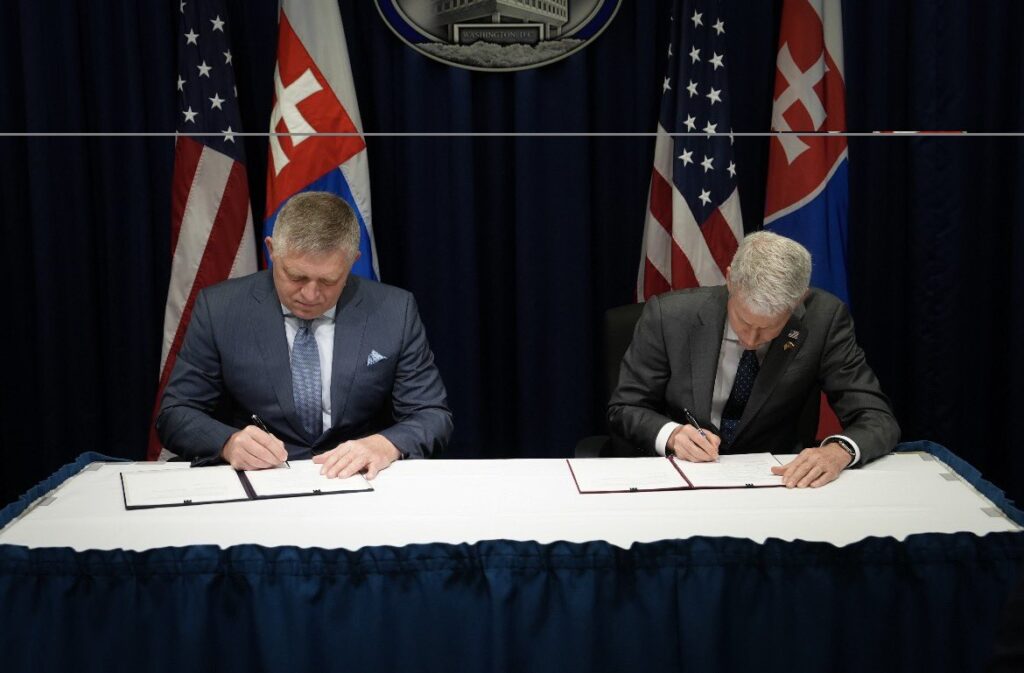
Image: from Secretary Chris Wright X @SecretaryWright
By Open Chronicle Staff with Agencies
BRATISLAVA/BUDAPEST – In a significant move to bolster transatlantic energy security and counter regional dependence on Russian power, U.S. Secretary of State Marco Rubio finalized two landmark civil nuclear agreements during a high-stakes visit to Central Europe on Monday.
The deals, signed in Bratislava and Budapest, are expected to generate over $15 billion in business opportunities for American companies while positioning the United States as a primary partner in the region’s green energy transition.
🇺🇸🇭🇺 US Secretary of State Marco Rubio and Hungary's FM Peter Szijjarto sign an Intergovernmental Agreement on Civil Nuclear Cooperation
How many eyes from Brussels are on Budapest? pic.twitter.com/0FwYeqJZYB
— Lord Bebo (@MyLordBebo) February 16, 2026
Building the Future: Large Reactors and SMR Hubs
The twin agreements focus on both traditional and next-generation nuclear technology:
-
Slovakia: Washington has pledged funding for pre-construction work on a new Westinghouse large-scale reactor. This support flows through the “Foundational Infrastructure for Responsible Use of Small Modular Reactor Technology” (FIRST) program, aimed at helping nations establish safe and modern nuclear frameworks.
-
Hungary: Secretary Rubio signed the U.S.-Hungary Civil Nuclear Intergovernmental Agreement. Beyond general cooperation, the framework aims to establish Hungary as a regional hub for the development and deployment of Small Modular Reactors (SMRs).
Economic and Strategic Rationale
The State Department emphasized that these accords are not merely commercial but are deeply rooted in “mutual security interests.” By integrating American technology into the Central European grid, the U.S. aims to:
-
Enhance Energy Security: Reducing the region’s historical reliance on Russian nuclear fuel and technology.
-
Support AI and Tech Growth: Officials noted that the increased power capacity is essential for meeting “tech competitiveness goals,” specifically providing the massive energy required to power AI data centers and advanced manufacturing.
-
Job Creation: The $15 billion in projected business is expected to support thousands of high-skilled jobs across the American energy sector.
The Wider Context: Diplomacy and Peace Talks
The signing occurred against a backdrop of intense regional diplomacy. While in the region, reports also surfaced regarding broader U.S. efforts to stabilize Eastern Europe. Concurrently, Ukrainian President Volodymyr Zelenskyy commented on separate U.S. proposals regarding security guarantees, though he emphasized that such protections must be legally binding before any discussions on territorial compromises could occur.
Secretary Rubio’s visit underscores a renewed U.S. commitment to “energy diplomacy,” using American technological superiority to forge long-term strategic dependencies in a region that has long been a geopolitical tug-of-war between East and West.