
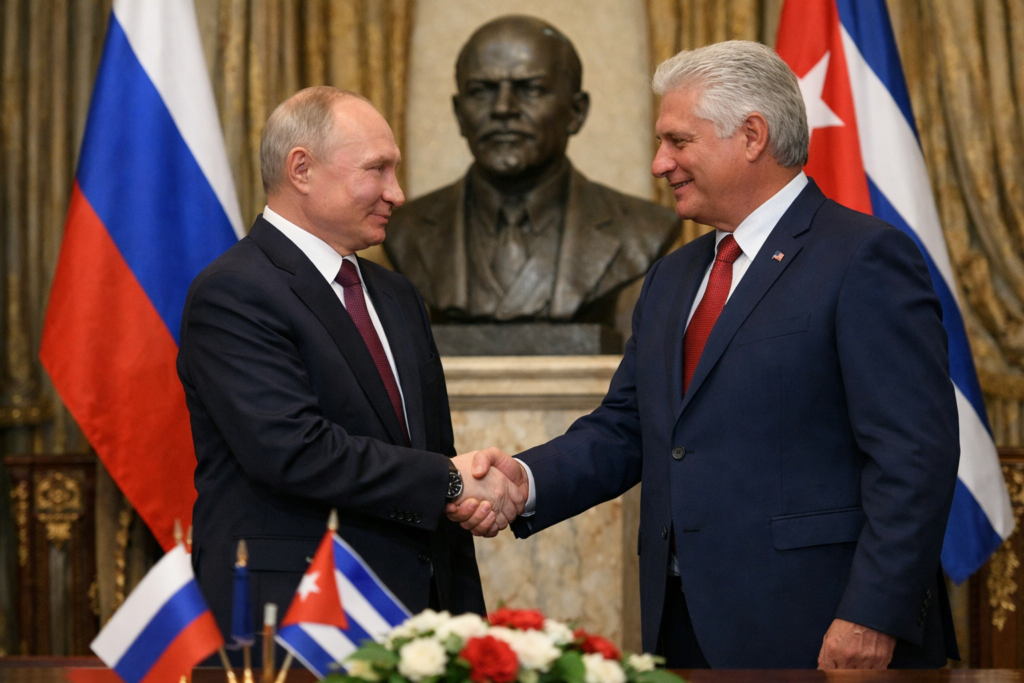
Image Credentials: Image Title: MOSCOW PLEDGES ‘UNWAVERING’ SUPPORT FOR HAVANA AMID FUEL CRISIS. Source: (sora.openai) Date: Feb 2026. Attribution: This image was created using AI-generated imagery (sora.openai) and does not depict a real-world scene.
By Open Chronicle with Agencies
MOSCOW – Russian President Vladimir Putin reaffirmed his nation’s “unshakeable” alliance with Cuba on Wednesday, as the Caribbean island struggles under the weight of a severe energy crisis and a tightening web of U.S.-led sanctions.
In a high-profile meeting at the Kremlin’s Senate Palace, Putin hosted Cuban Foreign Minister Bruno Rodríguez Parrilla, signaling a deepening of the Cold War-era bond between the two nations. The Russian leader utilized the platform to launch a scathing critique of Washington’s foreign policy, specifically condemning the “de facto oil blockade” that has paralyzed the Cuban economy.
“We have always stood by Cuba in its struggle for independence and the right to follow its own path,” Putin told Rodríguez during the session. “We do not accept sanctions like this. They are illegitimate and anti-humane.”
Fuel Crisis and Economic Strangulation
The visit comes at a desperate moment for Havana. The Cuban government is currently grappling with its most acute economic depression since the 1991 collapse of the Soviet Union. Widespread blackouts have become the norm, and fuel shortages have brought much of the country’s transportation and industry to a standstill.
The crisis has been exacerbated by the return of “maximum pressure” tactics from the Trump administration. Recent U.S. executive orders have targeted tankers delivering oil to the island and threatened additional tariffs on nations that facilitate energy trade with the communist-run state.
Foreign Minister Sergey Lavrov, who met with Rodríguez earlier in the day, echoed Putin’s sentiments, calling on Washington to “show common sense” and refrain from what he described as a “military-maritime blockade of the island of freedom.”
Strategic Alliances and Geopolitical Chess
While the Kremlin was vocal in its rhetorical support, it remained characteristically vague regarding specific material aid. Although Kremlin spokesperson Dmitry Peskov confirmed that “support measures” were discussed, no formal announcement of immediate oil shipments or credit lines was made during the press briefing.
However, the meeting serves as a potent symbol of Russia’s broader strategy to solidify its influence in the Western Hemisphere. As Moscow faces its own barrage of Western sanctions stemming from the four-year war in Ukraine, it has increasingly sought to bolster ties with traditional allies like Cuba, North Korea, and Venezuela.
For its part, Havana has remained a loyal partner to Moscow on the global stage. Cuba has refrained from condemning the Russian invasion of Ukraine, and the Kremlin has frequently praised the island as a “priority partner” in its vision of a “multipolar world” free from U.S. hegemony.
A Defiant Havana
Despite the economic turmoil, Minister Rodríguez remained defiant, insisting that Cuba would not alter its political trajectory under duress. He denounced the current international order as “unjust and precarious,” accusing the United States of attempting to “suffocate” the Cuban people into submission.
As the meeting concluded, the message from the Kremlin was clear: while the logistics of aid remain behind closed doors, the political alignment between Moscow and Havana is as firm as it was decades ago.