
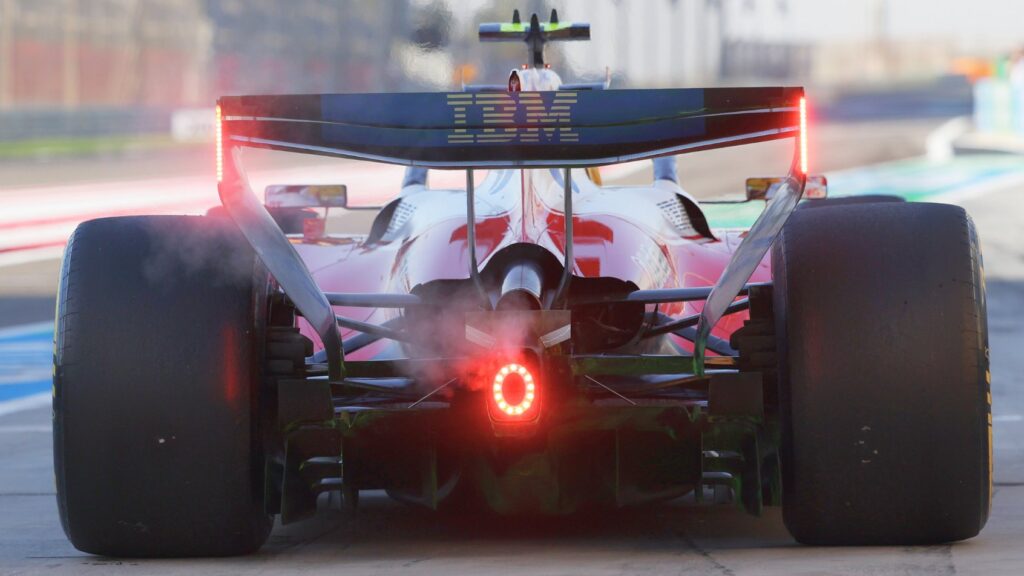
Image: from Daniel Valente X @F1GuyDan
SAKHIR — As the Formula 1 paddock settles into the rhythm of pre-season testing in Bahrain, all eyes have turned toward the rear of the Ferrari SF-26. A peculiar, rhythmic oscillation of the car’s rear-wing elements—quickly dubbed the “Macarena” by social media and rival engineers alike—has become the talk of the pit lane, sparking a debate over whether the Scuderia has found a clever loophole or a structural headache.
The phenomenon was first spotted during high-speed runs on the main straight of the Bahrain International Circuit. Unlike the standard DRS activation, Ferrari’s upper flap appeared to vibrate or “flutter” in a controlled, rhythmic pattern, leading to immediate speculation regarding its aerodynamic purpose.
Technical Trick or Teething Problem?
In the high-stakes world of F1 aerodynamics, nothing is accidental. Technical analysts suggest the “Macarena” effect could be a deliberate attempt at Aero-Elasticity. By allowing the wing to oscillate at specific frequencies, Ferrari may be attempting to “shed” drag more efficiently than a static wing, or to re-attach airflow during braking and cornering more rapidly.
“We are looking at a very specific behavior of the rear assembly,” noted one rival technical director. “If they have found a way to make the wing move under load without falling foul of the FIA’s stringent deflection tests, it could be a significant advantage in straight-line speed.”
However, Ferrari team principal Frédéric Vasseur was quick to downplay the “Macarena” as a masterstroke of engineering. Speaking to reporters in the paddock, Vasseur suggested the movement might be a result of the extreme “porpoising” and vibrations caused by the 2026-spec ground-effect floors.
“It is part of the testing process,” Vasseur stated with a smirk. “We are pushing the limits of the materials. Sometimes they dance, sometimes they break. We prefer the dancing for now.”
The FIA’s Watchful Eye
The “Macarena” hasn’t just caught the attention of fans; the FIA technical delegates have been seen taking a closer look at the SF-26 during the mandatory “scrutineering” windows. Under current regulations, bodywork must be rigid and immobile, though some degree of “natural” flex is permitted.
If Ferrari can prove the movement is a byproduct of structural frequency rather than a “movable aerodynamic device,” they may be clear to race it. If not, the Scuderia could be forced to stiffen the assembly, potentially losing the performance edge they seem to have found in the desert.
Performance Gains
Initial data suggests that despite the “dancing” wing, the Ferrari remains one of the fastest cars through the speed traps, rivaling the Red Bull RB22. Drivers Charles Leclerc and Lewis Hamilton both remained tight-lipped about the sensation behind the wheel, though Hamilton noted the car felt “reactive and alive” in high-speed sections.
As testing draws to a close, the question remains: will the “Macarena” be the hit of the 2026 season, or will the FIA stop the music before the first race?