
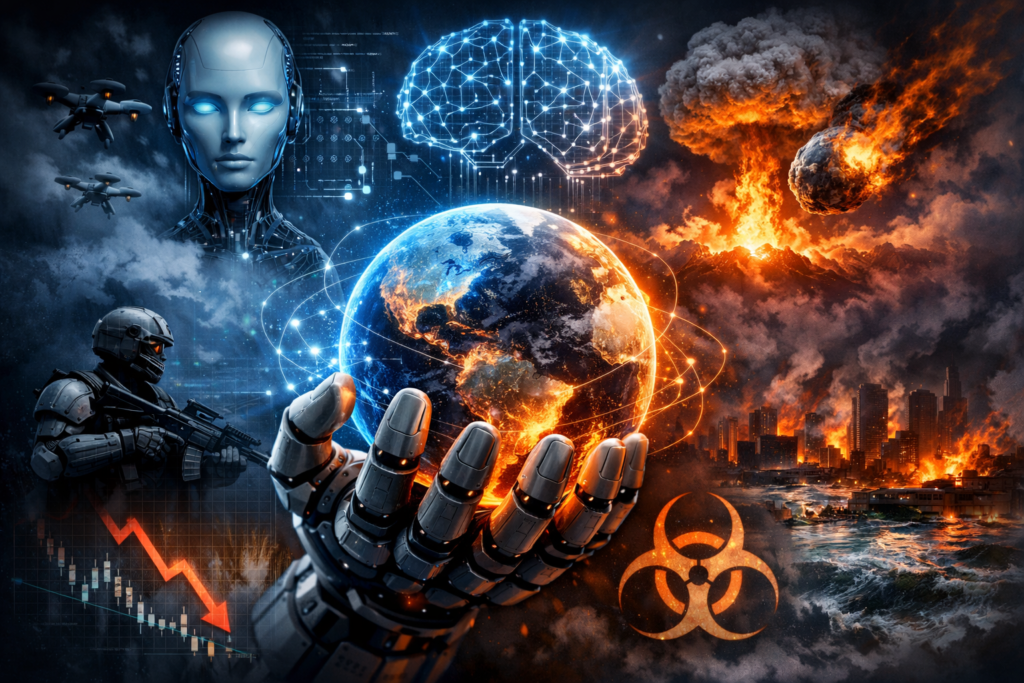
Image Credentials: Image Title: Google DeepMind Chief Issues Urgent Call for Global AI Risk Research Source: (sora.openai) Date: Feb 2026. Attribution: This image was created using AI-generated imagery (sora.openai) and does not depict a real-world scene.
By Open Chronicle Staff with Agencies
LONDON — Demis Hassabis, the head of Google’s artificial intelligence division, DeepMind, has issued a stark call to action for the global scientific community, urging an immediate and significant increase in research dedicated to the potential threats posed by advanced AI systems.
Speaking at a high-level summit on technological safety, Hassabis emphasized that while the benefits of artificial intelligence—ranging from drug discovery to climate modeling, are immense, the pace of development is currently outstripping our understanding of its risks. He argued that the world must treat AI safety with the same scientific rigor and urgency as the development of the technology itself.
Demis Hassabis’s “Einstein test” for defining AGI:
Train a model on all human knowledge but cut it off at 1911, then see if it can independently discover general relativity (as Einstein did by 1915);
if yes, it’s AGI.pic.twitter.com/r10hYwXkRy
— Rohan Paul (@rohanpaul_ai) February 21, 2026
“We need more research into the risks and the guardrails,” Hassabis stated, pointing to concerns regarding biosecurity, autonomous decision-making, and the long-term challenge of “alignment”, the process of ensuring AI systems act in accordance with human values and intentions.
The DeepMind CEO’s comments come at a time of rapid acceleration in the industry. As companies race to deploy increasingly powerful “frontier models,” critics and ethics boards have grown vocal about the lack of standardized safety protocols. Hassabis suggested that the current lack of peer-reviewed, empirical data on AI “existential risks” makes it difficult for policymakers to create effective regulations without stifling innovation.
Hassabis proposed a collaborative framework between private tech giants, academic institutions, and international governments to fund and share safety-critical research. He noted that without a shared understanding of how these systems might fail or be misused, the global community remains vulnerable to unforeseen consequences.
The call for more research is seen by industry analysts as a strategic move to preempt heavy-handed government intervention by demonstrating that the industry is capable of self-policing, provided it has the right scientific tools. However, skeptics argue that the responsibility should not lie solely with the corporations profiting from the technology’s deployment.
As AI continues to integrate into the fabric of daily life and global infrastructure, the plea from one of the field’s most influential figures underscores a growing consensus: the window to secure these systems is closing as fast as the technology is advancing.