
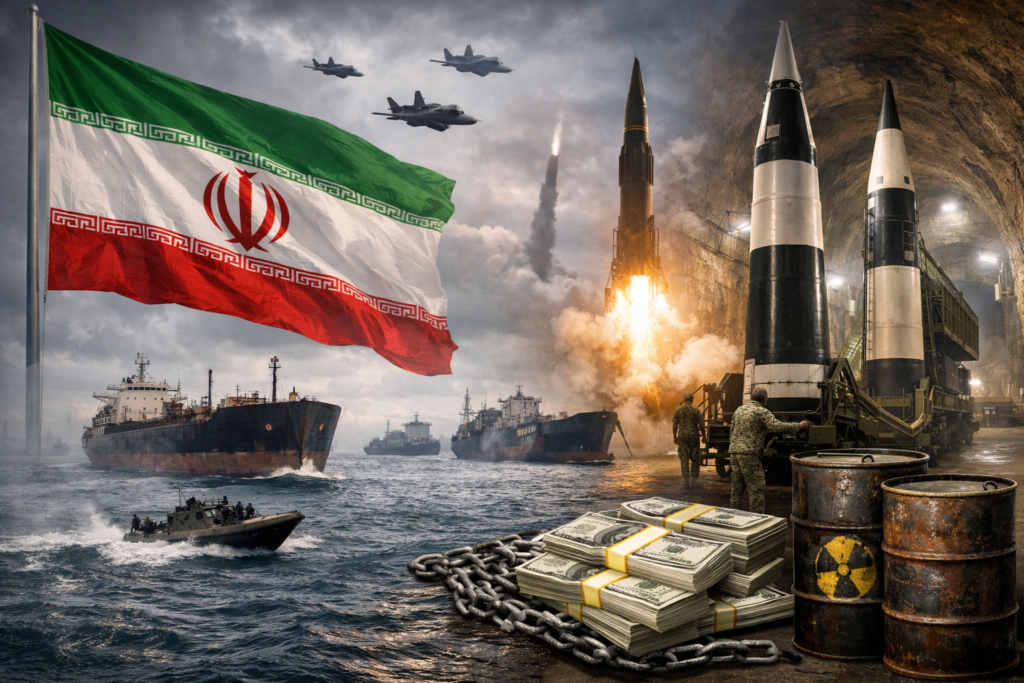
Image Credentials: Image Title: U.S. Expands Iran Sanctions, Targeting ‘Shadow Fleet’ and Ballistic Missile Networks Source: (sora.openai) Date: Feb 2026. Attribution: This image was created using AI-generated imagery (sora.openai) and does not depict a real-world scene.
By Open Chronicle Staff with Agencies
Wednesday, February 25, 2026
WASHINGTON, D.C. — The United States moved to further tighten the economic noose around Tehran on Wednesday, announcing a sweeping expansion of sanctions aimed at dismantling Iran’s “shadow fleet” of oil tankers and its clandestine weapons procurement networks.
The Department of the Treasury’s Office of Foreign Assets Control (OFAC) unveiled the new measures as part of a broader “maximum pressure” strategy under the Trump administration. The sanctions specifically target the logistics and financial infrastructure that allow Iran to continue exporting petroleum in defiance of international bans and to secure the advanced machinery required for its ballistic missile program.
Cracking the “Shadow Fleet”
For years, Iran has utilized a vast, unregulated network of aging tankers, often operating under flags of convenience and with disabled tracking systems, to transport oil to global markets. Today’s action blacklists dozens of new vessels and front companies across multiple jurisdictions, including the UAE, Hong Kong, and the Marshall Islands.
“We are methodically stripping away the layers of anonymity that the Iranian regime uses to fund its regional aggression,” said a Treasury spokesperson. “The ‘shadow fleet’ is no longer invisible, and those who provide it with insurance, docking services, or ship-to-ship transfers will find themselves locked out of the global financial system.”
Targeting Missile Precursors
Beyond oil, the sanctions hit the heart of Iran’s military industrial complex. OFAC identified several networks that have successfully bypassed export controls to acquire sensitive precursor materials and precision machinery used in the production of ballistic missiles.
The timing of the announcement is particularly notable, coming just 24 hours after President Trump’s State of the Union address, where he characterized Iran as a “rogue actor” and an imminent threat to global stability. The sanctions serve as a forceful backdrop to the upcoming diplomatic summit in Geneva, where U.S. and Iranian negotiators are scheduled to meet for what many analysts call a “last chance” for a non-military resolution.
Regional Reaction
In Israel, officials praised the move, with Defense Minister Israel Katz stating that the international community must focus as much on Iran’s “ballistic arsenal” as its nuclear ambitions. Meanwhile, Tehran has responded with defiance. Iranian Parliament Speaker Mohammad Bagher Ghalibaf warned earlier today that “all options remain on the table” for Iran to protect its economic sovereignty.
Market analysts suggest that while the sanctions may lead to short-term volatility in oil prices, the primary goal is the long-term depletion of the Iranian Revolutionary Guard Corps’ (IRGC) operating budget.
As the “game of chicken” between Washington and Tehran intensifies, the effectiveness of these financial hammers may determine whether the region moves toward a new interim deal or slips further toward a direct kinetic confrontation.