
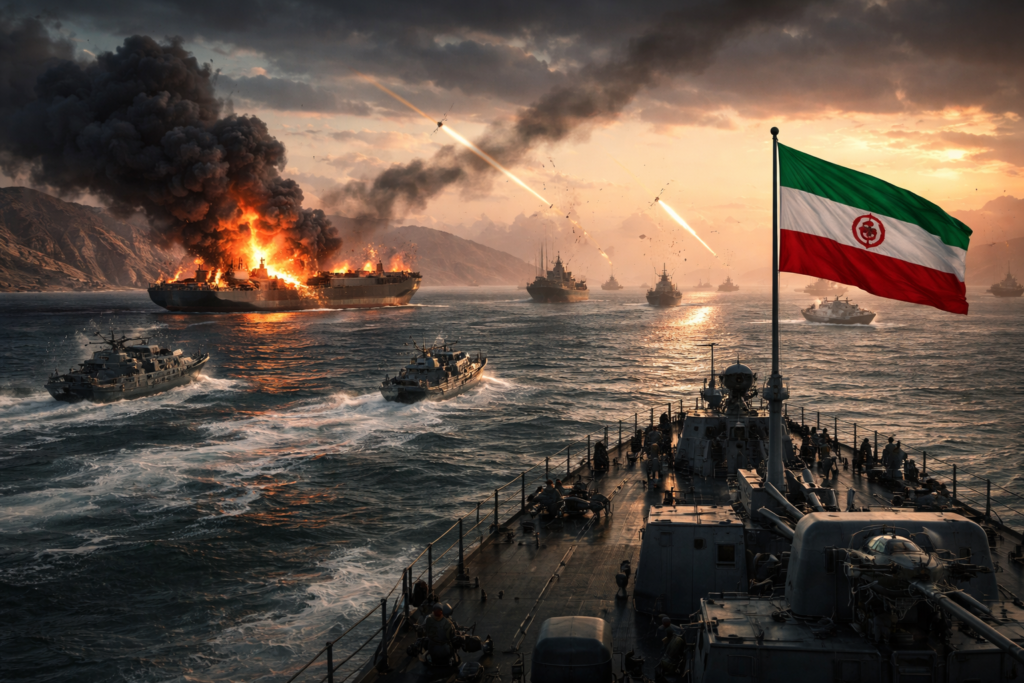
Image Credentials: Image Title: Global Markets Braced for Chaos as Iran Signals Closure of Strait of Hormuz Source: (sora.openai) Date: Mar 2026. Attribution: This image was created using AI-generated imagery (sora.openai) and does not depict a real-world scene.
By Open Chronicle Staff with Agencies
LONDON — Global energy markets and the international shipping industry were plunged into a state of high alert on Sunday as reports emerged that Iran’s Revolutionary Guard Corps (IRGC) has begun enforcing a blockade of the Strait of Hormuz. The move, a direct response to the ongoing U.S.-Israeli military campaign “Operation Epic Fury,” threatens to choke off more than 20% of the world’s daily oil and gas supply.
While Tehran has not issued a formal diplomatic declaration of a total blockade, the United Kingdom Maritime Trade Operations (UKMTO) and the EU’s naval mission, Aspides, confirmed that merchant vessels in the region have received VHF radio broadcasts from Iranian naval assets warning that “no ship is allowed to pass.”
A $100-a-Barrel Reality
The potential closure of the world’s most critical maritime chokepoint sent shockwaves through financial hubs. Crude oil traders warned that Brent crude, which settled at approximately $73 per barrel on Friday, could spike by as much as $20 to $30 when markets open on Monday, potentially exceeding the $100-per-barrel threshold for the first time in years.
“Sealing the Strait of Hormuz is the economic equivalent of pulling the fire alarm in a crowded theater and locking the exits,” said one market analyst.
The impact is expected to be felt most acutely in Asia, where over 80% of the energy transiting the 21-mile-wide waterway is bound. China, which relies on the Gulf for a vast majority of its energy imports, faces a particularly severe supply shock as its main supplier, Iran, enters a state of total war.
Shipping Giants Halt Transit
In response to the heightened risk, several of the world’s largest tanker owners and oil majors have reportedly suspended all transit through the Strait.
-
Diversions: Vessels are currently anchoring in the Gulf of Oman or the Arabian Sea, awaiting further instructions.
-
Insurance Spikes: Shipping insurers have already warned that war risk premiums could increase “manyfold,” with some firms refusing to cover vessels with any ties to U.S. or Israeli interests.
-
Neutrality at Risk: The U.S. Navy has issued a “maritime warning zone” advisory, stating it cannot currently guarantee the safety of neutral commercial traffic in the region.
The Strategic “Suicide” Gamble
Western officials, including U.S. Secretary of State Marco Rubio, had previously characterized an Iranian closure of the Strait as “economic suicide” for Tehran, given that the regime relies on the same waterway for its own dwindling oil exports. However, following the decapitation strike that killed Supreme Leader Ali Khamenei, analysts suggest the IRGC may be operating under a “scorched earth” policy.
“If they can’t sell their oil, they’re going to make sure no one else in the Gulf can either,” said a senior fellow at the Foundation for Defense of Democracies.
OPEC+ Response
In a bid to stabilize the global economy, eight OPEC+ member nations, led by Saudi Arabia and the UAE, announced on Sunday that they would shift into a “higher-output mode” starting in April. However, experts noted that additional production is meaningless if the primary export route remains blocked. While Saudi Arabia and the UAE possess pipelines that bypass the Strait, their combined capacity can only handle a fraction of the 20 million barrels that typically flow through Hormuz daily.
As the sun sets on a weekend of unprecedented military escalation, the world now waits to see if the U.S. Navy will move to forcibly reopen the shipping lanes, a move that would signify a major new phase in the conflict.