
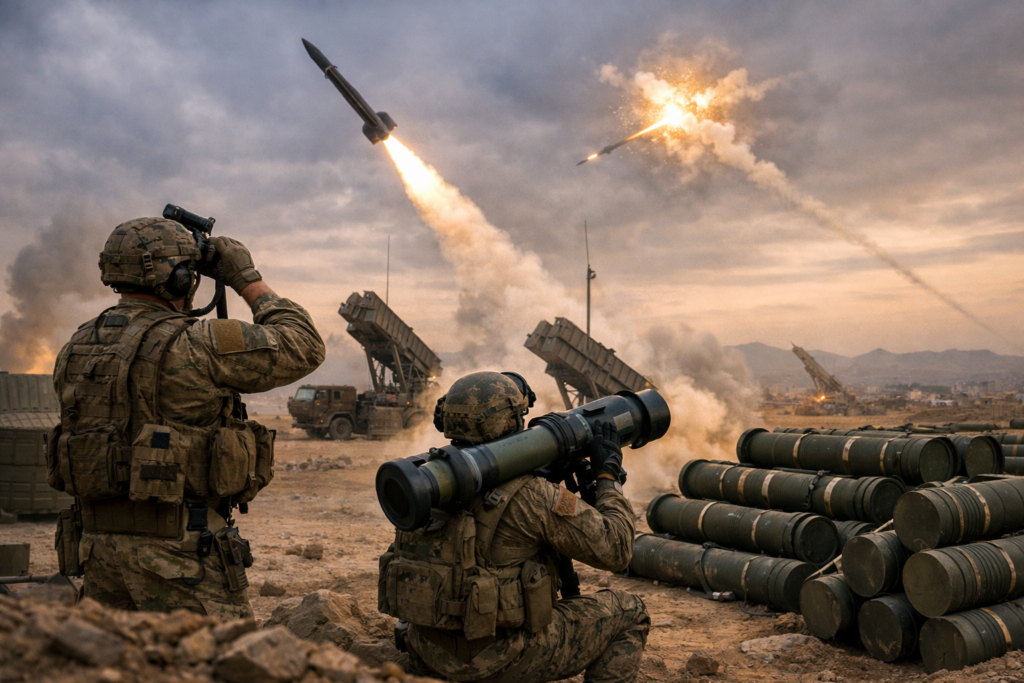
Image Credentials: Image Title: Ammo Crunch: U.S. Forces in Iran Face “Race Against the Clock” as Interceptor Stockpiles Dwindle Source: (sora.openai) Date: Mar 2026. Attribution: This image was created using AI-generated imagery (sora.openai) and does not depict a real-world scene.
By The Grand Strategy Institute
WASHINGTON — Despite the high-profile success of “Operation Epic Fury,” a sobering new report suggests that U.S. forces operating in and around Iran are locked in a desperate logistical race. According to The Wall Street Journal, the military is scrambling to dismantle Iran’s remaining nuclear and ballistic facilities before running out of the critical interceptor missiles needed to parry Tehran’s retaliatory strikes.
The report, published Sunday, highlights a growing anxiety within the Pentagon: the U.S. may be winning the tactical air war, but it is rapidly losing the war of attrition regarding advanced munitions.
The “Numbers Game” of Missile Defense
As U.S. Central Command (CENTCOM) continues to report “largely successful” defenses against hundreds of Iranian drones and missiles, experts warn that the volume of fire is unsustainable. The sophisticated interceptors used by Aegis destroyers and Patriot batteries are being expended at a rate that far outstrips current production capacities.
“Eventually it boils down to numbers,” Jonathan Conricus, a senior fellow at the Foundation for Defense of Democracies, told The Journal. “How many interceptors will we have versus how many launchers will they be able to field and fire.”
The exact size of the U.S. stockpile remains classified. Still, analysts point to two years of high-intensity regional conflicts, including the 2025 campaign against Houthi militants in Yemen, as the primary cause of the current shortage.
A Depleted Arsenal
The strain isn’t limited to defensive systems. The report indicates that U.S. forces are also running low on:
-
Sea-launched Tomahawk cruise missiles: The “workhorse” of long-range precision strikes.
-
Aircraft-launched munitions: Precision bombs and missiles used by carrier-based jets.
-
Standard Missile (SM) Interceptors: Critical for protecting the fleet from ballistic threats.
“One of the challenges is you can deplete these really quickly,” said Kelly Grieco, a senior fellow at the Stimson Center. “We’re using them faster than we can replace them.”
Strategic Implications for the Trump Administration
This logistical bottleneck places immense pressure on President Trump to deliver a “knockout blow” to Iran’s military infrastructure before the defensive umbrella folds. While the administration has celebrated the death of Supreme Leader Ali Khamenei, the IRGC’s “Operation Lion’s Roar” continues to saturate regional skies with projectiles.
If the U.S. runs out of interceptors, high-value assets, including aircraft carriers like the USS Abraham Lincoln and regional bases in Kuwait and the UAE, could become vulnerable to “leaking” missiles that bypass depleted defenses.
The Industrial Base Crisis
The crisis has reignited a fierce debate in Washington over the state of the American defense industrial base. Lawmakers have long warned that “just-in-time” manufacturing is insufficient for a sustained, large-scale conflict with a near-peer adversary or a well-armed regional power like Iran.
For the troops on the front lines of the “Epic Fury” campaign, the mission has now become a sprint: destroy the launch sites today, because there may not be enough interceptors to stop the missiles tomorrow.