
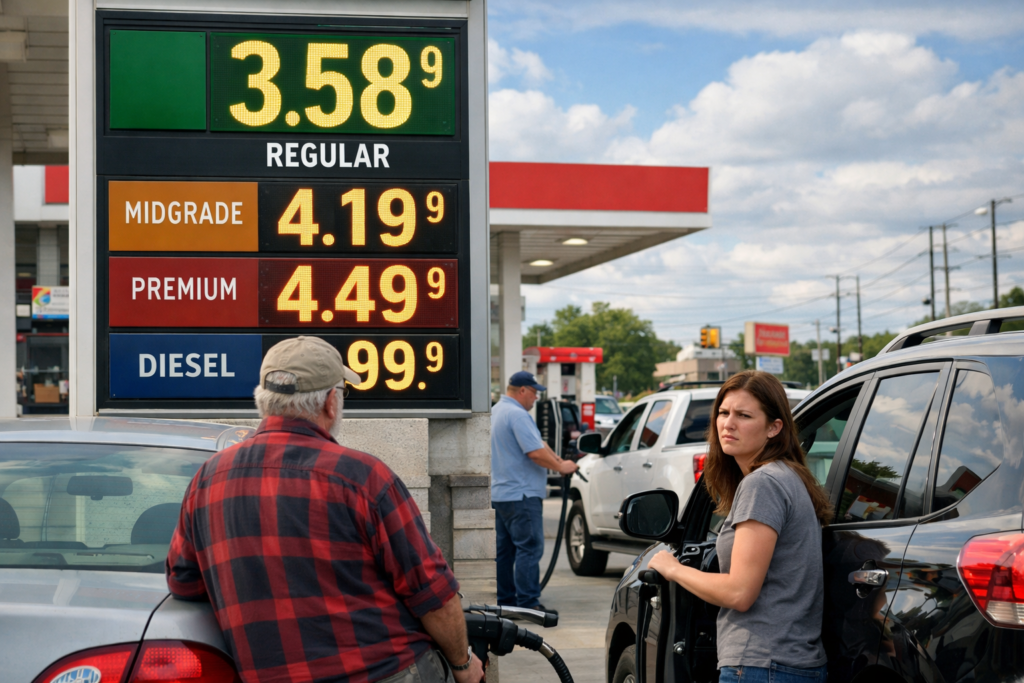
Image Credentials: Image Title: Economic Shockwaves: How the Iran Conflict is Hitting Global Pockets Source: (sora.openai) Date: March 2026. Attribution: This image was created using AI-generated imagery (sora.openai) and does not depict a real-world scene.
By Open Chronicle Staff
WASHINGTON — Just as the global economy began to find its footing after years of post-pandemic volatility, a new and aggressive disruption has emerged from the Persian Gulf. According to a detailed report by The Washington Post on March 12, 2026, the intensifying conflict between a U.S.-Israeli coalition and Iran has triggered a “massive jolt” to logistics, energy, and consumer prices that could linger for months.
⛽ Gas at the pumps just hit $3.57 per gallon, marking a 21% jump in just the past month. 📈
What that means for the average driver:
• 1 month ago (14-gallon tank): $41.05
• Today (14-gallon tank): $49.98That’s +$8.93 more per fill-up in just a month. 👀 pic.twitter.com/rA3QskHxY4
— Quant Data (@QuantData) March 11, 2026
While the Trump administration has characterized the economic fallout as a “short-term disruption,” economists warn that the closure of the Strait of Hormuz is creating the largest supply disruption in the history of the global oil market.
The national average for a gallon of gasline is $3.598. ⛽️
This is up 65 cents in one month.
Gains from the One Big Beautiful Bill will partially be evaporated by higher gas prices.
The pain will likely keep on coming:
U.S. crude oil prices are up 6% today to $93 per barrel.… pic.twitter.com/BkqVSQkArZ
— Liberty Nation (@libertynation) March 12, 2026
The Pain at the Pump
The most immediate impact for American consumers is appearing at gas stations. The national average for a gallon of regular gasoline hit $3.58 this Wednesday, a 22% increase in just one month.
-
Regional Disparity: While states like Louisiana hover around $3.20 due to local refining capacity, California has seen prices surge to $5.34, largely because the state relies on refined product imports from Asia that are now delayed or rerouted.
-
The $4 Milestone: Energy analysts warn that if the Strait remains contested, $4.00 per gallon could become the new national floor by April.
Shipping, Airfare, and “Surge Pricing”
The maritime blockade isn’t just an oil problem; it’s a logistics nightmare. Cargo traffic through the Strait of Hormuz has ground to a near-total halt, forcing ships to take longer, more expensive routes around Africa.
-
Jet Fuel Spike: Jet fuel prices have soared by over 70% since the start of “Operation Epic Fury.” United Airlines CEO Scott Kirby warned that airfare could rise “quickly and significantly” as carriers struggle with runaway fuel costs.
-
The “Uber” Effect: High demand for air cargo on Asia-to-Europe routes is drawing planes away from other regions, effectively creating “surge pricing” for international shipping.
The Grocery Store “Time Bomb”
While energy prices hit immediately, a secondary shock is brewing in the agricultural sector. The Persian Gulf is a major hub for Urea, a critical component of nitrogen fertilizer.
-
Fertilizer Costs: Urea prices jumped by 25% last week.
-
The Lag Effect: Economists note that while fuel hits the wallet today, higher fertilizer costs will feed into U.S. agricultural expenses over the next few months, eventually translating into higher prices for meat, dairy, and produce at local supermarkets.
Inflation and Federal Reserve Anxiety
The timing of the conflict is particularly fraught for the U.S. Federal Reserve. Government data released this week showed that inflation had flattened at 2.4% in February—a snapshot taken just before the war began.
-
The Rule of Ten: Economists estimate that for every $10 increase in the price of a barrel of oil, overall inflation rises by roughly 0.2%.
-
Political Fallout: With midterm elections approaching, the “oil shock” has injected deep anxiety into GOP camps. While President Trump has dismissed the price hikes as a “small price to pay” for neutralizing the Iranian regime, his opponents are pointing to his aggressive tariff policies as a compounding factor that has already made household goods—like canned vegetables (up 6.2%) and furniture (up 4.2%), more expensive.
Emergency Measures
In a bid to arrest the price spiral, the International Energy Agency (IEA) has authorized a record release of 400 million barrels of oil from strategic reserves. While this move temporarily cooled Brent crude from its $120 peak back toward $100, analysts say the relief will be fleeting unless the “chokehold” on the Strait of Hormuz is broken.