
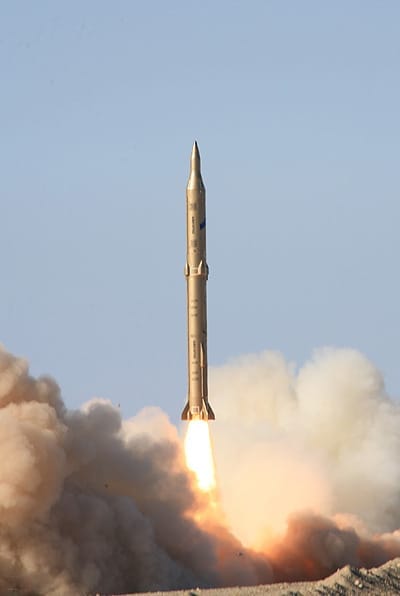
Image: from Aimen Jamil X @jamil_aimen
By Open Chronicle Staff with Agencies | Monday, March 16, 2026
TEHRAN — In a dramatic and dangerous escalation of the ongoing regional conflict, Iran has reportedly launched its sophisticated “Sejjil” medium-range ballistic missile for the first time in an operational combat setting. The deployment of the weapon, aimed at targets involving U.S. and Israeli interests, marks a significant shift in the technical scale of the current hostilities.
The Sejjil, a cornerstone of Iran’s domestic missile program, represents a heightened threat level due to its advanced propulsion and range. As the international community reacts to this development, military analysts are highlighting five critical aspects of this weapon system and what its use means for the theater of war.
The Power of Solid Fuel
Unlike the older liquid-fueled missiles in Iran’s arsenal, the Sejjil uses solid propellant. This is a game-changer on the battlefield because solid-fuel missiles can be fueled long in advance and stored in a ready-to-launch state. This drastically reduces the launch window, making the missiles much harder for U.S. and Israeli satellite intelligence to detect and preemptively strike before they leave the pad.
Reach Across the Region
The Sejjil is a two-stage missile with an estimated range of approximately 2,000 to 2,500 kilometers (1,240 to 1,550 miles). This range comfortably puts the entirety of Israel, as well as several U.S. military installations across the Middle East and parts of Southeastern Europe, within Tehran’s crosshairs. Its use confirms Iran’s willingness to strike at strategic depths rather than sticking to localized skirmishes.
Enhanced Survivability
The missile is launched from a mobile Transporter Erector Launcher (TEL). Combined with the quick-launch capability of solid fuel, the Sejjil can be moved rapidly to a hidden location, fired, and relocated before retaliatory strikes can be zeroed in. This “shoot-and-scoot” capability poses a significant challenge to air superiority maintained by the U.S. and its allies.
The Islamic Revolutionary Guard Corps (IRGC) has used the Sejjil high-speed, long-range, solid-fuel ballistic missile for the first time in the current war, as announced during Wave 54 of Operation True Promise 4 today.
Key specifications of the Sejjil missile include:
— Vanguard Intel Group (@vanguardintel) March 15, 2026
A Message to the “Hormuz Coalition.”
The timing of the launch is being viewed by many as a direct response to the Trump administration’s efforts to form a multinational naval coalition to secure the Strait of Hormuz. By demonstrating the capability to strike distant targets with high-speed ballistic missiles, Tehran is signaling that any increased naval presence in the Persian Gulf will be met with a diversified and high-tech military response.
Iran Deploys Sejjil Ballistic Missile in “Operation True Promise 4”
The solid-fuel, two-stage missile capable of 2,000–2,500 km range and Mach 12–14 speeds allow rapid launch within 30 minutes, signaling a potentially more aggressive phase of IRGC operations. #WashingtonEye pic.twitter.com/eeby8kTDiw
— Washington Eye (@washington_EY) March 16, 2026
Testing the “Arrow” and “Patriot” Shields
The Sejjil enters the atmosphere at extremely high speeds, testing the limits of sophisticated missile defense systems like Israel’s Arrow-3 and the U.S. Patriot batteries. While defense officials have not yet released the success rate of interceptions following this latest launch, the sheer velocity and trajectory of the Sejjil are designed to saturate and overwhelm even the most advanced radar and interceptor networks.
JUST IN:
Get to know Iran’s “Sejjil” missile, used by Tehran yesterday for the first time!
Type: Long-range ballistic missile
Launch: Vertical
Range: 2,000 km
Length: 17.5 meters
Launch platform: Mobile or fixed
Year of production: 2008 pic.twitter.com/1LnJKL8adQ— China pulse 🇨🇳 (@Eng_china5) March 15, 2026
The Path to Total War?
The introduction of the Sejjil into active combat has sent shockwaves through global markets and diplomatic circles. UN officials have called for an immediate “strategic pause” to prevent the conflict from spiraling into a full-scale continental war. However, with both sides doubling down on military commitments, the maiden combat flight of the Sejjil may be a precursor to an even more intense phase of the confrontation.