
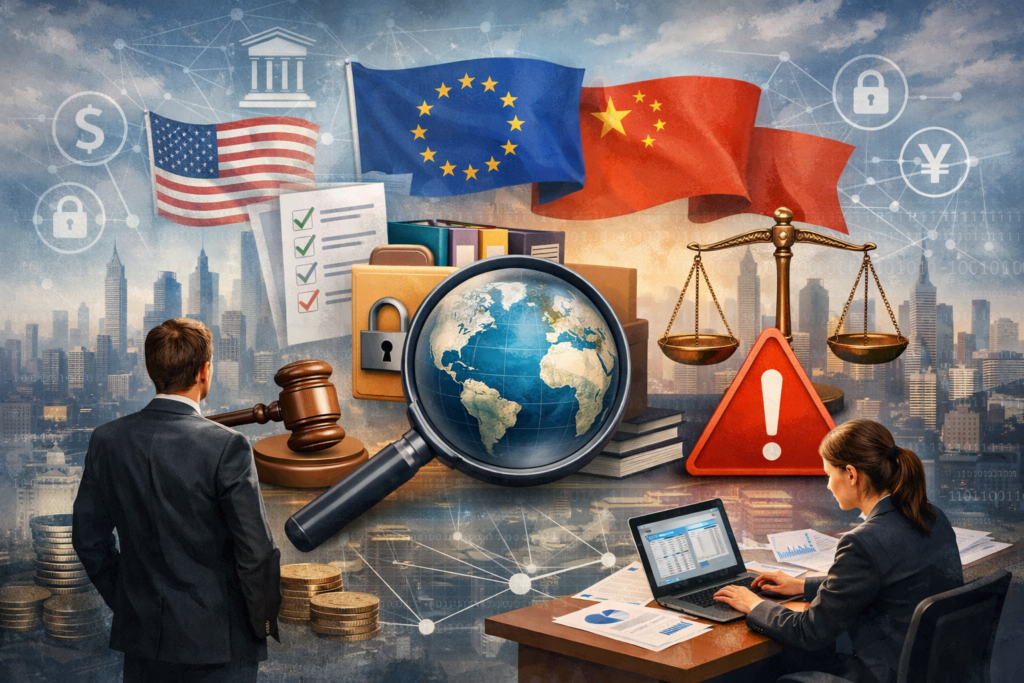
Image Credentials: Image Title: THE NEW COMPLIANCE CRUNCH: WHAT EVERY MULTINATIONAL SHOULD KNOWSource: (sora.openai) Date: March 2026. Attribution: This image was created using AI-generated imagery
EXPERTS WARN OF “REGULATORY FRAGMENTATION” AS GLOBAL CORPORATE LEGAL LANDSCAPE SHIFTS
By OPEN CHRONICLE STAFF
NEW YORK — For the boardrooms of the world’s largest multinational corporations, the era of predictable global expansion is officially over. Legal experts are sounding the alarm over a rapidly evolving regulatory environment that is forcing companies to navigate a minefield of conflicting national laws, aggressive antitrust enforcement, and a “weaponization” of compliance that threatens the traditional model of borderless business.
According to a comprehensive briefing released by top legal analysts this week, the primary challenge for 2026 is no longer just market entry, but the management of “regulatory fragmentation”—the growing divide between Western legal standards and those emerging in the Global South and East.
The Death of “One-Size-Fits-All” Compliance
Historically, multinationals could often apply a centralized compliance framework across their global operations. However, the rise of divergent data privacy laws, localized environmental mandates, and varying definitions of “national security” has made this approach obsolete.
“We are seeing the end of the global rulebook,” says Marcus Thorne, a partner at a leading international law firm. “A tech giant now has to comply with three different, and often contradictory, sets of data sovereignty laws in Washington, Brussels, and Beijing. One slip-up in any of these jurisdictions can lead to fines that wipe out an entire year’s profit.”
The “S” in ESG Becomes a Liability
While Environmental, Social, and Governance (ESG) criteria have been a corporate mainstay for years, the “Social” component is becoming a legal flashpoint. New supply chain transparency laws in Europe and the U.S. now hold parent companies liable for labor violations and human rights abuses committed by third-party contractors thousands of miles away.
Legal analysts warn that “ignorance is no longer a defense.” Companies are now required to perform forensic-level audits of their entire value chains, a task made increasingly difficult by the fracturing of global logistics.
Antitrust: The New Geopolitical Tool
The report also highlights a shift in how antitrust and competition laws are being applied. No longer limited to protecting consumers from monopolies, these laws are increasingly being used by governments to shield “national champions” from foreign competition.
The recent wave of blocked mergers in the semiconductor and energy sectors demonstrates that “public interest” is being redefined to mean “strategic independence.” For multinationals, this means that even the most economically sound acquisitions are now subject to political vetoes that can last for years in court.
Preparing for “Event-Driven” Litigation
Perhaps the most significant warning for C-suite executives is the rise of “event-driven” litigation. In an age of instant social media and high-frequency trading, a single incident,a data breach, a chemical spill, or a controversial political statement by a CEO can trigger a cascade of lawsuits across multiple continents simultaneously.
“The speed of risk has outpaced the speed of the legal department,” the briefing notes. Experts recommend that multinationals move toward “proactive resilience,” which involves stress-testing their legal structures against hypothetical geopolitical shocks, such as a sudden break in trade relations or a total regional internet blackout.
The Path Forward
Despite the grim outlook, the analysis suggests that those who can master this new complexity will find a significant competitive advantage. By investing in “localized expertise” and agile legal frameworks, companies can turn the regulatory thicket into a moat that protects them from less-prepared rivals.
As the sun sets on the age of easy globalization, the message to multinationals is clear: the boardrooms that thrive in 2026 will be those that treat legal compliance not as a back-office function, but as a front-line strategic priority.