
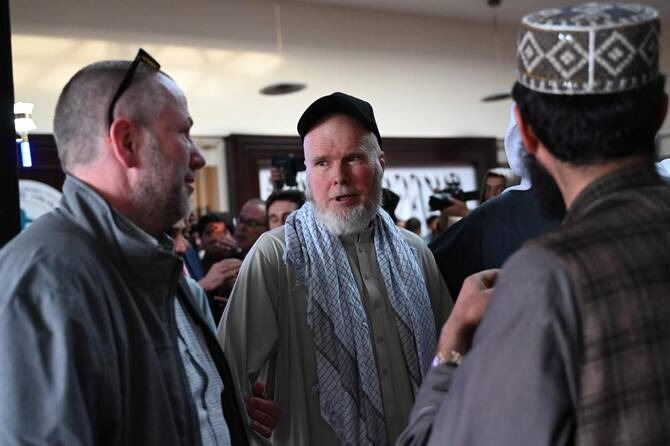
Image: from Washington Eye X @washington_EY
By Harrison Vane | Open Chronicle International Correspondent
KABUL, AFGHANISTAN — In a sudden diplomatic breakthrough, Taliban authorities on Tuesday released American academic researcher Dennis Coyle, ending a grueling fourteen-month detention that had become a flashpoint in the strained relations between Washington and Kabul. The release, described by the Afghan Foreign Ministry as a “humanitarian gesture of goodwill,” coincided with the start of Eid al-Fitr, the Muslim festival marking the end of the holy month of Ramadan.
Coyle, who was detained in January 2025 on unspecified allegations of violating local laws, was seen boarding a plane at Kabul International Airport on Tuesday afternoon. His release follows months of quiet mediation led by Qatar and the United Arab Emirates.
An American held in Afghanistan has been freed, the Taliban said Tuesday.
Dennis Coyle of Colorado was released after a letter from his family was sent requesting his release on the occasion of Eid Al-Fitr, the Taliban foreign ministry said. https://t.co/SGFa1jelVd pic.twitter.com/vVUYoL2Avs
— ABC News (@ABC) March 24, 2026
A Judicial Review or Diplomatic Bargain?
The official statement from the Afghan Foreign Ministry indicated that Coyle was released after the country’s Supreme Court “considered his previous imprisonment sufficient” for the alleged violations. However, the timing of the release has drawn scrutiny from international observers.
Only weeks ago, the U.S. State Department officially designated Afghanistan as a sponsor of “wrongful detention,” accusing the Taliban of engaging in “hostage diplomacy” to extract political and financial concessions. While the Taliban has consistently denied using foreign detainees as leverage, the ministry’s statement on Tuesday expressed hope that the release would “strengthen the atmosphere of trust” and lead to “constructive dialogue” regarding frozen Afghan assets and diplomatic recognition.
High-Level Mediation
The path to Coyle’s freedom appears to have been paved by veteran diplomat Zalmay Khalilzad, the former U.S. Special Representative for Afghanistan Reconstruction. Khalilzad reportedly met with Afghan Foreign Minister Amir Khan Muttaqi in Kabul just days before the release.
While the U.S. State Department has not yet issued a formal comment on the specifics of the deal, sources suggest that no direct policy concessions were made. Instead, the release is being framed as a unilateral act of clemency aimed at de-escalating tensions during a period of intense regional instability.
The Missing Contractor
Despite the celebration surrounding Coyle’s return, the shadow of at least one other American remains over Kabul. Mahmood Habibi, an Afghan American telecommunications contractor who vanished in 2022, is still missing. While the FBI and Habibi’s family maintain he is being held by Taliban forces, Afghan authorities continue to deny any knowledge of his whereabouts.
“We are relieved for Dennis and his family,” a spokesperson for the Habibi family said in a brief statement. “But our hearts remain heavy. We can only hope that this ‘goodwill’ extends to the others who have been forgotten in the system.”
As Dennis Coyle returns to American soil, the question remains whether this Eid amnesty represents a genuine shift in Taliban diplomacy or a tactical maneuver in a long-running game of geopolitical chess.