
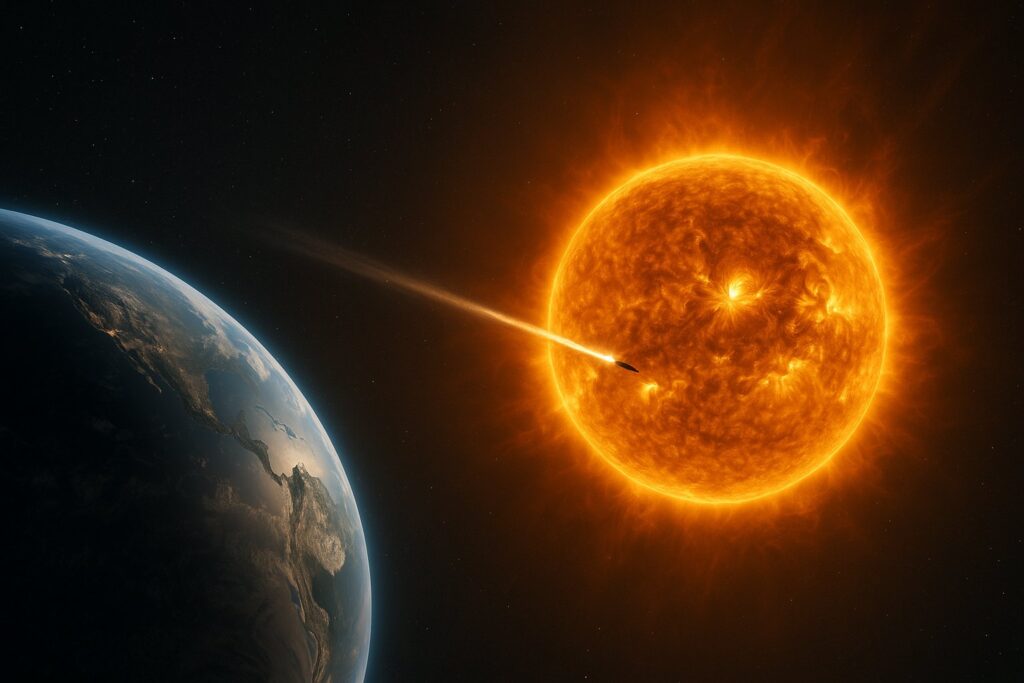
Image: from Skywatch Signal X @UAPWatchers
By Julian Thorne | Open Chronicle Science & Tech Correspondent
DARMSTADT, GERMANY — The European Space Agency (ESA) has launched a formal investigation after a blindingly bright fireball streaked across the skies of Central Europe Tuesday morning, turning day into night for a fleeting second. The celestial event, captured by thousands of dashcams and security sensors from Stuttgart to Prague, has sparked intense interest among planetary defense experts and “meteor hunters” racing to locate potential fragments on the ground.
The fireball, described as one of the most significant “bolide” events in the region since the 2013 Chelyabinsk strike, triggered sonic booms that rattled windows across the German state of Hesse.
Anatomy of a Bolide
Initial data from the ESA’s Planetary Defence Office suggests the object was a “stray” asteroid, likely measuring between 1 and 2 meters in diameter. Traveling at an estimated velocity of 14 kilometers per second (over 31,000 mph), the friction with Earth’s atmosphere caused the rock to superheat and explode in a process known as fragmentation.
“The brilliance of the flash indicates a high metallic content, possibly a nickel-iron composition,” said an ESA astrophysicist. “What makes this event unique is the altitude at which the final explosion occurred, approximately 35 kilometers, which is low enough to have deposited ‘space rocks’ in a predictable debris field.”
The Hunt for Meteorites
The search is now concentrated in a 10-kilometer “strewn field” just east of the city of Kassel. Scientists are urging residents to look for small, black, “fusion-crusted” rocks that may appear out of place in fields or on rooftops.
-
Scientific Value: These fragments are “time capsules” from the early solar system, potentially containing primitive minerals that predate the formation of Earth.
-
Market Value: Due to the high-profile nature of the event, collectors warn that authentic “German Fireball” fragments could fetch prices higher than gold on the private market.
Planetary Defense: A Warning Shot?
The event has reignited discussions regarding Earth’s “blind spots” for small-scale asteroids. Because the object approached from the direction of the sun, it was invisible to ground-based telescopes until it entered the atmosphere.
“We are getting better at spotting the ‘dinosaur killers,’ but these 2-meter rocks are still flying under the radar,” noted one planetary scientist. “While this one provided a spectacular light show, a slightly larger or denser object at a steeper angle could have caused significant structural damage to a populated area.”
Social Media and Citizen Science
The speed of the investigation has been credited to “Citizen Science.” Within thirty minutes of the flash, the AllSky7 Fireball Network, a grid of amateur-operated cameras, had triangulated the meteor’s trajectory with enough precision to narrow the search area for researchers.
As of Wednesday evening, no official recovery has been confirmed, but the “Gold Rush” in rural Germany is well underway. For the residents of Hesse, the morning of March 24 will be remembered not for the geopolitical tensions of the day, but for the moment the heavens briefly opened a window into the deep history of our solar system.