
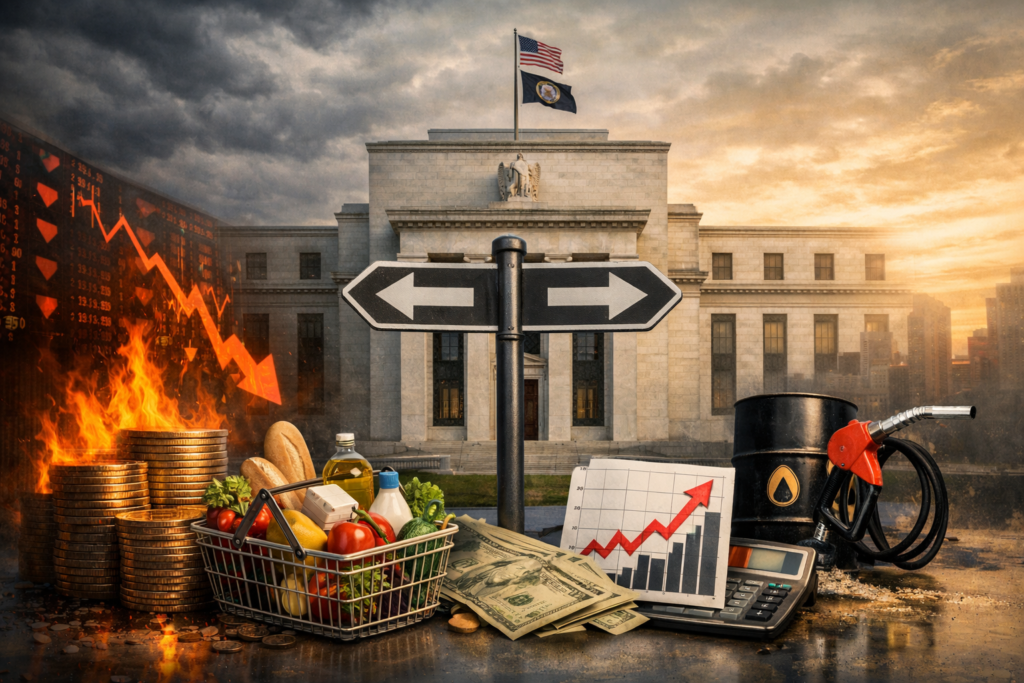
Image Credentials: Image Title: U.S. Inflation Surge and Weakening Forecasts Leave Federal Reserve in a Holding Pattern Source: (sora.openai) Date: March 2026. Attribution: This image was created using AI-generated imagery (sora.openai) and does not depict a real-world scene.
By OPEN CHRONICLE STAFF with Agencies
WASHINGTON — The American economic outlook has darkened as a fresh inflationary shock, fueled by the ongoing conflict with Iran and soaring energy prices, forces economists to slash growth projections and delay expectations for relief from the Federal Reserve.
Market data released Friday suggests that the “soft landing” once envisioned by policymakers is becoming increasingly fragile. A Bloomberg survey revealed that the average forecast for the Personal Consumption Expenditures (PCE) index, the Fed’s preferred inflation metric, has jumped to 3.1% for the year, up significantly from previous estimates of 2.6%.
The Energy Catalyst. The primary driver of this resurgence is the volatile situation in the Middle East. Gasoline prices in the U.S. have spiked by more than 30% this month alone, reaching levels around $4 per gallon. It is the largest monthly increase since the aftermath of Hurricane Katrina in 2005.
While the Federal Reserve historically “looks through” temporary energy spikes, the duration of the current conflict is complicating that strategy. With inflation having remained above the 2% target for five consecutive years, the central bank’s patience is being tested. At last week’s meeting, the Fed opted to maintain interest rates at 3.50% to 3.75%, adopting a hawkish tone that suggests rate cuts may not materialize until September at the earliest.
Downward Revisions. The impact of these “cost-push” shocks is visible across the board. Economists have downgraded U.S. GDP growth forecasts to 2.3% for the year, down from 2.5%. More concerning is the cooling labor market, with the expected average monthly job creation revised downward to 43,000 from 70,000.
“We are seeing a shift where the conflict is no longer viewed as a temporary disruption, but as a structural inflationary shock,” noted one senior market analyst. “Higher fuel and transportation costs are immediate hits to household purchasing power, and we expect that to bleed into food prices and other consumer goods in the coming months.”
Institutional Caution. Major financial institutions are reacting to the uncertainty with increased pessimism. Goldman Sachs now assesses the risk of a recession at 30%, while Morgan Stanley has lowered its consumption growth forecast for 2026 to 1.7%.
Despite the gloom, some sectors remain resilient. Continued investment in artificial intelligence and data center infrastructure, industries less dependent on energy imports than traditional manufacturing, has provided a partial cushion for the broader economy. Additionally, credit card spending data through mid-March suggests that households are currently maintaining their purchasing activity, though sentiment indices are beginning to “take a nosedive.”
The Fed’s Dilemma. Federal Reserve Chair Jerome Powell has acknowledged the “downside risk” in the labor market but remains focused on the “sticky” nature of inflation. The central bank now faces a grueling balancing act: keeping rates high enough to dampen price pressures without triggering a deeper downturn in a softening job market.
As the “Leo Era” of global caution takes hold, the U.S. economy appears to be entering a period of “wait and see,” where the trajectory of interest rates depends entirely on whether the current energy shock is a passing storm or a permanent climate change.