
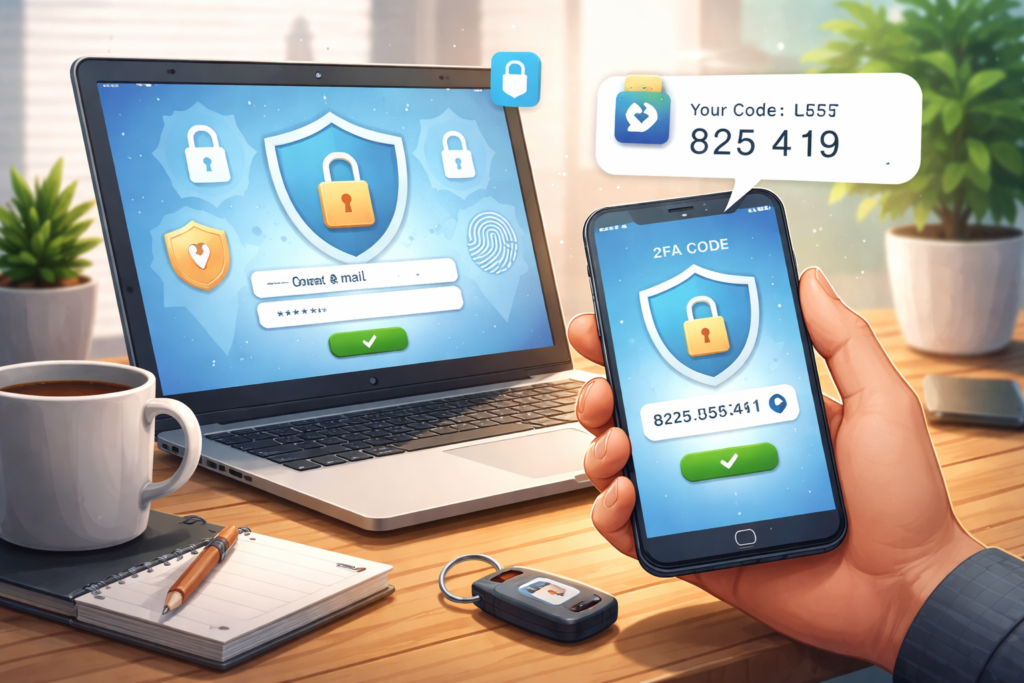
Image Credentials: Image Title: The One Simple Step That Finally Secured My Online Accounts Source: (sora.openai) Date: March 2025. Attribution: This image was created using AI-generated imagery (sora.openai) and does not depict a real-world scene.
By Julian Thorne | Open Chronicle Tech
As the digital landscape becomes increasingly treacherous, with state-sponsored hackers and AI-driven phishing schemes reaching new heights of sophistication, cybersecurity experts are pointing to one “simple step” that remains the single most effective defense against account takeovers: the transition to hardware security keys.
While millions of users have adopted two-factor authentication (2FA) via SMS codes or mobile apps, a new report highlights that these methods are no longer foolproof against modern “man-in-the-middle” attacks.
For years, the gold standard for personal security was the six-digit code sent to a smartphone. However, as the conflict in the Middle East and the recent hacking of high-profile officials like FBI Director Kash Patel have shown, digital intercepts are becoming more common. Hackers can now “clone” SIM cards or create fake login pages that trick users into entering both their password and their temporary code in real-time.
“If a hacker can see your screen or intercept your messages, your software-based 2FA is essentially an unlocked door,” says tech analyst David Nield. “The shift toward hardware is no longer just for government agents; it’s for anyone with a bank account or an email address they care about.”
The “simple step” involves using a physical USB or NFC-enabled security key, such as those manufactured by Yubico or Google’s Titan series. Unlike a code sent to a phone, a hardware key requires a physical touch to authorize a login.
Because the key uses public-key cryptography to “handshake” directly with the website, it is mathematically impossible for a phishing site to spoof the connection. If the URL in the browser isn’t exactly what it claims to be, the key won’t authenticate, stopping the attack instantly.
Historically, hardware keys were viewed as cumbersome tools for the “ultra-paranoid.” However, the latest generation of keys works seamlessly with iPhones, Android devices, and laptops via a simple tap or plug-in.
Major platforms, including Google, Apple, and various global financial institutions, have recently streamlined their settings to make adding a physical key as easy as pairing a set of Bluetooth headphones. For many users, the initial $25 to $50 investment provides a level of “unhackable” peace of mind that software simply cannot match.
The push for physical security comes amidst a broader “Leo Era” of digital caution. With researchers recently identifying massive training gaps in maritime and industrial cybersecurity, the move toward hardware keys represents a “bottom-up” approach to securing the global digital infrastructure.
Experts recommend that users start by securing their “anchor” accounts—primary email and password managers—with a physical key. By securing the gateway to all other accounts, users can effectively neutralize the threat of remote password theft.
“It is the closest thing we have to a digital silver bullet,” the report concludes. “In an era where your identity is your most valuable asset, a physical lock is the only way to ensure you are the only one with the key.”