
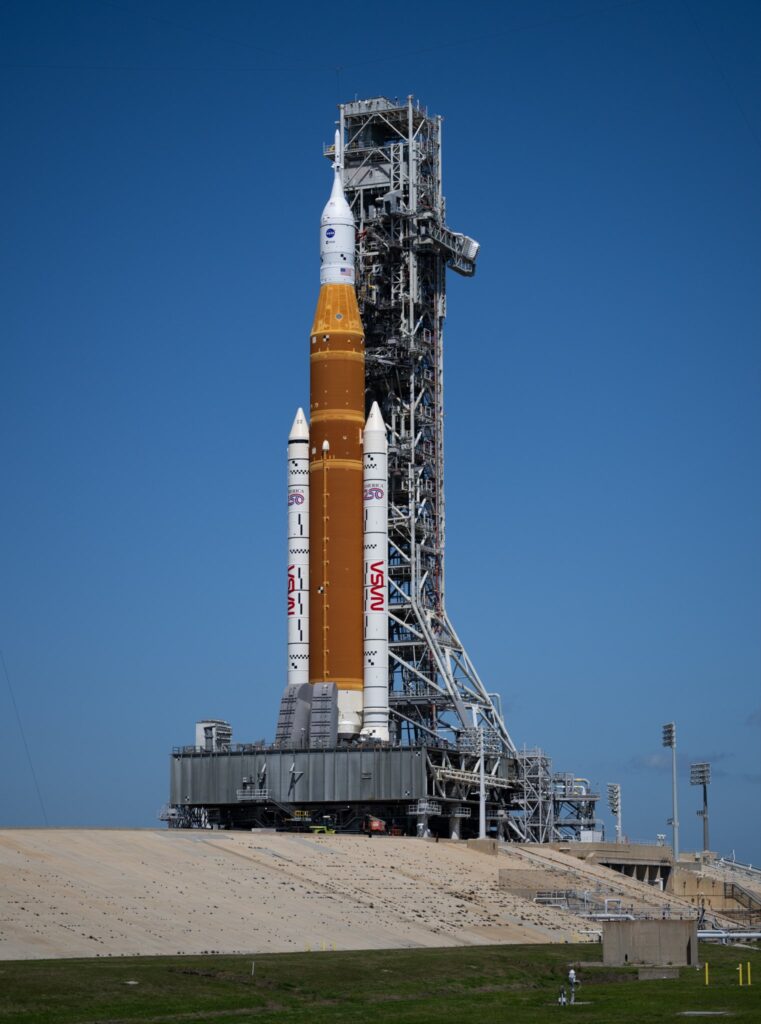
Image: from FearBuck X @FearedBuck
By Open Chronicle Staff with Agencies
CAPE CANAVERAL – For the first time in over half a century, a crewed spacecraft has ignited its engines to carry humanity beyond low Earth orbit. On Wednesday evening, NASA’s Artemis II mission successfully lifted off from Launch Complex 39B at the Kennedy Space Center, marking the dawn of a new era in lunar exploration.
The mission, commanded by NASA astronaut Reid Wiseman, carries a four-person crew on a high-stakes, 10-day journey that will take them further from Earth than any human in history. Joining Wiseman are NASA pilot Victor Glover, mission specialist Christina Koch, and Jeremy Hansen of the Canadian Space Agency.
🚨BREAKING: The Artemis II crew is inside the rocket and ready for launch to the Moon from the Kennedy Space Center.
"We're very encouraged by operations so far — things are running smoothly."
— Derrick Evans (@DerrickEvans4WV) April 1, 2026
A Precision Launch Amid Technical Hurdles
The 322-foot-tall Space Launch System (SLS) rocket, the most powerful in the world, cleared the tower at 6:24 p.m. EDT (2224 UTC), piercing a sky that launch weather officers had previously rated at an 80% chance for “go” conditions.
The successful liftoff followed a tense countdown. Engineers worked through two eleventh-hour technical glitches: a battery issue in the Launch Abort System and a minor fault in an onboard safety mechanism. NASA officials confirmed both were resolved within the launch window, though science editors noted the “nerve-jangly” nature of the last-minute repairs.
“The vehicle is ready. The system is ready. The crew is ready,” said NASA Associate Administrator Amit Kshatriya before launch. “Behind this flight stands a campaign: landings, a lunar base, and nuclear propulsion into deep space.”
HISTORY.
Humans are on their way to the moon for the first time in more than 50 years as Artemis II blasts off from Cape Canaveral.
This is a new era for humanity. pic.twitter.com/RFsSjyUFTA
— Peter Gillibrand (@GillibrandPeter) April 1, 2026
Life Aboard ‘Integrity’
Liftoff. 🚀 I cried like a baby!😭
At 6:35 p.m. ET, NASA’s Artemis II mission blasted off from Kennedy Space Center, sending four astronauts on a voyage around the Moon.
This mission marks a major step toward returning humans to the lunar surface and eventually, making the leap… pic.twitter.com/3D9sMChJWW
— Ashley (TeamTrump47) (@TeamTrump47) April 1, 2026
The crew is traveling in the Orion spacecraft, which they have named Integrity. While the capsule boasts state-of-the-art technology, its habitable volume of 330 cubic feet (roughly the size of two small minivans) makes for cramped quarters for a week-long journey.
The flight plan for the first 24 hours is a complex “ballet” of orbital mechanics:
-
Initial Ascent: The twin solid rocket boosters separated two minutes into flight, followed by the core stage at the eight-minute mark.
-
Powering Up: Twenty minutes post-liftoff, the European Service Module deployed its four 23-foot-long solar arrays to begin charging the ship’s batteries.
-
Manual Pilot Demo: On Thursday, Wiseman and Glover will perform a manual piloting demonstration, bringing Integrity within 10 meters of the spent upper stage to test the dexterity required for future moon-landing dockings.
The Journey to the Far Side
Artemis II will not land on the lunar surface; instead, it will utilize a “free-return trajectory.” On Thursday, NASA mission control will make the final “go/no-go” decision for the Trans-Lunar Injection (TLI) burn. If committed, the crew will swing around the far side of the Moon, using lunar gravity to slingshot them back toward Earth.
This trajectory will allow the astronauts to see parts of the lunar far side directly with their own eyes, views that have been unavailable to humans since the conclusion of the Apollo program in 1972. The data gathered regarding radiation exposure and deep-space life support will be foundational for the upcoming Artemis III landing mission and eventual human voyages to Mars.
A Global Milestone
The inclusion of Jeremy Hansen marks a milestone for international cooperation, making Canada the second nation to send an astronaut into deep space. As the world watches the live feed from Orion’s cameras, the mission serves as a rare moment of global unity amidst a period of significant terrestrial tension.