
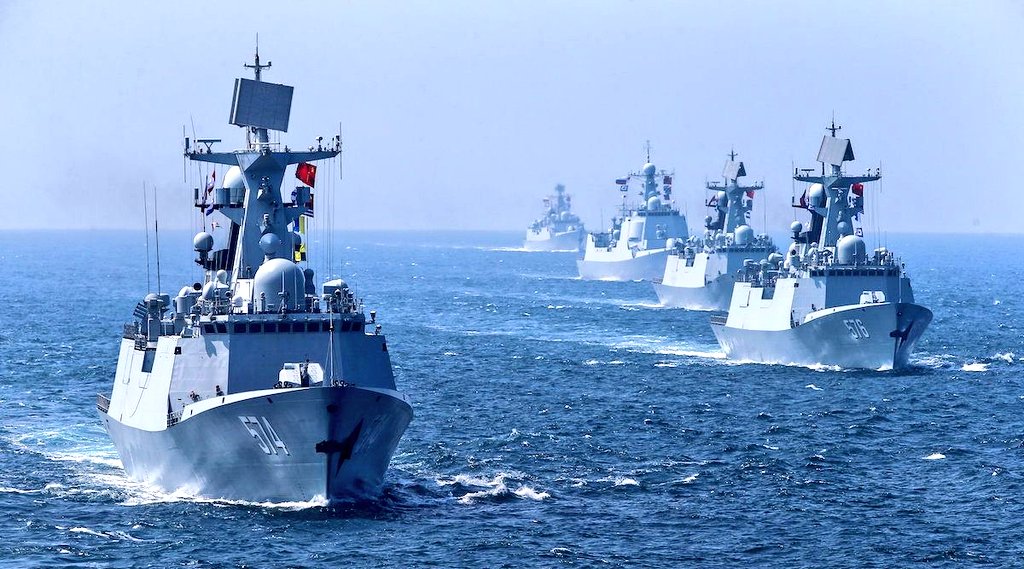
Image: from WAR X @warsurv
By Open Chronicle Staff with Agencies
TOKYO – Tensions in East Asia reached a new flashpoint on Tuesday as a Chinese naval flotilla transitioned into the Sea of Japan, coinciding exactly with Tokyo’s final deployment of its sophisticated Type 25 long-range missile systems.
The Japanese Ministry of Defense confirmed that five Chinese vessels, including guided-missile destroyers, transited the Tsushima Strait and were tracked heading northeast. The move is widely viewed as a direct military demonstration following Beijing’s repeated warnings against what it terms Japan’s “neo-militarism.”
Japan’s New Defensive Shield
The deployment marks the completion of the Japan Ground Self-Defense Force’s (JGSDF) integration of the newly designated Type 25 surface-to-ship guided missiles (SSM) and hypervelocity gliding projectiles (HGP). These systems are specifically designed to bolster Japan’s standoff defense capabilities, allowing the nation to strike maritime threats from significantly greater distances.
Tokyo has maintained that the deployment is purely defensive, aimed at protecting its remote southwestern islands. However, the Type 25’s extended range and the HGPs’ ability to maneuver at high speeds to evade interception have drawn sharp condemnation from Beijing.
Beijing’s “Strong Response”
The Chinese Ministry of National Defense issued a stern protest, characterizing the deployment as a provocative step that “threatens regional stability and violates the spirit of peaceful development.”
The dispatch of the five-ship fleet into the Sea of Japan, a strategic maritime corridor, serves as a physical manifestation of Beijing’s “strong response.” Military analysts suggest the fleet’s presence is intended to monitor Japanese missile activities and signal China’s ability to project power deep into the waters surrounding the Japanese archipelago.
A Growing Regional Arms Race
The simultaneous naval movement and missile deployment underscore a deepening security dilemma in the Indo-Pacific.
-
Japanese Modernization: Tokyo is currently undergoing its most significant military buildup since World War II, fueled by concerns over regional territorial disputes and the rapid modernization of the People’s Liberation Army (PLA).
-
Chinese Maritime Assertiveness: China continues to expand its naval footprint, frequently conducting drills in the East and South China Seas to assert its maritime claims.
This latest escalation in East Asia mirrors a global trend of deteriorating security architectures. From the U.S. reassessing its role in NATO to the ongoing high-intensity conflict in the Middle East and the closure of U.S. embassies in the Gulf, the arrival of Chinese warships in the Sea of Japan adds another layer of complexity to a world increasingly defined by military posturing.