
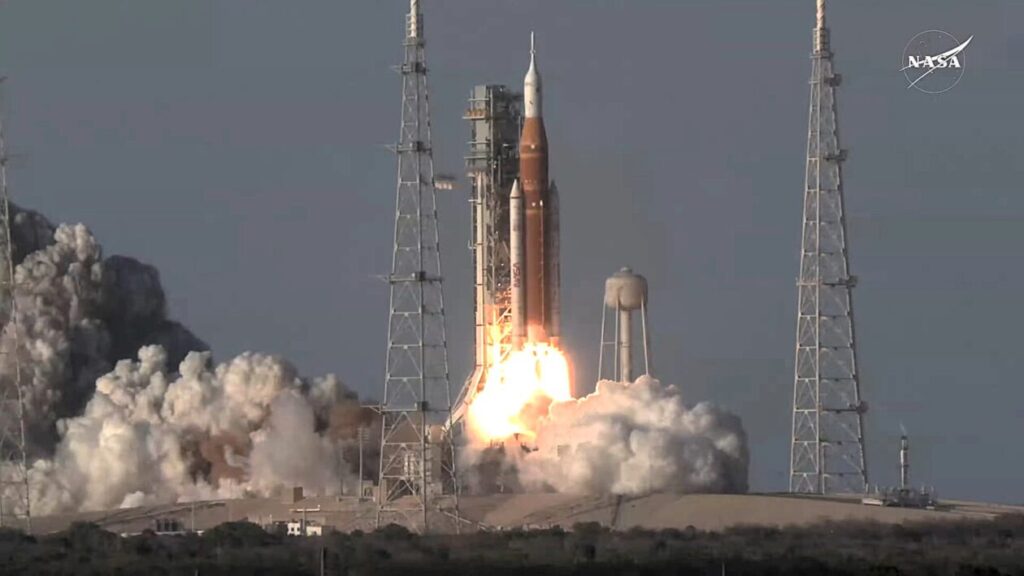
Image: by NASA
By Open Chronicle Staff with Agencies
KENNEDY SPACE CENTER, Fla. – With a thunderous roar that echoed the Apollo era, NASA’s 322-foot-tall Space Launch System (SLS) rocket surged off Launch Complex 39B at 6:35 p.m. ET Wednesday. The historic liftoff carries four astronauts on Artemis 2, humanity’s first journey to the lunar vicinity since Apollo 17 in 1972.
“Godspeed, Artemis 2,” Launch Director Charlie Blackwell-Thompson told the crew seconds before ignition. “Let’s go!”
The mission serves as the “opening act” for a new golden age of exploration, according to NASA Administrator Jared Isaacman. While the crew will not land on this 10-day flight, they are set to become the farthest-flung travelers in history, reaching 4,700 miles beyond the lunar far side.
A Crew of “Firsts”
The mission is defined as much by its crew as its destination. Commander Reid Wiseman is joined by:
-
Christina Koch: Set to become the first woman to venture beyond Earth orbit.
-
Victor Glover: The first Black astronaut to fly a lunar mission.
-
Jeremy Hansen: Representing the Canadian Space Agency as the first non-American to leave low Earth orbit.
During the ascent, Wiseman radioed Mission Control with an update on the view: “We have a beautiful moonrise, we’re headed right at it.”
Overcoming Technical Hurdles
The path to the pad was fraught with the complexities of modern rocket science. The program, which has cost an estimated $93 billion through 2025, faced several delays this year due to liquid hydrogen leaks and helium pressurization issues. Even in the final two hours of the countdown, engineers had to scramble to address concerns regarding the flight termination system and a battery on the launch abort system.
Each SLS launch carries a price tag of roughly $4.1 billion, a figure NASA justifies as necessary to secure “the best real estate on the moon” ahead of a projected Chinese crewed landing in 2030.
Science on the Far Side
While in transit, the crew will act as both pilots and test subjects. They will practice emergency protocols for solar radiation storms and monitor the health effects of deep-space travel outside Earth’s protective magnetosphere.
A primary highlight will be the observation of the lunar far side. “They’re going to be able to see the whole moon as a lunar disk,” said Marie Henderson, lunar science deputy lead. “That’s a brand-new, unique perspective that humans haven’t been able to look at before.”
The Road to 2028
Artemis 2 is the critical precursor to Artemis 3, the mission intended to return humans to the lunar surface in 2028. Private partners are already deeply integrated into this future; Jeff Bezos’ Blue Origin is developing the “Blue Moon” lander, while companies like Boeing and L3Harris continue to manufacture hardware for missions as far out as Artemis 8.
Upon completion of their figure-8 journey, the Orion capsule is scheduled to splash down in the Pacific Ocean off the California coast, where Navy recovery teams will be waiting, a scene that will finally bridge the gap between the pioneers of 1968 and the explorers of 2026.