
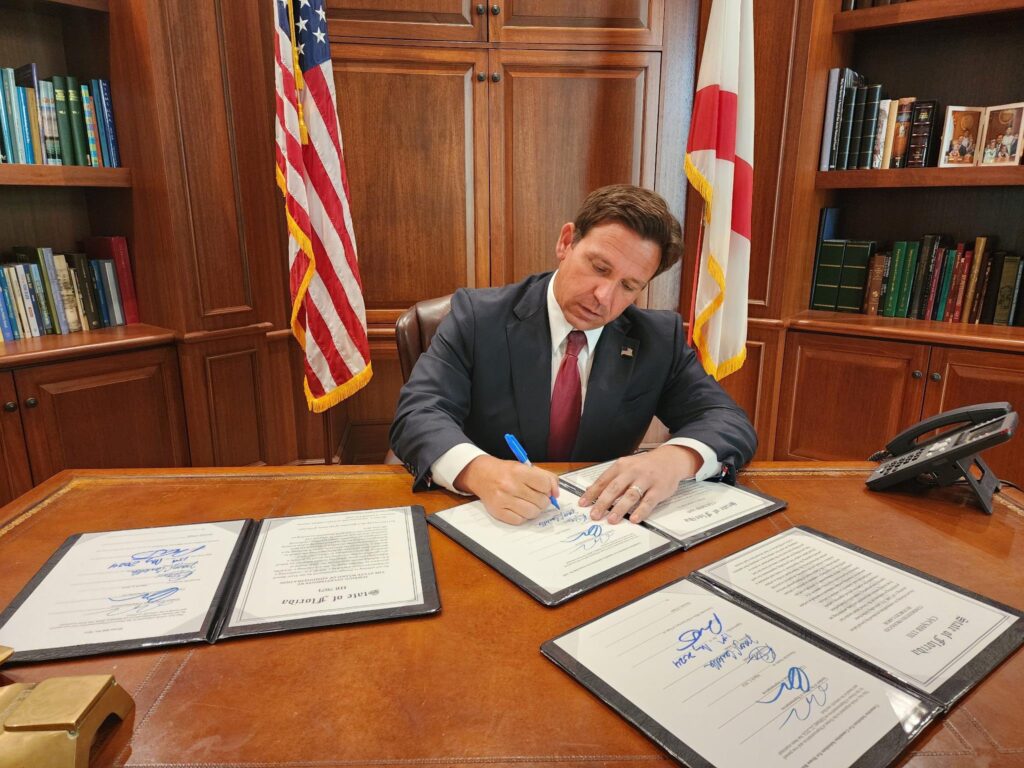
Image: from Keyser X @KeyserSoese
By Open Chronicle Staff with Agencies
TALLAHASSEE – Governor Ron DeSantis on Wednesday signed into law a sweeping elections overhaul that establishes Florida as one of the most restrictive states in the nation for voter registration, requiring documentary proof of U.S. citizenship for all new and existing voters.
The legislation, described by proponents as the Florida version of the federal Safeguard American Voter Eligibility (SAVE) Act, was signed just one day after the end of the 2026 legislative session. It effectively creates a state-level mandate for citizenship verification that has currently stalled in the U.S. Senate.
BREAKING: @GovRonDeSantis signs Florida’s version of the "SAVE Act," to further tighten election security
The law mandates citizenship verification for voter registration and requires paper ballots statewide to ensure a "verifiable hard copy" for recounts. pic.twitter.com/eK2cbrumFo
— Florida’s Voice (@FLVoiceNews) April 1, 2026
A New Barrier to the Ballot Box
Under the new law, the Florida Department of Highway Safety and Motor Vehicles (DHSMV) must now verify the citizenship status of every voter registration applicant. If the state’s database does not already contain proof of citizenship. such as a birth certificate or passport, the applicant will be flagged as an “unverified voter.”
These individuals will be permitted to vote only via a provisional ballot, which will not be counted unless the voter provides physical documentation of their legal status within a specified timeframe. The law also targets the state’s existing 14 million registered voters, requiring the Department of State to cross-check the entire voter roll for citizenship verification.
“This is about making sure that only Florida citizens are doing the voting,” said State Senator Erin Grall, a primary sponsor of the bill. “A law without enforcement is merely a suggestion, and today we are closing the gaps that have existed for too long.”
Students and Seniors Impacted
In addition to the citizenship requirement, the law removes student identification cards and retirement home IDs from the list of acceptable forms of photo identification at polling places.
Critics and Democratic lawmakers have blasted the move as a direct attack on younger and older populations who may lack a Florida driver’s license. State Representative Anna Eskamani argued that the removal of student IDs is “intentionally making it harder for students to vote,” noting that there is no evidence of fraud involving university identification.
Civil rights groups, including the ACLU of Florida and the League of Women Voters, have warned that the law will disproportionately affect naturalized citizens, married women whose names have changed, and low-income residents who cannot easily afford the $165 fee for a U.S. passport.
Implementation and Legal Challenges
While Florida Republicans initially pushed for the law to take effect before the 2026 midterm elections, the final version signed by DeSantis delays the implementation of the citizenship verification provisions until January 1, 2027. This delay was a concession to local election supervisors who warned that a mid-cycle overhaul would be “incredibly disruptive.”
However, legal challenges are expected to begin immediately. Marc Elias, a prominent Democratic elections attorney, has already pledged to sue the state, arguing the law violates the National Voter Registration Act.
The move aligns Florida closely with the national agenda of President Donald Trump, who recently threatened to withhold federal funding from the Department of Homeland Security unless Congress passes the federal SAVE Act. As that battle continues in Washington, Florida’s new law serves as a blueprint for other Republican-led states seeking to impose similar restrictions through local legislation.