
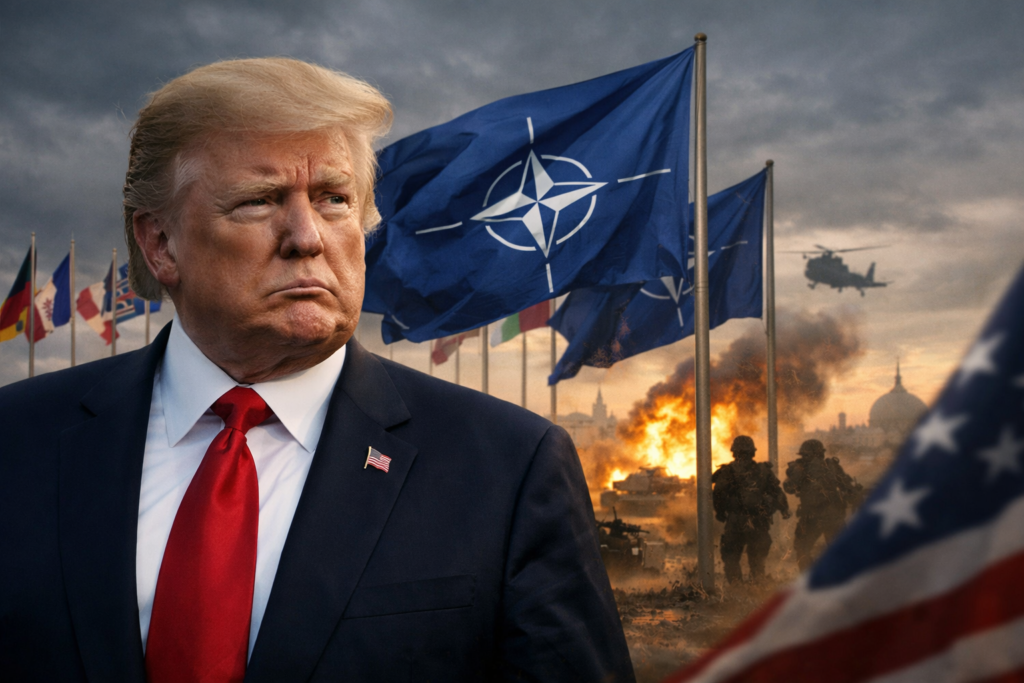
Image Credentials: Image Title: Trump Issues Renewed Nuclear Threat Against Iran as Conflict Enters “Critical Phase” Source: (sora.openai) Date: April 2026. Attribution: This image was created using AI-generated imagery (sora.openai) and does not depict a real-world scene.
By Open Chronicle Staff with Agencies
WASHINGTON — In a move that has sent shockwaves through the global security establishment, President Donald Trump has stated he is considering withdrawing the United States from NATO, describing the alliance as a “paper tiger” during an interview with The Telegraph.
The President’s remarks follow a sharp diplomatic rupture over the U.S.-led military campaign in Iran. Trump expressed profound frustration with European allies who have declined to provide military support or grant overflight rights for operations linked to the conflict in the Middle East.
“Beyond Reconsideration”
When asked if a U.S. exit from the 77-year-old alliance was a serious possibility, Trump was blunt. “Oh yes, I would say it’s beyond reconsideration,” he told the British newspaper. “I was never swayed by NATO. I always knew they were a paper tiger, and Putin knows that too.”
The escalation in rhetoric marks a historic low in transatlantic relations. U.S. Secretary of State Marco Rubio echoed the President’s sentiments, suggesting a fundamental reassessment of the treaty is looming. “Has it become something that only benefits one side?” Rubio asked, questioning the utility of an alliance where members refuse to assist in what Washington deems critical security operations.
The Article 5 Dispute
The friction stems from a fundamental disagreement over treaty obligations. Under the North Atlantic Treaty, Article 5’s collective defense clause is only triggered if a member state is attacked. Because the current operations in Iran are classified by many international observers and several NATO members as offensive rather than defensive, there is no legal requirement for allies to participate.
British Prime Minister Keir Starmer has remained firm in his refusal to commit UK forces to the conflict. “I have to act in our national interests,” Starmer said during a press conference in London, confirming that the UK would instead focus on independent diplomatic efforts to reopen the Strait of Hormuz.
A Pattern of Friction
This is not the first time the Trump administration has clashed with NATO members this year. Tensions peaked earlier in 2026 when the President threatened tariffs against Denmark over its refusal to discuss a U.S. acquisition of Greenland, an autonomous Danish territory. At the time, Trump dismissed Denmark’s sovereignty over the island as “a joke.”
Global Markets and the Iran “Off-Ramp”
The threat of a U.S. withdrawal from NATO comes as the conflict in Iran shows the first tentative signs of a potential de-escalation. Iranian President Masoud Pezeshkian stated that Tehran has the “necessary will” to end the war, provided there are guarantees against further escalation.
Oil markets, which have been reeling from the conflict, saw prices surge above $100 per barrel before retreating slightly as Trump hinted that U.S. involvement in Iran could conclude “within weeks.” However, the long-term damage to the Western security architecture may be harder to repair, as the “toll booth” tactics in the Strait of Hormuz and the diplomatic rift in Brussels signal a new, more fragmented era of global politics.