
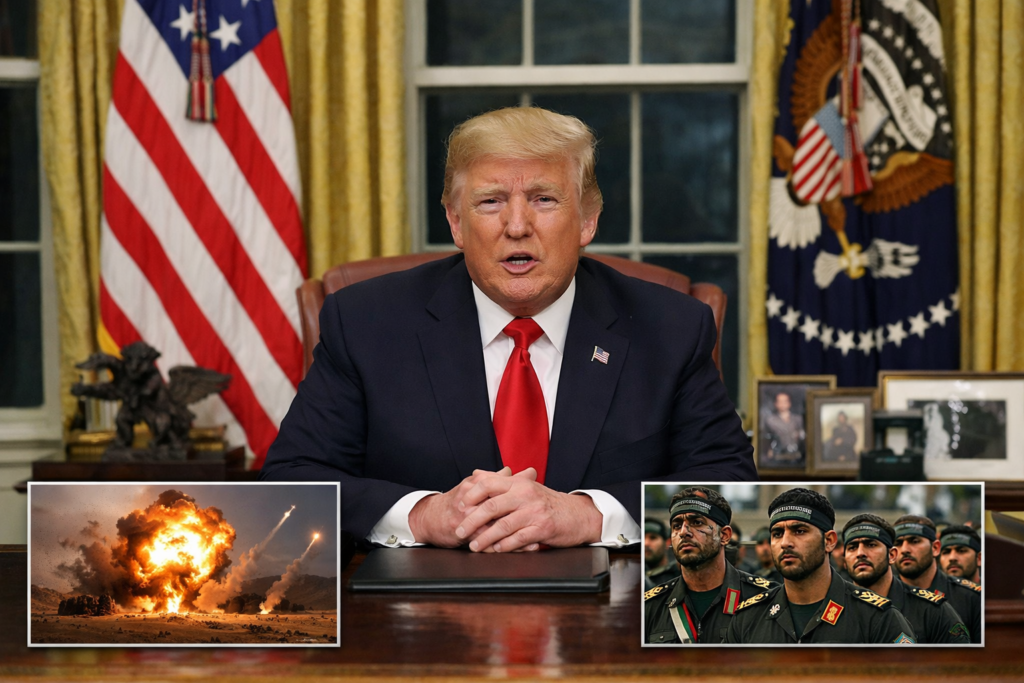
Image Credentials: Image Title: Trump Declares Iran ‘No Longer a Threat’ After 32 Days of Operation Epic Fury Source: (sora.openai) Date: March 2025. Attribution: This image was created using AI-generated imagery (sora.openai) and does not depict a real-world scene.
By Open Chronicle Staff with Agencies
WASHINGTON – In a primetime address from the White House on Wednesday, President Donald Trump declared that the Iranian regime has been “eviscerated” and is “essentially really no longer a threat” following a 32-day military campaign. Despite this declaration of victory, the President warned that the United States is prepared to hit Iran “extremely hard” over the next two to three weeks to “finish the job.”
The President characterized the current state of the conflict as one where the U.S. holds “all the cards,” contrasting the month-long operation with the protracted American involvement in World War II, Vietnam, and Iraq.
Donald Trump compares US involvement in past wars to the 32-day campaign against Iran, claiming it’s “so powerful, so brilliant” that the country is no longer a threat.
So much for the ‘President of Peace’ pic.twitter.com/AGYq6ljz5I
— The Vivlia (@TVivlia) April 2, 2026
“Obliterated” Infrastructure and Leadership
A central theme of the President’s address was the systematic destruction of Iran’s strategic assets under Operation Epic Fury, which began on February 28. Trump highlighted the role of B-2 stealth bombers in neutralizing Iran’s nuclear infrastructure.
“The nuclear sites that we obliterated… have been hit so hard that it would take months to get near the nuclear dust,” Trump said, adding a stern warning that any attempt by Tehran to recover nuclear material would be met with immediate missile strikes.
Furthermore, the President claimed a fundamental shift in Iran’s government, asserting that “regime change has occurred” not through policy, but through the death of the nation’s original leadership. “They’re all dead,” Trump stated, referring to senior figures killed in the strikes. He also claimed that Iran’s air defenses and radar systems have been “100% annihilated,” rendering the U.S. military “unstoppable” in Iranian airspace.
The Human and Economic Toll
The President directly addressed the domestic impact of the war, specifically the volatility in global energy markets. He blamed the recent spike in American gasoline prices entirely on “deranged terror attacks” by the Iranian regime against commercial shipping and regional infrastructure. He predicted that once the conflict concludes and the Strait of Hormuz “opens up naturally,” fuel prices will rapidly decline.
The human cost of the operation was also acknowledged. According to U.S. Central Command, the 32-day campaign has resulted in:
-
13 U.S. service members killed
-
350 U.S. service members injured
-
Over 12,000 targets struck inside Iran
-
155 Iranian naval ships damaged or destroyed
Trump recounted his recent visits to Dover Air Force Base to meet the families of the fallen, stating that their primary request was for him to “finish the job.”
A Call for Global Burden-Sharing
In a notable shift regarding maritime security, President Trump called on international allies to take the lead in protecting the Strait of Hormuz. He argued that countries reliant on Middle Eastern oil should no longer depend solely on the U.S. military to secure the chokepoint.
“The countries of the world that do receive oil through the Hormuz Strait must take care of that passage,” Trump said. “Go to the strait and just take it. Protect it. Use it for yourselves.”
The Next Phase: “Stone Ages”
The President concluded by outlining a grim “next phase” if diplomatic discussions fail to produce a deal. He threatened to target Iran’s entire power grid, stating, “We are going to hit every one of their electric generating plants… and bring them back to the Stone Ages where they belong.”
While the President expressed confidence that the mission’s objectives would be completed “very shortly,” the discrepancy between his claims of total annihilation and the need for another three weeks of “extremely hard” strikes suggests the final chapter of the conflict remains unwritten.