
Image: Rose L. Thayer X @Rose_Lori
By Open Chronicle Staff with Agencies
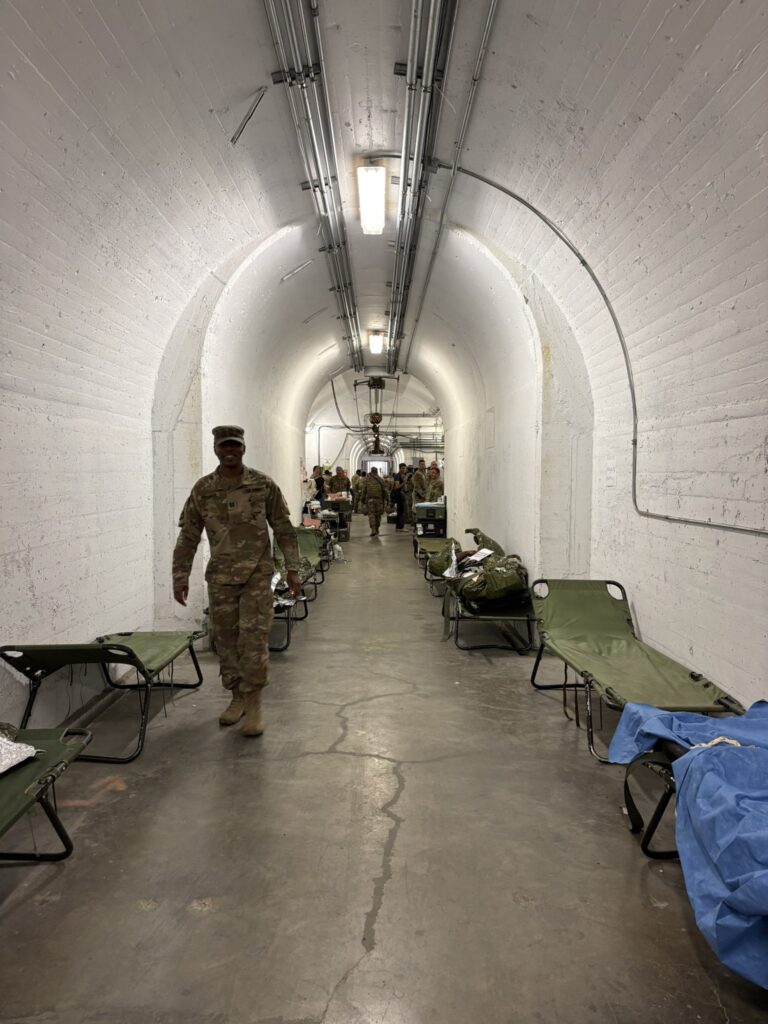
FORT HOOD, TX – In a stark shift reflecting the realities of modern warfare, the 1st Medical Brigade of the III Armored Corps concluded a massive training exercise this week, moving its field hospitals into decommissioned nuclear bunkers to escape the watchful eyes of enemy drones.
The exercise, dubbed “Operation Silver Lightning,” took place between March 23 and April 1. It transformed several miles of 1940s-era tunnels, originally designed to house atomic weapons, into a fully functional subterranean medical complex, including triage centers, operating rooms, and veterinary clinics.
The Death of the “Tented Hospital”
Military officials say the move underground is a direct response to the “transparent battlefield” observed in recent conflicts like Ukraine and the ongoing U.S. operations in Iran. Traditional field hospitals, which can sprawl across 15 acres of tents, are now considered “death traps” due to the proliferation of loitering munitions and surveillance UAVs.
“The medics have understood that you cannot set up a multi-tent field hospital… above ground anymore,” Col. Kamil Sztalkoper, director of public affairs for the III Armored Corps, told Fox News. “We have to disperse, and we have to hide in plain sight.”
Mass Casualties in the Dark
The drill involved approximately 300 soldiers and role-players simulating a mass casualty event. Medics were forced to navigate the logistical nightmare of “reverse triage”, managing a flood of patients that far outnumbers available surgeons and nurses.
The exercise pushed medical personnel to their limits:
-
Advanced Trauma: Doctors and nurses treated simulated compound fractures and traumatic blast injuries in cramped, dimly lit environments.
-
Veterinary Combat Care: The 43rd Medical Detachment practiced life-saving surgery on “diesel dogs”, sophisticated robotic K-9s, simulating hind-limb fractures and chest wounds while their handlers were treated in the same room.
-
Logistical Drills: Troops practiced the grueling process of rushing wounded soldiers from helicopters to armored medical vehicles and finally into the safety of the tunnel network.
A Legacy of Service
For some, the “brutal” nature of the training felt like a return to the past. Combat medic William Rothwell, a Boston native, noted that his grandfather served as a medic during the push on Omaha Beach in World War II.
“The stories of how much he cared and was willing to go the mile and above to get his brothers home really touched me,” Rothwell said, noting that while medicine has advanced, the “rough” and “traumatic” nature of combat care remains a constant.
As the U.S. remains embroiled in “Operation Epic Fury” in the Middle East, where Iran continues to launch hundreds of drones despite heavy U.S. strikes, the lessons learned in the tunnels of Fort Hood may soon become the new standard for survival on the front lines.