
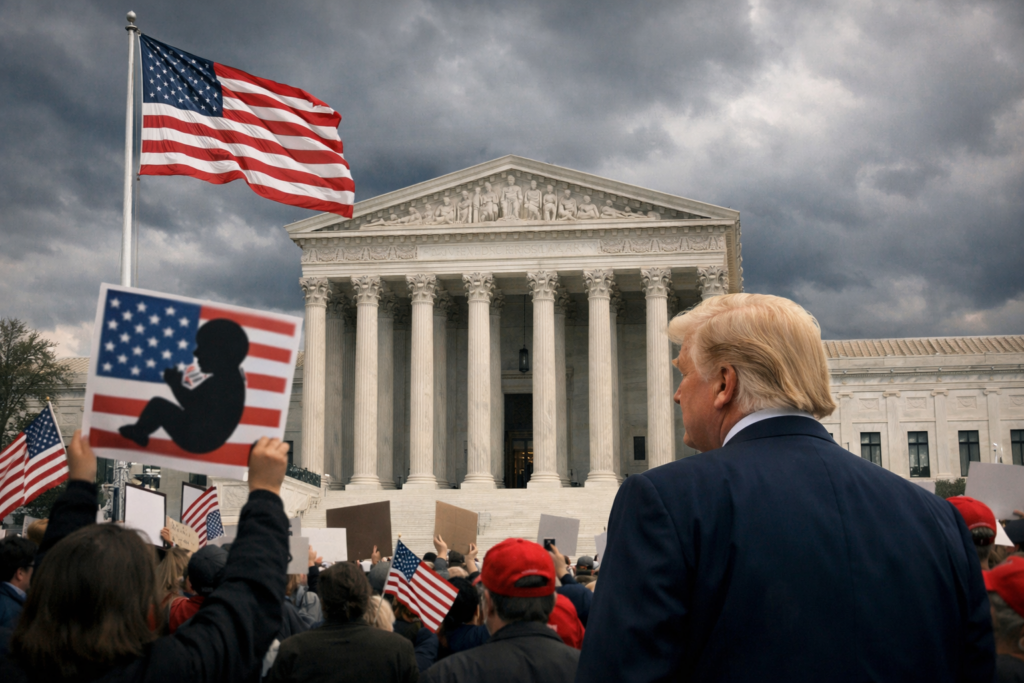
Image Credentials: Image Title: Supreme Court Weighs Trump’s Bold Move to Rescind Birthright Citizenship Source: (sora.openai) Date: April 2026. Attribution: This image was created using AI-generated imagery (sora.openai) and does not depict a real-world scene.
By Open Chronicle Staff with Agencies
WASHINGTON — In a historic and high-stakes confrontation over the bedrock of American identity, the U.S. Supreme Court on Wednesday heard oral arguments regarding President Donald Trump’s executive order to end birthright citizenship.
Trump attended the session for 90 minutes, marking the first time a sitting president has personally appeared in the gallery during Supreme Court arguments. Shortly after, he took to Truth Social to double down on his position, writing: “We are the only Country in the world stupid enough to allow ‘Birthright’ Citizenship!”
A Challenge to the 14th Amendment
At the heart of the legal battle is the 14th Amendment, ratified in 1868, which states that “all persons born or naturalized in the United States, and subject to the jurisdiction thereof, are citizens.”
The Trump administration argues that the phrase “subject to the jurisdiction thereof” was never intended to apply to the children of foreign nationals or those in the country illegally. Trump has publicly claimed the amendment was originally intended only for the children of formerly enslaved people, calling the current interpretation, which allows for “birth tourism,” both “ridiculous” and “stupid.”
Justices Signal Skepticism
Despite the administration’s push for a “new world” interpretation of the Constitution, several justices appeared wary of bypassing a century and a half of legal precedent:
-
Chief Justice John Roberts: Rebuffed the administration’s plea for a modern shift, simply stating, “It’s the same Constitution.”
-
Justice Ketanji Brown Jackson: Questioned the logistical chaos of the order, asking pointedly, “Is this happening in the delivery room?”
-
Conservative Skepticism: Justices Amy Coney Barrett and Neil Gorsuch also raised sharp questions regarding whether an executive order can legally override existing federal law and constitutional text.
Impacts on Legal Immigrants and Visa Holders
While much of the President’s rhetoric has focused on undocumented immigrants, the proposed policy would have immediate, far-reaching consequences for legal residents.
Experts suggest that H-1B and F-1 visa holders, particularly from India, would be among the hardest hit. Under the proposed rule, children born to parents on temporary visas would no longer automatically receive U.S. citizenship. This could lead to immediate deportation risks for families and eliminate the ability for children to eventually sponsor their parents for residency, creating a “long-term legal nightmare,” according to Sam Andrabi of Jotwani Associates.
The Numbers and the Process
The Migration Policy Institute estimates that over 250,000 babies born in the U.S. each year could be affected by the ruling.
Legal scholars noted during the hearing that changing the Constitution typically requires a grueling process under Article V, involving a two-thirds vote in both the House and Senate followed by ratification by three-fourths of the states. Trump’s attempt to achieve this via executive order represents a massive expansion of presidential authority that the Court is now tasked with refereeing.
A final decision is expected by the end of June. The ruling comes as the White House continues to reel from the Court’s February decision to strike down Trump’s global tariffs, adding to a string of high-profile legal battles between the executive and judicial branches.