
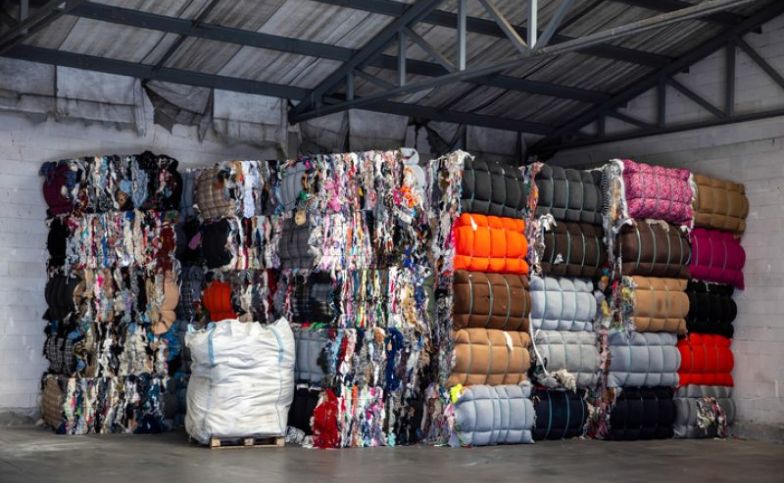
Image: from Waste & Recycling Magazine X @WasteRecycleMag
By Open Chronicle Staff with Agencies
ZHANGJIAGANG, China — In an industrial park on China’s east coast, a high-speed “Fastsort-Textile” machine is providing a high-tech solution to one of the fashion industry’s most pressing environmental problems. Utilizing advanced artificial intelligence, the system identifies and sorts used clothing by material composition at speeds far exceeding human capability.
Developed by the Chinese AI firm DataBeyond, the machine was recently named one of Time magazine’s Best Inventions of 2025. It is currently spearheading operations at Shanhesheng Environmental Technology Ltd., where it is drastically reducing the amount of synthetic waste destined for landfills.
Breaking the Efficiency Barrier
The disparity between human labor and AI precision is stark. Traditional manual sorting of textile fibers is slow and prone to inaccuracy, as human workers struggle to distinguish between high-percentage polyester blends.
-
Speed: The AI system sorts 100 kilograms (220 pounds) of clothing in just two to three minutes. A human worker requires approximately four hours to complete the same task.
-
Capacity: The machine processes two tons per hour. For two humans to sort that volume with similar (though less accurate) results, it would take two full days.
-
Accuracy: Previously, 50% of processed textiles at the facility were deemed unrecyclable and incinerated. With the Fastsort-Textile scanner, that figure has dropped to 30%.
How the “Hissing” Scanner Works
The system consists of a 5-by-2-meter AI scanner integrated into a network of conveyor belts. As stacks of clothing pass through, the scanner emits a sharp hiss while reading the chemical composition of the fibers in less than a second.
A live video feed displays the material breakdown in real-time. Once identified, items are automatically routed to specific sorting areas for nylon or polyester recycling. Items that fall below specific quality benchmarks are diverted for incineration, a last resort that the company hopes to eventually eliminate.
The Global Context: A “Dark Factory” Future
China remains the world’s leading textile exporter, with 2025 exports reaching $142 billion—more than double that of the European Union. However, this production comes with a massive environmental footprint, as synthetic textiles (derived from fossil fuels) account for roughly 70% of global production.
“The ultimate goal is a ‘dark factory’ with robots running 24 hours,” said Shanhesheng Sales Director Li Bin, referring to a fully automated facility that requires no human lighting or presence.
As global energy markets remain volatile due to the ongoing conflict in the Middle East and the closure of U.S. embassies in the Gulf, the push for “resilient” and “independent” recycling economies has gained momentum. By maximizing the reuse of existing synthetic materials, China aims to reduce its reliance on the raw petroleum products currently threatened by geopolitical instability in the Strait of Hormuz.