
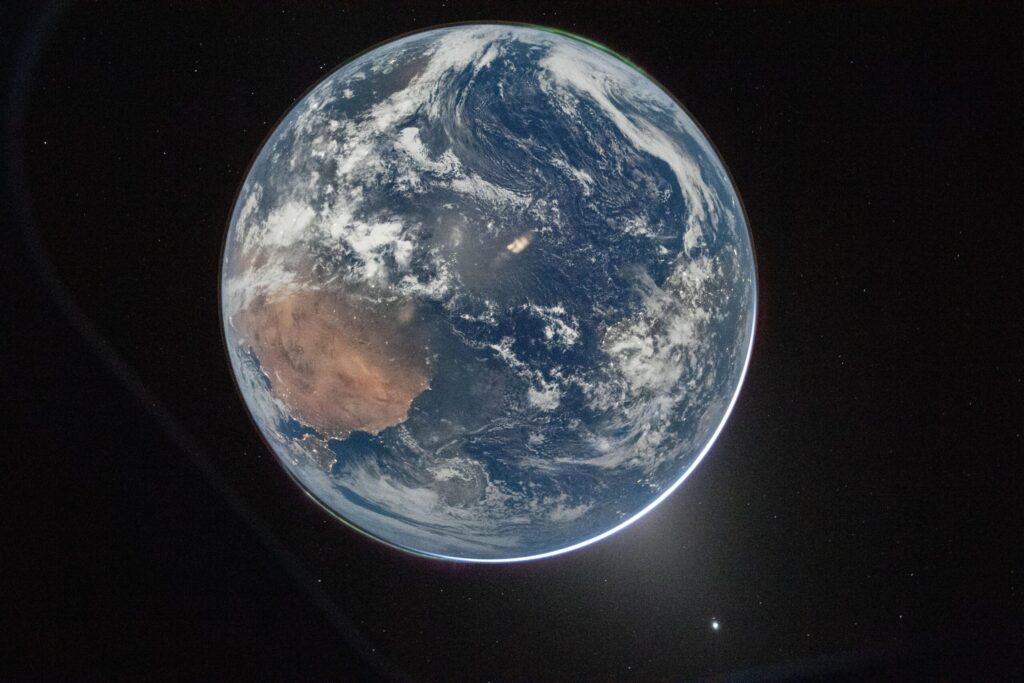
Image: from NASA Earth  X @NASAEarth
By Open Chronicle Staff with Agencies
HOUSTON – As the four-person crew of Artemis II journeys further from Earth than any human in more than half a century, NASA has released the first high-resolution “spectacular” images captured from the Orion spacecraft.
The photos, taken by Mission Commander Reid Wiseman, mark a poignant milestone as the crew completed their trans-lunar injection (TLI) burn in the early hours of Friday, officially setting them on a looping trajectory toward the Moon.
STUNNING🚨: Artemis II crew captured a stunning image of Earth this morning from 41,000 miles away.
The first time since 1972 that humans have seen a crescent Earth in full. pic.twitter.com/poL63oKYvs
— All day Astronomy (@forallcurious) April 2, 2026
A New Perspective: “Hello, World”
The standout image, titled Hello, World, captures the Earth in a state of celestial transition. From Orion’s vantage point, the planet appears “upside down,” with the Western Sahara and the Iberian Peninsula visible to the left, while the eastern coast of South America stretches to the right.
Key details from the transmission include:
-
Atmospheric Glow: A thin, luminous ring of atmosphere frames the deep blue of the Atlantic Ocean as the Earth eclipses the Sun.
-
Polar Lights: Striking green auroras are visible dancing at both the northern and southern poles.
-
Planetary Cameo: NASA identified a brilliant speck of light in the bottom right of the frame as the planet Venus.
“Glued to the Windows”
After the successful engine burn that broke Earth’s gravitational hold, the crew, Wiseman, Victor Glover, Christina Koch, and Jeremy Hansen—reportedly spent hours at the spacecraft’s portholes.
“We are getting a beautiful view of the dark side of the Earth, lit by the Moon,” Canadian astronaut Jeremy Hansen told Mission Control in Houston. The enthusiasm was so high that Commander Wiseman later radioed down to ask for advice on how to clean the windows, noting they had become smudged from the astronauts’ excitement.
Wiseman initially compared the difficulty of photographing Earth from deep space to “trying to take a picture of the moon from your backyard,” citing the extreme challenge of adjusting exposure settings at such vast distances. However, the latest batch of photos, including a striking shot of the terminator, the line dividing day and night on the planetary disk, proves the crew has mastered the orbital photography.
The Road Ahead
Artemis II is currently traversing the 200,000-mile void between Earth and its closest neighbor.
-
April 6: The crew is expected to swing around the lunar far side, providing them with a direct human view of terrain unseen since 1972.
-
April 10: The mission will conclude with a high-speed reentry and splashdown in the Pacific Ocean.