
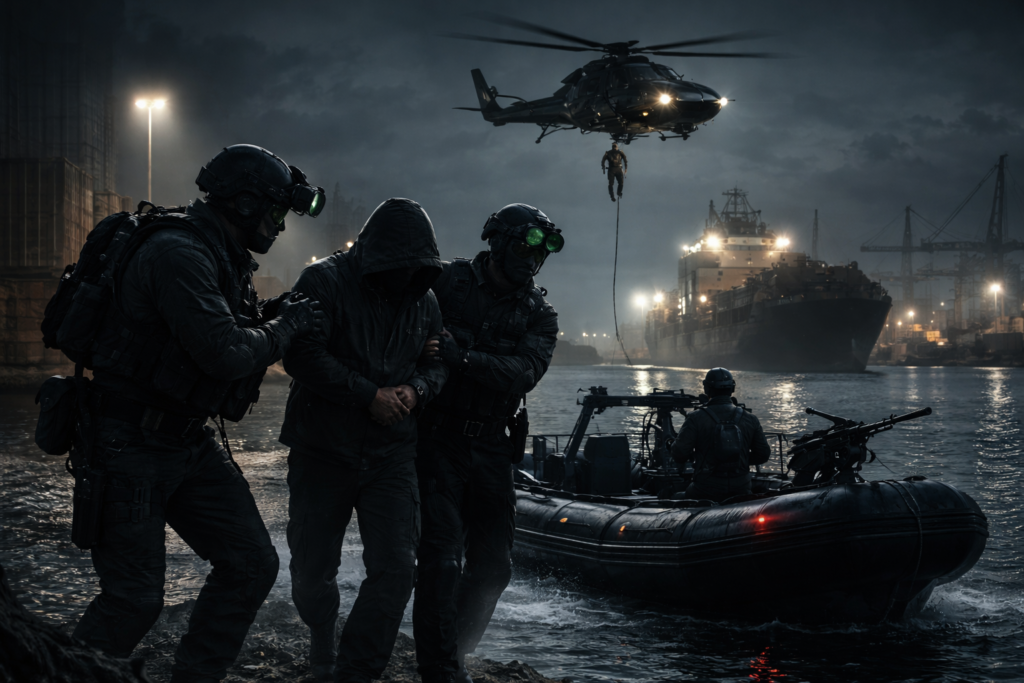
Image Credentials: Image Title: Silent Extraction Anatomy of a Covert Exfiltration Source: (sora.openai) Date: April 2026. Attribution: This image was created using AI-generated imagery (sora.openai) and does not depict a real-world scene.
By Open Chronicle Staff
Operations File | Shadow Protocols
Silent exfiltration is one of the most unforgiving tasks an intelligence apparatus can undertake. It demands not only precise planning and execution but also the ability to navigate ambiguity, deception, and the weight of unknown variables. This analysis breaks down the key phases of a covert extraction, supported by real‑world operational profiles and tactical insights essential for practitioners.
1. Pre‑Operational Intelligence: Foundations of an Extraction
Exfiltration does not begin at the pickup point. It begins with intelligence that anticipates movement, adversary posture, and geopolitical friction points. Critical elements include:
Target Profiling
Understanding who is being extracted: motivations, personality, network, risk tolerance.
Environmental Mapping
Identifying all accessible routes, choke points, surveillance nodes, human terrain features, and electronic signatures.
Operational Windows
Perfect timing disrupts enemy predictability. Low probability transit windows are as important as the route itself.
Shadow Insight:
The stronger the intelligence baseline, the quicker the team transitions from planning to execution. Half the risk in exfiltration exists while still in the planning room.
2. Execution Discipline
In the field, precision outweighs speed. A silent extraction is not a sprint — it is an orchestration.
Camouflage and Concealment
Not only visual — but digital and behavioral camouflage: using benign transport, blending with civilian movements, and adaptive patterns.
Communication Modality
Encrypted radios, prearranged tones, hand signals, and intermittent bursts avoid continuous transmissions that could be intercepted.
Operational Deconfliction
Teams use layered roles: advance scouts, decoy units, main task force, overwatch — each with specific contingency triggers.
Shadow Insight:
A disciplined cadence of movement and pause creates unpredictability, not chaos.
3. Risk Management — Anticipating the Unexpected
Every extraction plan assumes the world will not cooperate.
Hostile Presence
Unmapped patrols, dynamic checkpoints, and civilian interaction.
Environmental Disturbances
Sudden weather shifts, urban congestion, unplanned events.
Cognitive Load
Operational effectiveness declines under stress; teams rehearse failure scenarios to inoculate against panic.
Shadow Protocol:
Redundancy is not waste, it is insurance.
4. Technology in the Field
Technology is force multiplication in exfiltration, but it never replaces judgment:
- Encrypted Comms & Burst Messaging
- Covert Position Monitoring
- Multi‑Spectrum Recon (EO/IR/UV)
- Portable Signal Intercept & RF Pattern Analysis
- Low Observable Transport Platforms
Shadow Insight:
The best systems are silent by design — they reduce signature, not amplify it.
5. Case Studies: Real‑World Templates
Below are declassified or publicly acknowledged operations that illustrate how theory translates into execution.
Case Study A — Operation Golden Dawn (1980s)
Location: Western Europe
Context: Extraction of a dissident intelligence source under high surveillance.
Tactical Approach:
- Staged reconnaissance teams to map shifts in patrol patterns.
- Multiple egress routes prepped, using alternate urban arteries to reduce predictability.
- Extraction executed at low movement hours, with a secondary convoy establishing false intent.
Operational Insight:
A single route with zero redundancy is a planning failure. True readiness consists of layers.
Case Study B — Operation Midnight Storm (2011)
Location: Pakistan, near Abbottabad
Context: High‑value operational target removal amid dense hostile electronic and human surveillance.
Tactical Approach:
- Extensive ISR (Intelligence, Surveillance, Reconnaissance) shaped the extraction window.
- Observed adversary ISR patterns for weeks to identify true operational pauses.
- Used airborne assets with near‑silent ingress and egress.
Operational Insight:
Knowing when not to move is as valuable as knowing how to move.
(Public context from Operation Neptune Spear; tactical framing adapted for analytical learning.)
Case Study C — Silent Harbor Initiative (Late 1990s)
Location: Middle East
Context: Extraction of an operative compromised by local forces during a region-wide sweep.
Tactical Approach:
- Counter-surveillance analysts fed real‑time updates to the exfiltration team.
- A dual‑axis withdrawal combined by land and sea reduced single-point interception risk.
- False traffic patterns and digitally muted comms maintained concealment.
Operational Insight:
Overreliance on a single egress vector limits maneuver. Multiplicity increases survivability.
6. Tactical Breakouts — What Works, What Fails
What Works
- Layered redundancies
- Real‑time reconnaissance updates
- Digital signature minimization
- Adaptive concealment strategies
Failure Modes
- Static routing
- Overcommunication
- Dependence on technology with a single failure point
- Disregard for human terrain
Conclusion — Patterns in the Silence
Silent extraction is less about a single method and more about a system of disciplined decision‑making. It thrives on anticipation, contingency and information advantage. From Golden Dawn to Midnight Storm, the guiding principle remains:
A successful extraction is measured not by speed, but by invisibility.