
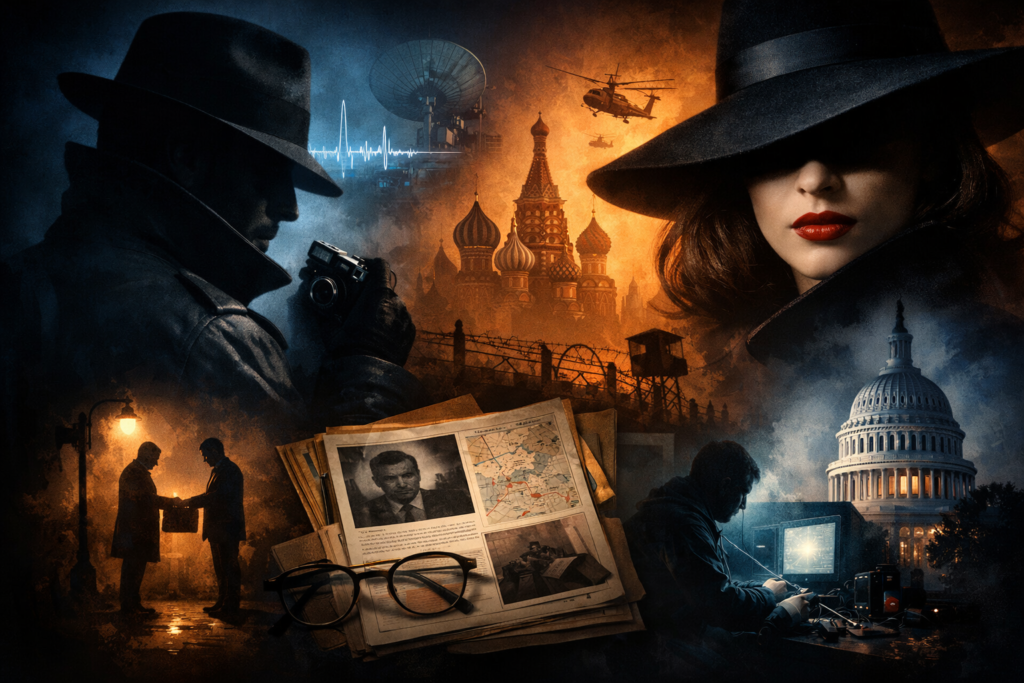
Image Credentials: Image Title: From the Shadows A Chronicle of Notorious Espionage Cases Source: (sora.openai) Date: April 2026. Attribution: This image was created using AI-generated imagery (sora.openai) and does not depict a real-world scene.
By Open Chronicle Staff
Operations File | Shadow Protocols
The history of intelligence is a high-stakes game of cat and mouse, where a single individual’s actions can alter the course of wars or compromise national security for decades. While the tools of the trade have evolved from hollowed-out pumpkins to sophisticated cyber-theft, the motivations, greed, ideology, and coercion remain remarkably consistent.
World War II: The Era of Infiltration
During the height of global conflict, access was the ultimate currency. Spies operated in the intimate circles of power, often hiding in plain sight.
-
Elyesa Bazna (“Cicero”): An Albanian valet to the British ambassador in Turkey, Bazna photographed top-secret documents, including plans for the D-Day invasion. Though paid over £1 million by the Nazis, he discovered too late that much of his compensation was counterfeit.
-
Frederick Rutland: A decorated British Navy officer turned double agent for Japan. He provided carrier designs to Japanese intelligence before being detained following the Pearl Harbor attack.
-
Coco Chanel: The fashion legend’s legacy remains clouded by her wartime associations. Reports suggest she acted as a German informer (Agent F-7124) in exchange for her nephew’s release from a POW camp.
The Cold War: Atomic Secrets and Double Lives
As the world split between East and West, the “Great Game” shifted to nuclear capabilities and ideological subversion.
The Nuclear Ring
The trial of Ethel and Julius Rosenberg remains one of the most controversial in U.S. history. Accused of passing atomic secrets to the Soviet Union, they became the only U.S. civilians executed for espionage. While Julius’s role as a recruiter was confirmed by later records, Ethel’s level of active participation continues to be a subject of intense historical debate.
The “Pumpkin Papers” and Missile Secrets
-
Alger Hiss: A high-ranking State Department official whose downfall came when microfilm was discovered hidden in a hollowed-out pumpkin on his Maryland farm.
-
Oleg Penkovsky: Perhaps the most valuable double agent of the era. A Soviet colonel, he provided the U.S. with the critical intelligence regarding missile placements in Cuba, giving President Kennedy the leverage needed during the 1962 Missile Crisis.
The Modern Era: Greed and Cyber Theft
The late 20th and early 21st centuries saw the rise of the “insider threat,” where trusted officials sold out their country for financial gain or digital assets.
The Infamous Traitors
| Spy | Role | Motivation | Outcome |
| Aldrich Ames | CIA Case Officer | Financial Greed | Life in prison; compromised dozens of Soviet sources. |
| Robert Hanssen | FBI Agent | Financial/Ego | Died in prison (2023) after selling secrets for $1.4M in cash/gems. |
The Digital Frontier
In 2024, the face of espionage changed with the indictment of Linwei Ding. A former Google employee, Ding, is accused of stealing proprietary Artificial Intelligence (AI) trade secrets to benefit Chinese organizations. This case highlights the shift from military secrets to the theft of intellectual property and “data sovereignty.”
Combating the Invisible Threat
Today, the National Counterintelligence and Security Center and the CIA use a combination of psychological profiling and digital footprint tracking to identify potential “insider threats.”
“We live in a digital world where we all have digital footprints,” notes Dr. Burch, a counterintelligence expert. “The ability to track activities through digital surveillance has revolutionized how we investigate these cases.”
As adversaries move toward unmanned vehicles and biometric surveillance, the U.S. Intelligence Community continues to evolve, proving that while the “pumpkin papers” are a thing of the past, the need for vigilance remains eternal.