
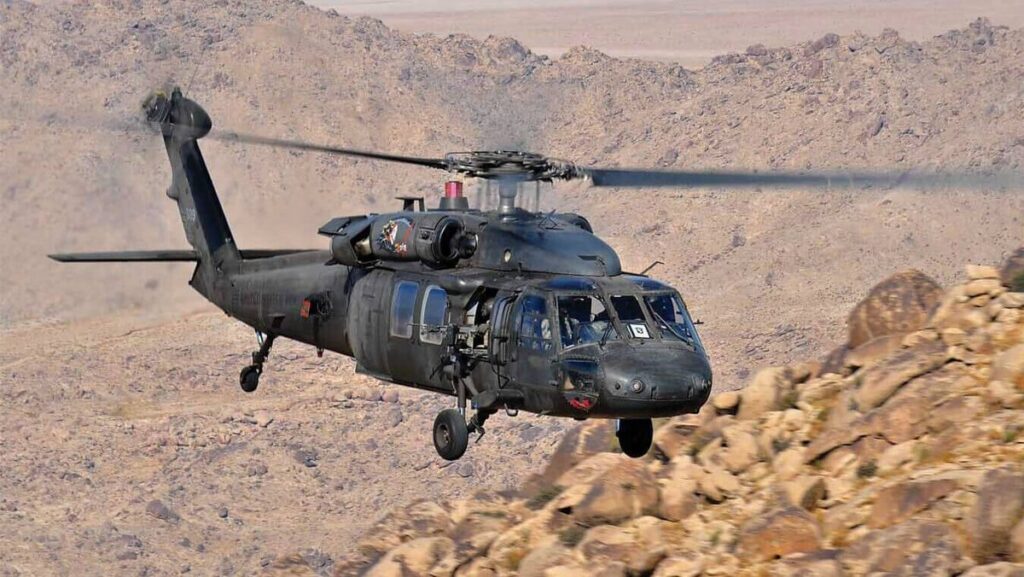
Image: A U.S. Black Hawk UH-60 helicopter, engaged in the search for a missing F-15 pilot, was reportedly struck over Iranian airspace. from Thomad X @FaithfulThomad
By Open Chronicle Staff with Agencies
TEHRAN / WASHINGTON — The U.S. military launched a high-stakes search-and-rescue mission in the rugged mountains of southwestern Iran on Saturday, racing against Iranian security forces and local “bounty hunters” to locate a missing American pilot.
The crisis follows the Friday downing of a U.S. F-15E Strike Eagle over the Kohgiluyeh and Boyer-Ahmad province, the first loss of a manned American aircraft within Iranian territory since the war began on February 28. While one crew member was successfully rescued by U.S. forces, the fate of the second remains unknown, prompting Tehran to broadcast appeals on state television urging citizens to capture the “enemy pilot” for a reward.
What's the strategy in the search for the U.S. pilot in Iran?
Watch here as our military analyst @BellusUK breaks down what rescue missions can look like ⬇️
Iran war latest: https://t.co/zAY6dbDhp1 pic.twitter.com/aNpOTw2C5K
— Sky News (@SkyNews) April 4, 2026
A War of Attrition
Now in its sixth week, the conflict has defied early predictions of a swift U.S.-Israeli victory. Despite President Donald Trump’s recent claims that the U.S. had “completely decimated” Iran’s military, the Islamic Republic’s air defenses proved lethal on Friday, reportedly striking not only the F-15E but also an A-10 Thunderbolt II over the Persian Gulf.
The human and economic toll of the war continues to mount:
-
Casualties: Over 1,900 killed in Iran; 1,400 in Lebanon; 19 in Israel; and 13 U.S. service members.
-
Displacement: More than 1 million people are displaced in Lebanon alone.
-
Infrastructure: Strikes have hit the Bushehr nuclear facility, killing a security guard, and targeted U.S. tech giants like Oracle and Amazon Web Services in the UAE and Bahrain.
Chokeholds on Global Trade
The conflict is increasingly being fought at strategic maritime “choke points.” While the U.S. has issued a Monday deadline for Iran to reopen the Strait of Hormuz, Iranian parliamentary speaker Mohammad Bagher Qalibaf issued a veiled threat Friday to disrupt the Bab-el-Mandeb Strait.
The Bab-el-Mandeb is a critical artery for global commerce, linking the Red Sea to the Indian Ocean. A blockade there would jeopardize:
-
10% of seaborne global oil.
-
25% of the world’s container ship traffic.
-
Massive shipments of LNG, wheat, and fertilizer.
Glimmer of Diplomacy in Islamabad
Despite the escalating violence, a diplomatic backchannel appears to be opening. Pakistan, alongside Turkey and Egypt, is working to broker a ceasefire. Iranian Foreign Minister Abbas Araghchi signaled a willingness to join talks in Islamabad, where mediators are proposing a temporary cessation of hostilities to allow for the reopening of shipping routes.
“Our efforts to broker a ceasefire are right on track,” said Pakistan’s Foreign Ministry spokesperson Tahir Andrabi.
However, the window for diplomacy is narrow. On his social media platform, Truth Social, President Trump reiterated his 48-hour ultimatum, warning that if the Strait of Hormuz is not opened by Monday, “all Hell will reign down on them.”
Tech Companies Under Fire
The war has also spilled into the corporate sector. An Iranian drone strike on Oracle’s headquarters in Dubai on Saturday highlights the Revolutionary Guard’s new doctrine of targeting U.S. tech firms, which they accuse of “terrorist espionage.” Debris from the interception caused significant damage to the building’s facade, though no injuries were reported.