
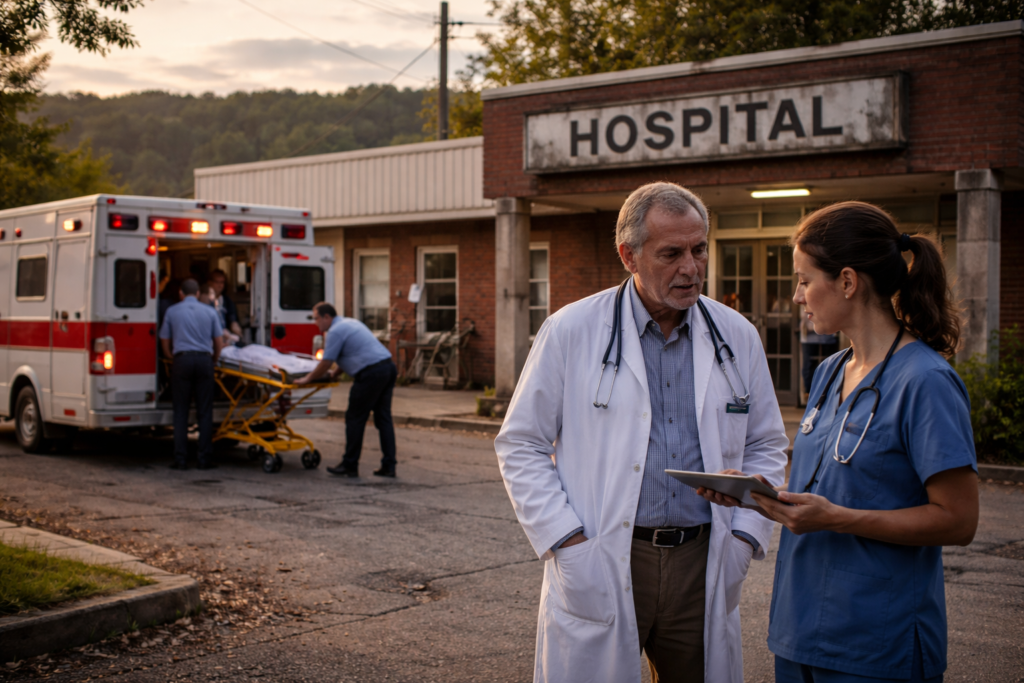
Image Credentials: Image Title: Rural U.S. Healthcare Strains Under New Federal Funding Model Source: (sora.openai) Date: April 2026. Attribution: This image was created using AI-generated imagery (sora.openai) and does not depict a real-world scene.
By Open Chronicle Staff with Agencies
CREIGHTON, Neb. – For families in rural America, the distance between home and the nearest hospital isn’t measured in miles, but in minutes of life or death. In the small town of Creighton, Nebraska, Rick and Jane Saint John moved specifically to be near Avera Creighton Hospital to support their child’s complex medical needs. After the facility saved Jane’s life during a bout of pneumonia three years ago, the couple now faces a chilling reality: their lifeline is in financial peril.
The Saint John’s story is a microcosm of a broader crisis unfolding across the rural United States. While the federal government has launched a $50 billion initiative to “revitalize” rural health, many communities are discovering that “innovation” does not always equate to “survival.”
Rural healthcare in the U.S. has become a geographic lottery.
Since 2010, 150+ hospitals have closed, and 450+ are at risk of closing—leaving 30 million Americans without reliable access to emergency care. For rural Americans, the “Golden Hour”—the critical window for survival… pic.twitter.com/JLfxTEiSCF— Anand Lalaji MD (Dr A) (@MDANANDLALAJI) March 30, 2026
The $50 Billion “Band-Aid” Problem
The Rural Health Transformation Program, championed by Health Secretary Robert F. Kennedy Jr. and CMS Administrator Dr. Mehmet Oz, was billed as a historic infusion of capital. However, healthcare analysts and hospital administrators argue the fund’s structure ignores the immediate operational bleeding caused by recent Medicaid cuts.
Research from the nonprofit KFF indicates that rural hospitals face an estimated $137 billion in losses over the next decade. The federal fund—split into $10 billion annual installments—is largely restricted to “big ideas” such as:
-
AI-driven patient monitoring
-
Telehealth expansion
-
Mobile medical sensors
-
School nutrition programs
While these advancements aim for long-term efficiency, they offer little relief for hospitals struggling to meet payroll or pay utility bills today. “It won’t pay to keep the lights on,” warns Dr. Ben Young of the Wellness Equity Alliance. “And it won’t turn the lights back on once they’ve been turned off.”
The Medicaid “Right-Sizing” Dilemma
A major driver of the current instability is the reduction in Medicaid reimbursements and the introduction of new work requirements set to take full effect in 2027. For many critical access hospitals, Medicaid is the primary source of revenue.
In Nebraska, which received $218 million in its first grant installment, the state’s strategy reflects a controversial trend:
-
Innovation over Inpatients: Only $10 million was allocated to help “right-size” hospitals.
-
Service Cuts: “Right-sizing” often serves as a euphemism for eliminating inpatient beds, forcing residents to travel an hour or more for emergency admissions.
State-Level Desperation
As federal funds fall short of covering operational gaps, rural states are taking drastic, unprecedented measures to keep their medical doors open:
-
Wyoming: Passed legislation allowing rural hospitals to file for Chapter 9 bankruptcy, a move typically reserved for cities to reorganize debt while maintaining essential services.
-
North Dakota: Lawmakers recently approved a special $5 million low-interest loan specifically to rescue a single rural hospital that serves as a primary employer for 5% of its county.
-
Colorado: Hospital associations have pushed back against state leaders, accusing them of ignoring the specific needs of rural facilities during the grant application process.
The Human Cost
As the 2026 midterm elections approach, the “rural-urban health divide” is becoming a central political flashpoint. For residents like Rick Saint John, the debate over “innovation” feels disconnected from the ground reality.
“The hospital is very important to this community, and for more than just medical care,” Saint John said, noting that a closure would trigger a domino effect of job losses and community decline. Without a shift from “transformative” grants to “operational” support, the lights in towns like Creighton may continue to flicker toward a permanent dark.
Note: Portions of this story were adapted from original reporting by PBS News.