
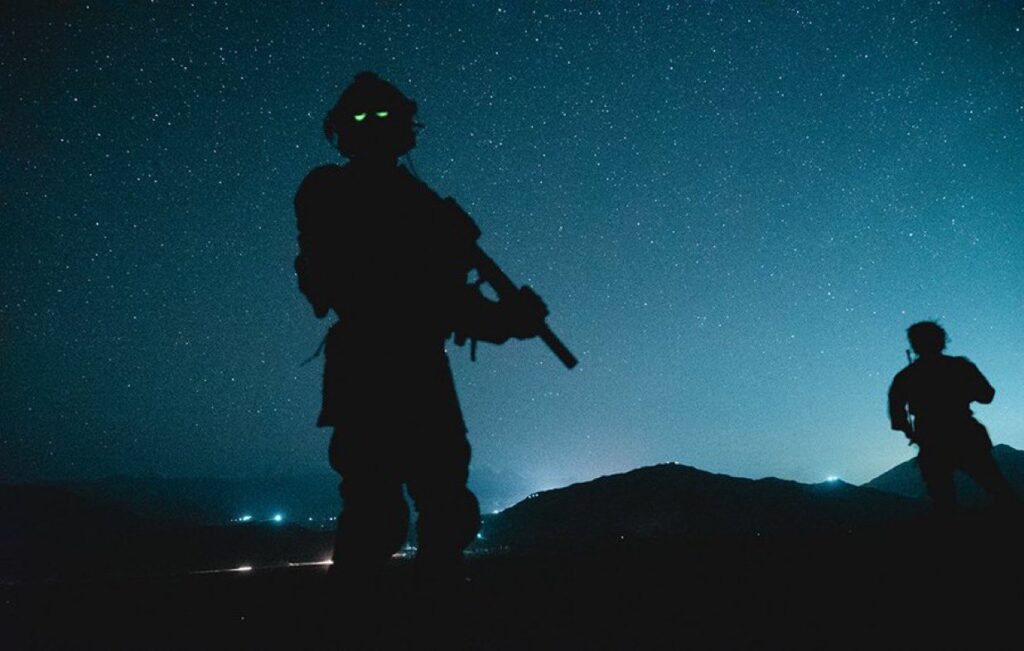
Image: from Prime X @nucleusprime
By Open Chronicle Staff with Agencies
WASHINGTON — In what is being described as one of the most high-stakes search-and-rescue operations in modern military history, U.S. specialized units have successfully extracted the second crew member of an F-15E Strike Eagle downed over Iranian territory.
The mission, which concluded late Sunday, brings an end to a 48-hour ordeal for the officer, identified as a highly decorated colonel serving as the aircraft’s Weapon Systems Officer (WSO).
The President’s Briefing
The successful recovery was first confirmed by President Donald Trump on his social media platform, Truth Social. The President praised the bravery of the rescue teams involved in the operation, which reportedly utilized dozens of aircraft to penetrate contested airspace.
“We have rescued our incredible officer, a crew member, and a highly respected colonel,” President Trump wrote. “I’m pleased to report that he is now completely safe! Our forces carried out one of the most daring search-and-rescue missions in our country’s history.”
Forty-Eight Hours in Hostile Territory
The colonel had been evading capture for approximately two days in the rugged provinces of Kohgiluyeh and Boyer-Ahmad. According to military sources, the officer was forced to hide from Iranian regular forces and local militia fighters who had mobilized to secure a capture.
The stakes were further heightened by Tehran’s announcement of a 10 billion toman reward for the pilot’s capture alive, turning the search into a race against time between U.S. elite units and Iranian search parties.
Anatomy of the Operation
The rescue was a massive, multi-platform undertaking. To avoid sophisticated Iranian air defense systems, U.S. assets performed high-risk, low-altitude maneuvers.
| Asset Type | Role in Mission |
| HC-130J Combat King II | Command, control, and aerial refueling coordination. |
| HH-60/UH-60 Black Hawks | Extraction and tactical transport. |
| F-22/F-35 Escorts | Air superiority and suppression of enemy air defenses (SEAD). |
Iranian state media had previously circulated footage of HC-130J aircraft and Black Hawk helicopters skimming the terrain at “nap-of-the-earth” altitudes to mask their radar signatures during the deep-penetration mission.
Background on the Incident
The crisis began on April 3, 2026, when Iranian authorities claimed to have downed a U.S. fighter jet. While initial reports from Tehran suggested the aircraft was an F-35 stealth fighter, analysis of the wreckage confirmed it was an F-15E Strike Eagle.
The aircraft was identified as belonging to the 494th Fighter Squadron, known as the “Panthers,” based at RAF Lakenheath in the United Kingdom.
While the first crew member was recovered shortly after the crash, the WSO remained behind enemy lines until the final extraction was confirmed today. The Department of Defense has not yet released the names of the crew members, citing security protocols and the ongoing sensitivity of operations in the region.