
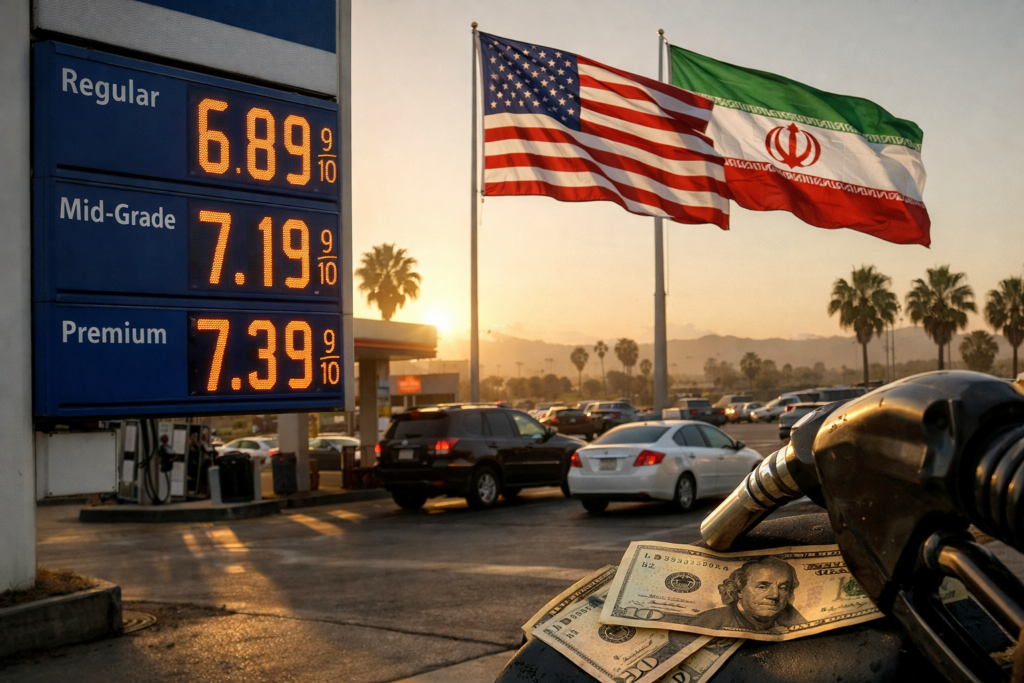
Image Credentials: Image Title: Why the U.S.-Iran Ceasefire Won’t Lower California Gas Prices Source: (sora.openai) Date: April 2026. Attribution: This image was created using AI-generated imagery (sora.openai) and does not depict a real-world scene.
By Open Chronicle Staff with Agencies
Wednesday, April 8, 2026
LOS ANGELES — California drivers hoping for immediate relief at the pump following the surprise U.S.-Iran ceasefire may be in for a long, expensive spring. Despite a double-digit plunge in global crude prices on Wednesday, energy analysts warn that “Golden State” motorists will likely continue to pay nearly $6 a gallon for months to come.
While the reopening of the Strait of Hormuz, a chokepoint for 20% of the world’s oil, sent benchmark Brent crude tumbling to $94.80 a barrel, California’s isolated fuel market remains trapped by structural bottlenecks and a shrinking domestic refining fleet.
The “Import Model” Trap
California’s energy landscape underwent a radical transformation in 2026. The state now depends on foreign countries for more than 60% of its oil supply, a vulnerability that became a crisis when the Strait of Hormuz was blocked in late February.
According to the U.S. Energy Information Administration (EIA), the “reset” of this supply chain will not be instant.
-
Lag Time: It can take three to five weeks for tankers from the Persian Gulf or Asian refineries to reach West Coast ports.
-
Refinery Bottlenecks: The EIA noted Tuesday that fuel costs could remain elevated for months as refineries work through current “expensive” crude stocks and address a backlog of demand.
A Shrinking Refining Fleet
The timing of the conflict has been particularly brutal for California. The state is currently grappling with the loss of nearly 20% of its total refining capacity.
-
Phillips 66: Shuttered its Los Angeles refinery in late 2025.
-
Valero: Its Benicia facility is scheduled for a full shutdown this month (April 2026).
“We’ve never seen the Strait close, and we’ve never seen it reopen,” the EIA stated in its short-term outlook. The agency predicts that even with the ceasefire, retail gasoline prices in high-cost states like California will peak in April and stay elevated throughout the year.
The California “Surcharge”
As of Tuesday, the national average for regular gas stood at $4.14 per gallon, but California’s average sat at a staggering $5.93. The nearly $2.00 “surcharge” is driven by factors unique to the state:
-
Climate Programs: The Cap-and-Trade program and the Low Carbon Fuel Standard (LCFS) add approximately 37 cents per gallon.
-
Taxes: The state excise tax currently sits at 61 cents per gallon.
-
Boutique Blends: California’s strict air quality standards require a special “summer blend” that few out-of-state refineries can produce, making it difficult to find alternative supplies when local production fails.
Diesel and the Supply Chain
The crisis is even more acute for diesel, the lifeblood of the state’s trucking and shipping industries. Diesel prices hit $5.65 a gallon this week, threatening to keep the cost of groceries and construction materials high despite the diplomatic breakthrough in the Middle East.
“The ceasefire is a welcome relief for global peace, but it doesn’t fix California’s broken energy math,” said energy economist Philip Verleger. For the 14 million daily commuters in California, the “peace dividend” may not be felt at the pump until the summer, if the truce holds.