
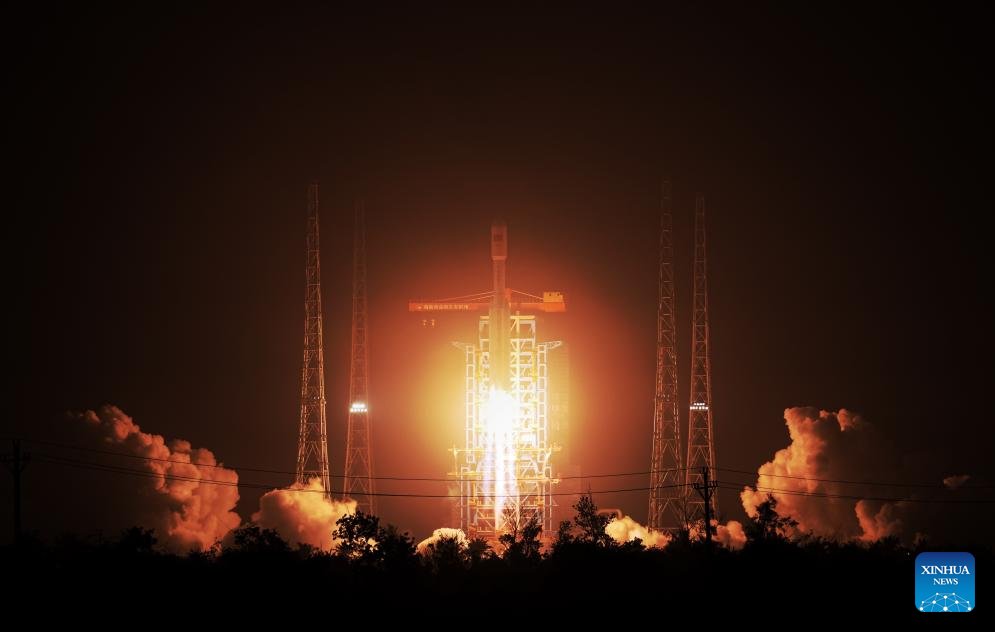
Image: from China Science X @ChinaScience
By Open Chronicle Staff with Agencies
Thursday, April 9, 2026
TAIYUAN, China — China successfully launched a fresh group of low-Earth orbit (LEO) internet satellites early Thursday morning, further advancing its mission to establish a comprehensive global communications infrastructure.
The satellites were launched from the Taiyuan Satellite Launch Center in northern Shanxi province, state-run media outlet Xinhua reported. Officials confirmed that the satellite group, identified as the 21st batch of its kind, successfully entered its designated orbit.
China's Long March-8 rocket launches 18 internet satellites into space #ChinaPulse pic.twitter.com/Lf22j6elyT
— China Xinhua News (@XHNews) April 8, 2026
Advancing Global Connectivity
The deployment of these satellites is part of China’s broader strategy to compete in the growing LEO satellite market. Unlike traditional geostationary satellites, LEO satellites orbit much closer to Earth, allowing for:
-
Lower Latency: Faster data transmission speeds.
-
Global Coverage: Providing internet access to remote and underserved regions.
-
Enhanced Resilience: A distributed network that is harder to disrupt than a single, large satellite.
China sent a new satellite group into space from the Taiyuan Satellite Launch Center in north China's Shanxi Province on Thursday.
The satellite group, the 21st group of low-orbit internet satellites, was launched at 3:38 a.m. (Beijing time) aboard a modified Long March-6… pic.twitter.com/mmFQmHQle6
— China News 中国新闻网 (@Echinanews) April 9, 2026
Milestone for the Long March Series
The mission was carried out by a Long March rocket, marking the 637th flight for the storied series. The Long March family remains the backbone of China’s space ambitions, consistently delivering hardware for everything from lunar exploration to the assembly of the Tiangong space station.
As China continues to expand its LEO presence, it joins a competitive international field aimed at reshaping how the world accesses and shares information via space-based technology.