
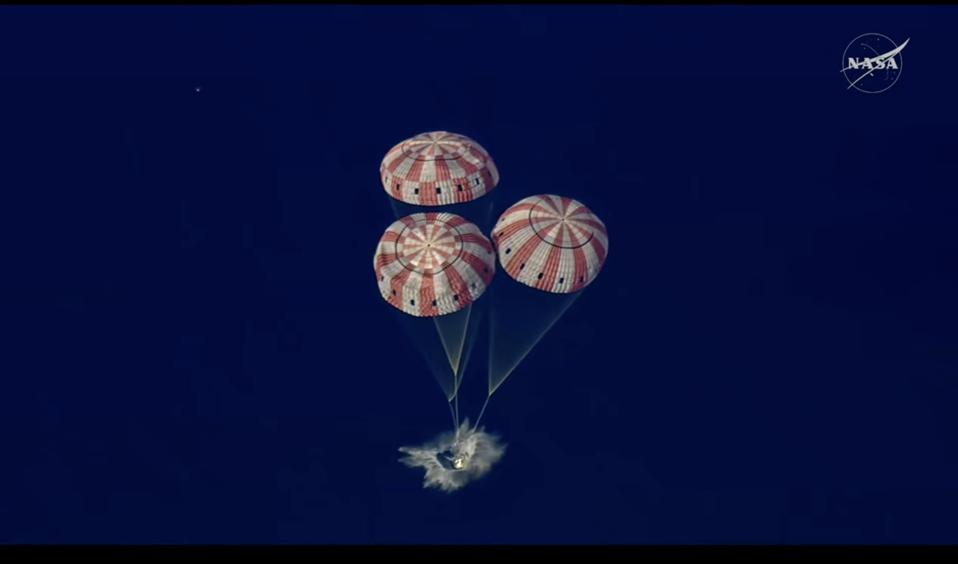
Image by NASA
By Open Chronicle Staff with Agencies
SAN DIEGO, CA — The first crewed voyage to the vicinity of the Moon in over half a century concluded successfully on Friday as NASA’s Orion capsule splashed down in the Pacific Ocean, marking a triumphant end to the Artemis II mission.
The spacecraft, carrying four astronauts, hit the water at 5:07 p.m. local time on April 10, following a high-stakes, 10-day journey that pushed the boundaries of human spaceflight. Recovery teams stationed aboard the USS John P. Murtha reached the capsule shortly after splashdown to begin medical evaluations and transport the crew back to Houston.
BREAKING: Splashdown complete! Artemis II crew return to Earth after a historic moon mission.
After hurtling through the Earth's atmosphere, the Orion capsule has safely landed in the Pacific Ocean off the coast of San Diego. 🚀
📺 Sky 501 pic.twitter.com/KvdlYKNWY9
— Sky News (@SkyNews) April 11, 2026
Breaking Apollo Records
The mission was crewed by NASA astronauts Reid Wiseman, Victor Glover, and Christina Koch, alongside Jeremy Hansen of the Canadian Space Agency. While the team did not land on the lunar surface, their trajectory around the far side of the Moon took them further from Earth than any human beings in history, surpassing the distance record set by the Apollo 13 mission in 1970.
The mission also set several societal milestones:
-
Victor Glover became the first person of color to travel to the Moon.
-
Christina Koch became the first woman to reach lunar distance.
-
Jeremy Hansen became the first non-American to participate in a lunar mission.
A “Fireball” Return
The final phase of the mission tested the limits of NASA’s engineering. Orion entered the Earth’s atmosphere at a staggering 24,000 miles per hour, enduring temperatures of approximately 2,760°C on its heat shield.
The intense heat generated a sheath of superheated plasma around the capsule, causing a planned communication blackout that lasted several minutes. Tension in Mission Control dissolved when contact was re-established just as the parachutes deployed. Orion landed within a mile of its primary target area.
“What a journey. We are stable. Four green crewmembers,” Commander Reid Wiseman radioed shortly after the capsule settled in the calm Pacific waters.
The Path to 2028
Flight Director Rick Henfling confirmed that the crew appeared “happy and healthy” and that the spacecraft’s life support systems performed flawlessly at lunar distances. The success of Artemis II is a critical validation of the hardware intended to carry humans to Mars eventually.
However, NASA’s lunar surface roadmap has seen recent adjustments. While Artemis II proved the viability of deep-space transit, Artemis III has been re-designated as an Earth-orbital mission to test docking and lander systems. The first actual lunar landing of the program is now targeted for 2028 as part of the Artemis IV mission.
As the crew returns to Houston for debriefing, they leave behind a trail of viral imagery, including high-definition views of a solar eclipse captured from deep space, a fitting visual legacy for the mission that finally brought humanity back to the Moon’s doorstep.