
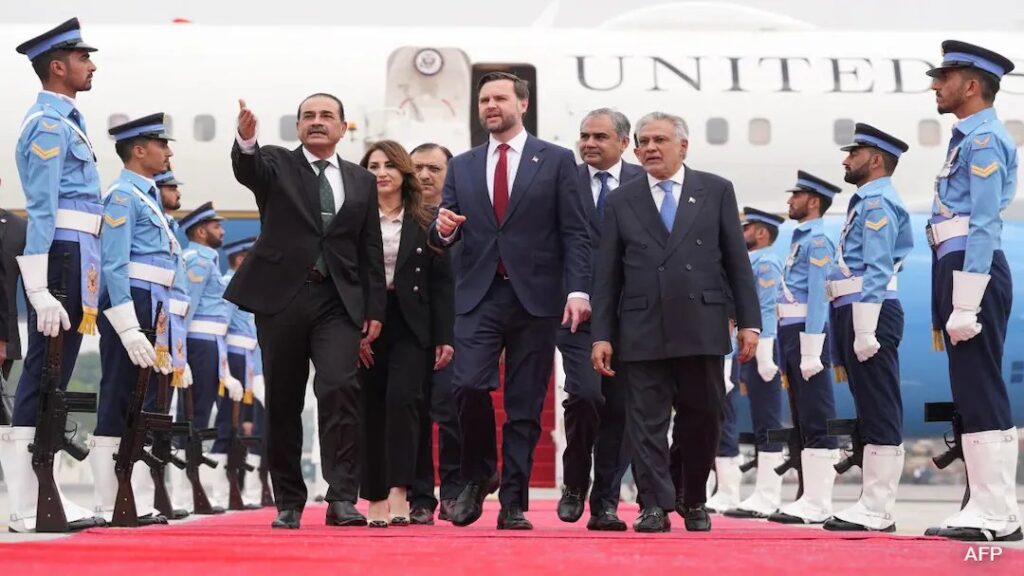
Image: from NDTV WORLD X @NDTVWORLD
By Open Chronicle Staff with Agencies
ISLAMABAD — High-stakes trilateral negotiations aimed at ending the six-week war between the United States and Iran commenced in Pakistan on Saturday. The face-to-face talks in Islamabad bring together top-level officials from Washington, Tehran, and the Pakistani military in a desperate push for a lasting diplomatic resolution to the regional conflict.
U.S. Vice President JD Vance and Pakistani Prime Minister Shehbaz Sharif met earlier today to set the stage for the discussions. According to sources cited by Reuters, the American delegation includes Vance, Special Envoy Steve Witkoff, and Jared Kushner, while Iran is represented by Parliament Speaker Mohammad Bagher Ghalibaf and Foreign Minister Abbas Araqchi.
We have a great negotiating team." — President Trump on JD Vance, Steve Witkoff, and Jared Kushner arriving in Islamabad. 🦅⚡
Expectations are high as talks begin this morning. The goal? Opening the Strait of Hormuz! 🌊🚀 pic.twitter.com/70IUWKwpzr— Huzaifa_Exclusives (@MemeVibes55) April 11, 2026
Trump: “Mine Dropper Boats” Sunk
While diplomats gathered in Islamabad, President Donald Trump signaled a shift in military posture. In a post on Truth Social, the President announced that U.S. forces have begun the process of “clearing out” the Strait of Hormuz.
“All 28 of Iran’s ‘mine dropper boats’ are also lying at the bottom of the sea,” Trump wrote, asserting that the U.S. Navy had neutralized Iran’s ability to block the waterway with sea mines. Following the post, reports emerged of multiple U.S. naval vessels successfully transiting the strait.
The maritime situation remains tense; Iranian state television claimed a warning was issued to a U.S. military ship, threatening an attack within 30 minutes if it crossed the waterway. However, U.S. officials told Axios that no such warning was received.
Commercial Shipping Resumes
Despite the lingering military tension, global energy markets saw a glimmer of hope as shipping data from LSEG confirmed that two Chinese supertankers, the Cospearl Lake and He Rong Hai, passed through the Strait.
Both vessels, chartered by the Chinese refining giant Sinopec, are believed to be the first commercial tankers to exit the Persian Gulf since the initial ceasefire was struck earlier this week. They reportedly utilized a “trial anchorage” that bypasses Iran’s Larak Island.
Escalation in Lebanon
The diplomatic movement in Pakistan stands in stark contrast to the continued violence in the Levant. The Israeli Defense Forces (IDF) reported striking over 200 Hezbollah targets in Lebanon over the last 24 hours, focusing on rocket launchers and military infrastructure.
The intensification of the air campaign comes even as Lebanon’s presidency announced that a separate meeting with Israeli officials is scheduled for next week in Washington to discuss a potential ceasefire on that front.
Global Pressure for De-escalation
French President Emmanuel Macron confirmed he is in “close contact” with Saudi Crown Prince Mohammed bin Salman regarding the Islamabad talks.
“I reiterated my support for the ceasefire, which must be fully respected and extended without delay to Lebanon,” Macron wrote on X. “We discussed the need to restore fully free and safe navigation in the Strait of Hormuz as quickly as possible.”
The Islamabad talks are seen as the most significant diplomatic effort since the conflict began on February 28. Brokered by Pakistan, the negotiations aim to transform the current fragile two-week truce into a comprehensive agreement to halt a war that has already claimed thousands of lives.