
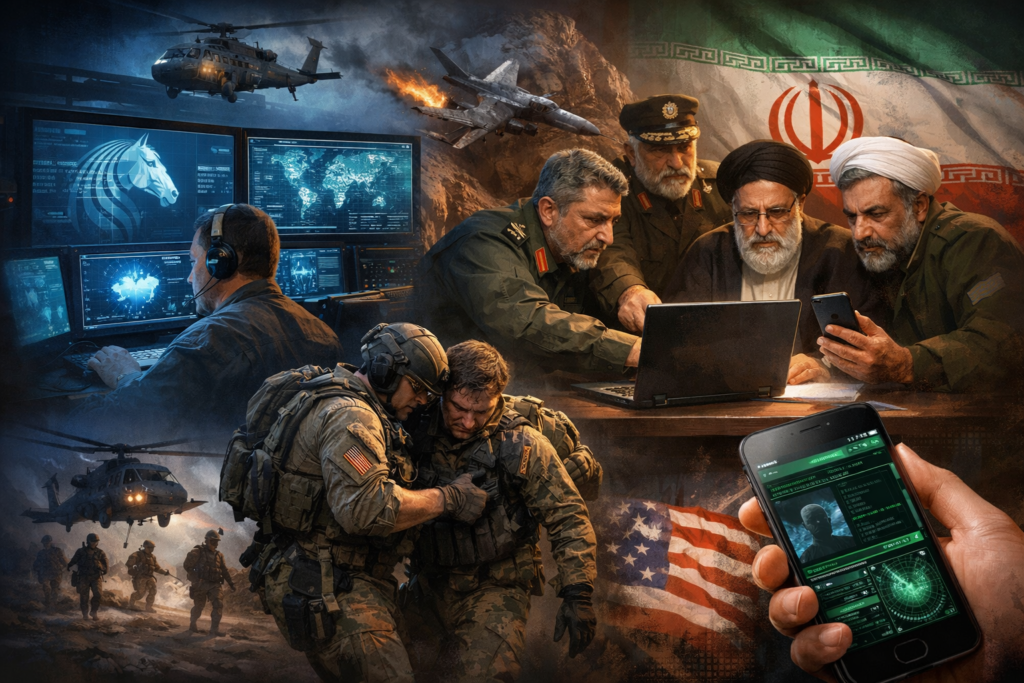
Image Credentials: Image Title: CIA Deception Operation; Pegasus Spyware Used to Mislead Iran During Airman Rescue Source: (sora.openai) Date: March 2025. Attribution: This image was created using AI-generated imagery (sora.openai) and does not depict a real-world scene.
By Open Chronicle Staff with Agencies
April 12, 2026
TEHRAN — New details have emerged regarding the high-stakes rescue of a downed U.S. airman in Iran last weekend, revealing that the CIA utilized the controversial Israeli-made Pegasus spyware to conduct a sophisticated deception campaign against Iranian leadership.
According to a report by the Times of London on Friday, American intelligence operators leveraged the software not just for surveillance, but to actively manipulate communications within the Islamic Revolutionary Guard Corps (IRGC). While Pegasus is primarily known for harvesting data and eavesdropping, its “spoofing” capabilities allowed the CIA to send fake WhatsApp and Signal messages from the devices of compromised Iranian officials.
The Subterfuge Strategy
The deception operation was designed to buy time for U.S. recovery teams. By sending messages through the hacked phones of Iranian operatives, the CIA reportedly convinced Tehran’s command structure that the downed officer had already been located and extracted, diverting Iranian search parties away from the airman’s actual location.
While U.S. officials have acknowledged that “subterfuge efforts” played a role in the mission’s success, they have stopped short of naming Pegasus as the specific tool used. The NSO Group’s software has faced international scrutiny for years following its use by various governments to target dissidents and journalists.
‘Ghost Murmur’ and Exquisite Tech
The operation also highlighted the deployment of a previously classified sensor technology dubbed “Ghost Murmur.” Reports suggest this system can detect a human heartbeat from dozens of miles away, a capability that far exceeds any publicly known biometric technology.
The airman was eventually located 7,000 feet up a mountain in the Iranian desert, hiding in a rocky crevice. When questioned about the technology by the New York Post, President Donald Trump remarked:
“It was very important. Nobody even knows what it is. Nobody ever heard of it before. We have many other things that nobody has ever heard about.”
CIA Director John Ratcliffe echoed these sentiments, describing the rescue as a “daunting challenge” that required “exquisite technologies that no other intelligence service in the world possesses.”
Regional Context and Conflict
The rescue follows the first loss of U.S. aircraft within Iranian territory since the outbreak of hostilities on February 28, a conflict that began with massive U.S. and Israeli airstrikes resulting in the death of Supreme Leader Ali Khamenei.
Despite the successful extraction and a fragile two-week ceasefire currently in place, regional tensions remain at a breaking point. Follow-up talks between U.S. and Iranian representatives in Pakistan failed to resolve on Saturday. Israel, which provided intelligence and kinetic support during the rescue mission, was not represented at the negotiations.