
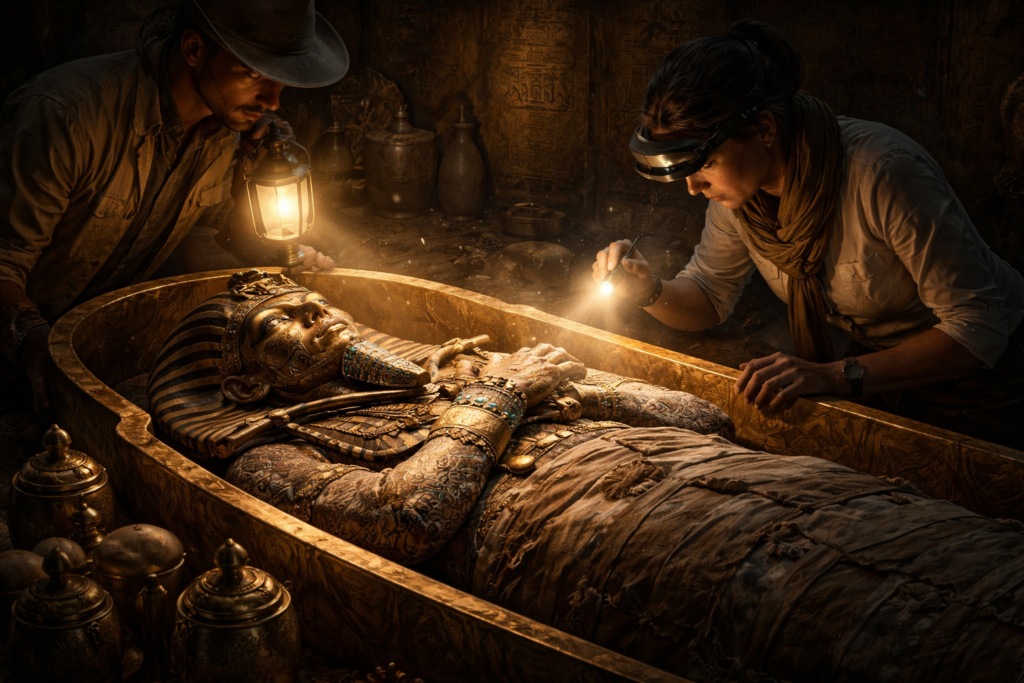
Image Credentials: Image Title: The Boy King’s Final Breath; Unraveling the Mystery of Tutankhamen Source: (sora.openai) Date: March 2025. Attribution: This image was created using AI-generated imagery (sora.openai) and does not depict a real-world scene.
History Desk | Forensic Archaeology Series
By the Open Chronicle History Desk
April 12, 2026
Since Howard Carter’s team first broke the seal of KV62 in 1922, the world has been captivated by the “Boy King,” Tutankhamen. While the gold of his funerary mask dazzled the public, a darker question lingered in the shadows of the cramped, hurriedly prepared tomb: How does a pharaoh die at eighteen?
A Death in Haste
The Eighteenth Dynasty was a period of immense power, yet Tutankhamen’s final resting place tells a story of panic. The tomb is uncharacteristically small for a sovereign, its wall paintings still damp when the door was sealed in 1323 B.C.E. This “expeditious arrangement” has long served as the primary evidence that Tutankhamen’s death was not only premature but entirely unexpected.
The Case for Cold-Blooded Murder
In 1968, the first major forensic breakthrough occurred when Ronald Harrison of the University of Liverpool X-rayed the mummy. The images revealed a fragment of bone within the skull and a thinning at the base, leading many to believe the Pharaoh had been felled by a violent blow to the head.
Historians immediately looked for a motive, identifying a “Circle of Suspects” who gained the most from a power vacuum:
-
Ay: The high-ranking adviser who claimed the throne immediately after Tutankhamen.
-
Horemheb: The ambitious army commander who eventually succeeded Ay and attempted to erase Tutankhamen from the historical record.
-
Ankhesenamun: His wife, who faced a desperate political marriage following his death.
The CT Scan: A Forensic Pivot
The murder theory held sway for decades until January 2005, when Zahi Hawass, Egypt’s chief archaeologist, conducted a comprehensive Computed Tomography (CT) scan. The digital reconstruction provided a much clearer picture of the young ruler’s health.
The results were transformative. The 1,700 generated images suggested that the “hole” in the skull was likely an artifact of the mummification process, a result of the resin-pouring technique—rather than a fatal wound. However, the scan did reveal a significantly fractured left femur (thighbone). Because the fracture showed no signs of healing, forensic experts now believe Tutankhamen may have suffered a traumatic accident, perhaps a fall from a chariot, that led to a fatal infection.
While the 2005 study largely cleared the suspects of assassination, the mystery remains partially veiled. Whether it was a fragile constitution, a sudden infection, or a tragic accident, the Boy King continues to be the most famous patient in the history of forensic science.
Timeline of Forensic Inquiry
-
1323 B.C.E.: Death of Tutankhamen at age 18.
-
1922: Tomb discovered by Howard Carter in the Valley of the Kings.
-
1968: X-ray analysis suggests possible cranial trauma.
-
2005: CT scan rules out murder by head trauma; identifies broken leg.
Bibliography
Brier, Bob. The Murder of Tutankhamen: A True Story. New York: Putnam’s Sons, 1998.
Hawass, Zahi. The Golden Boy: History, Archaeology and the CT Scan of Tutankhamun. Cairo: American University in Cairo Press, 2006.
James, T. G. H. Tutankhamun: The Eternal Splendour of the Boy Pharaoh. London: Tauris Parke, 2000.
Marchant, Jo. The Shadow King: The Bizarre Afterlife of King Tut’s Mummy. Cambridge: Da Capo Press, 2013.