
Image: from Melissa Redpill X @MelissaRedpill
Open Chronicle | With Agencies
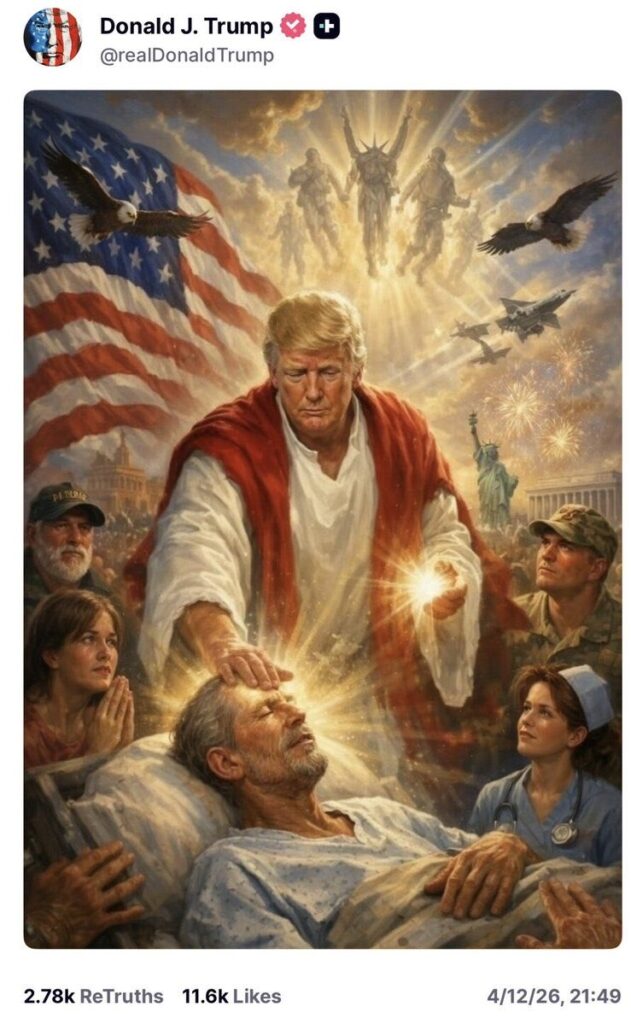
Washington — Donald Trump has drawn renewed controversy after posting, and later deleting, an AI-generated image portraying himself as Jesus Christ, shortly after launching verbal attacks against Pope Francis.
The image, widely circulated on social media before its removal, showed Trump stylized in a religious context, sparking backlash from religious communities, political commentators, and digital ethics experts. Critics described the post as provocative and disrespectful, particularly given its timing alongside remarks targeting the leader of the Catholic Church.
A Post That Ignited Backlash
The AI-generated depiction quickly gained traction online, amplifying debate over the boundaries of political expression and the use of artificial intelligence in shaping public narratives. While Trump has frequently used social media to communicate directly with supporters, the episode marked a striking escalation in tone and imagery.
Observers noted that the combination of religious symbolism and political messaging risked inflaming tensions among faith communities, especially in a politically polarized climate.
🚨This is about DISCLOSURE.🚨
Do you see a Red Cross worker on this image?
To be honest, President Trump doesn’t look like a doctor in this picture.
It looks like a depiction of Jesus Christ. He knows that.President Trump is facing widespread backlash — including from some… pic.twitter.com/InGdePZwE7
— Melissa Redpill (@MelissaRedpill) April 13, 2026
Criticism From Religious and Political Circles
Religious leaders and advocacy groups condemned the image, arguing that it trivialized deeply held beliefs. The controversy was further intensified by Trump’s earlier criticism of Pope Francis, which had already drawn attention in international media.
Some political figures also weighed in, warning that such content contributes to the erosion of respectful discourse and could deepen divisions both within the United States and globally.
AI, Politics, and the New Media Landscape
The incident underscores growing concerns about the role of AI-generated content in politics. As tools capable of creating hyper-realistic images become more accessible, public figures face increasing scrutiny over how such technologies are used.
Experts highlight the risks of misinformation, manipulation, and the blurring of lines between satire and official messaging. In this case, even though the image was removed, its rapid spread demonstrated how difficult it is to contain digital content once released.
A Familiar Pattern
Trump has a long history of provocative online behavior, often using controversial posts to dominate news cycles and rally his political base. The deletion of the image, however, suggests an awareness of the sensitivity surrounding religious imagery and the potential political cost of crossing certain lines.
Broader Implications
Beyond the immediate backlash, the episode reflects a wider shift in how political figures engage with emerging technologies. The convergence of AI, social media, and high-profile personalities is reshaping the dynamics of public communication, raising new ethical and regulatory questions.
As the debate continues, the incident serves as a reminder of the powerful impact of digital imagery and the responsibilities that accompany its use in the public sphere.