
Open Chronicle | With Agencies
London — The United Kingdom economy recorded stronger-than-expected growth in February, according to new official data, offering a brief glimpse of resilience before the economic fallout of the Iran war began to weigh on global markets.
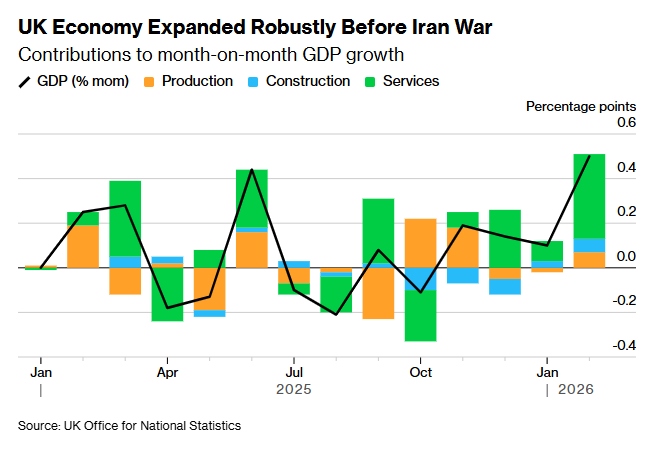
Figures released by the Office for National Statistics show that gross domestic product expanded by 0.5 percent month-on-month in February, marking the fastest growth since January 2024 and significantly outperforming forecasts.
'What it does mean is our economy is more resilient to weather the challenges that come our way'
Business Secretary Peter Kyle spoke to #BBCBreakfast after official figures revealed the UK grew by 0.5% in February – the month before the US-Israel war with Iran… pic.twitter.com/KEDsmw6KJE
— BBC Breakfast (@BBCBreakfast) April 16, 2026
Growth Surprises Economists
The expansion followed a modest 0.1 percent increase in January, which was revised upward from earlier estimates. Economists had expected February growth to come in at just 0.1 percent, making the latest figures a notable upside surprise.
Across the three months to February, GDP growth also exceeded expectations, reflecting a broad-based improvement across key sectors of the economy.
Services Drive the Expansion
According to ONS chief economist Grant Fitzner, the growth was largely driven by the services sector, with strong performances in wholesaling, market research, hospitality, and publishing.
Industrial production also showed signs of recovery, particularly in the automotive sector, which rebounded following disruptions caused by a cyber incident in late 2025.
However, construction remained a drag on growth, continuing its decline, albeit at a slower pace.
War in the Middle East Clouds Outlook
Despite the positive data, economists warn that the figures reflect conditions before the outbreak of the Iran war, which has since disrupted global energy markets and dampened economic expectations.
Rising oil prices linked to the conflict are expected to increase costs for businesses and households, putting pressure on growth and inflation in the months ahead.
IMF Downgrades UK Prospects
The International Monetary Fund has already revised down its outlook for the UK, forecasting growth of just 0.8 percent for 2026, a sharp drop from earlier projections.
The downgrade is among the largest within the G7, highlighting the UK’s vulnerability to global economic shocks, particularly energy price volatility.
Some analysts have even warned of a potential return to stagflation, where weak growth coincides with rising inflation, driven by higher energy and food prices.
Policy Dilemmas for the Bank of England
The changing economic landscape presents a difficult challenge for the Bank of England. Governor Andrew Bailey has acknowledged the “significant uncertainties” facing policymakers, as they weigh the risks of inflation against slowing growth.
Rising consumer concerns over inflation, particularly food prices expected to increase sharply later this year, further complicate the outlook.
At the same time, signs of a softening labor market could limit the central bank’s ability to raise interest rates aggressively.
Government Response and Economic Strategy
UK Treasury officials have emphasized the need for stability and investment to navigate the evolving environment. Measures aimed at boosting competitiveness and reducing energy costs for businesses are being positioned as key pillars of the government’s strategy.
However, the effectiveness of these policies will depend heavily on external factors, particularly the trajectory of the Middle East conflict and global energy markets.
A Fragile Recovery
The February growth figures suggest that the UK economy entered 2026 with some momentum. Yet that progress now faces significant headwinds, as geopolitical tensions reshape the global economic landscape.
For policymakers and businesses alike, the challenge will be to sustain growth in an environment defined by uncertainty, rising costs, and shifting international dynamics.