

Image: from Owen Gregorian X @OwenGregorian
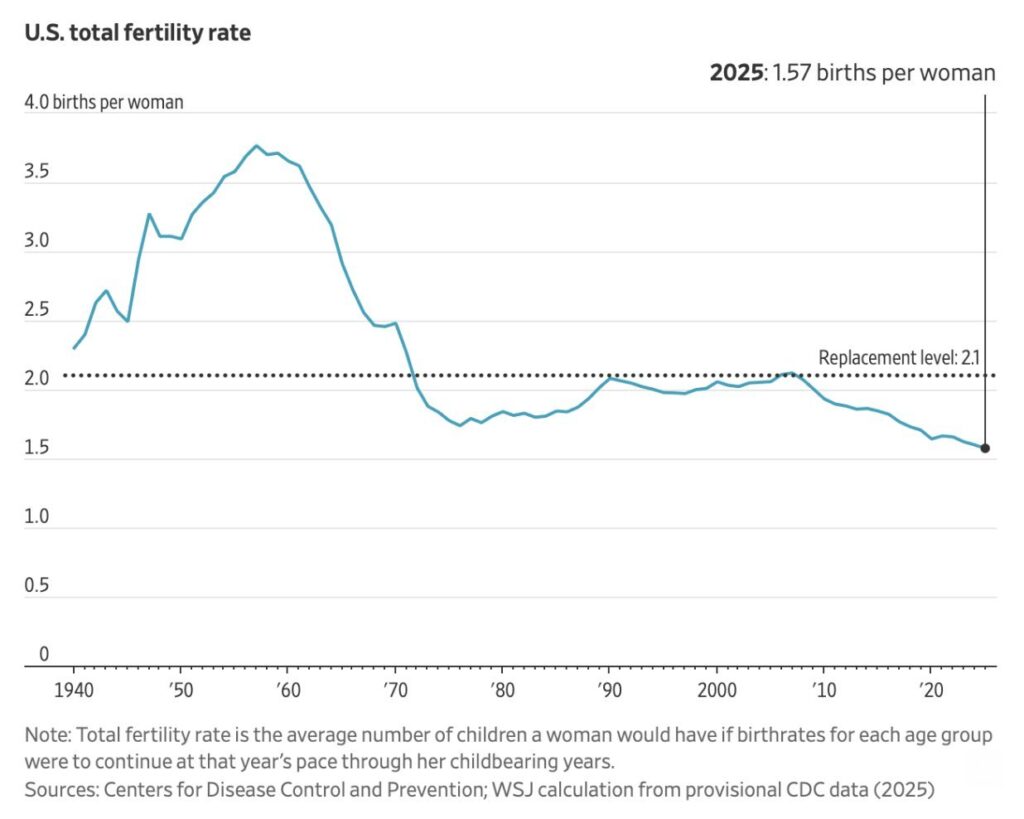
Washington — The number of babies born in the United States declined again in 2025, reinforcing a long-term demographic trend that policymakers are now seeking to reverse through sweeping changes to federal family planning policy.
New data from the Centers for Disease Control and Prevention show that 3.6 million births were recorded last year, a 1 percent drop from 2024. The fertility rate fell to 53.1 births per 1,000 women aged 15 to 44, marking a 23 percent decline since 2007.
A Long-Term Shift, Not a Sudden Drop
Researchers say the decline reflects broader social and economic changes rather than a single policy factor. Women are increasingly delaying childbirth as they pursue higher education, stable employment, and financial security before starting families.
Demographers note that most women still have around two children over their lifetime, suggesting that the trend is less about people choosing not to have children and more about postponing when they do.
“Childbearing has become more planned and more contingent on life circumstances,” said Alison Gemmill, a demographer at UCLA.
Trump Administration Pushes for a “Baby Boom”
The administration of Donald Trump has made reversing the decline a policy priority, calling for a “new baby boom” and exploring measures ranging from financial incentives for parents to expanded fertility planning initiatives.
At the center of the debate is a proposed overhaul of Title X, the federal government’s long-standing family planning program, which has historically focused on providing access to contraception and reproductive health services for low-income populations.
A Redefinition of Family Planning
Under the proposed changes, Title X would shift its focus toward fertility, family formation, and broader reproductive health conditions, placing less emphasis on contraception, which has been a cornerstone of the program since its creation in 1970.
Critics argue that the changes represent a fundamental redefinition of the program’s mission.
“This is an attempt to use family planning as a vehicle for a different agenda,” said Jessica Marcella, a former official who oversaw the program in a previous administration.
Supporters, however, say the shift reflects a more holistic approach to reproductive health, including greater attention to conditions such as endometriosis and fertility awareness.
Experts Question Policy Direction
Economists and sociologists caution that restricting access to contraception is unlikely to increase birth rates. Instead, they argue that policies should focus on making parenthood more economically and socially feasible.
“Efforts to increase births will be more effective if they make having children more desirable, not harder to avoid unintended pregnancies,” said economist Phillip Levine.
Data show that infertility rates in the United States have remained relatively stable, even as birth rates have declined, suggesting that underlying health issues are not the primary driver of the trend.
Public Health Concerns
Healthcare experts warn that reducing access to contraception could have unintended consequences, including higher rates of unintended pregnancies and increased strain on healthcare systems.
The United States already has one of the highest maternal mortality rates among developed countries, with many pregnancy-related deaths considered preventable.
Since the Supreme Court’s 2022 decision overturning federal abortion protections, access to reproductive healthcare has become more limited in many states, adding further complexity to the issue.
A Program Under Pressure
Title X has served as a critical safety net for decades, providing millions of Americans with access to contraception, screenings, and basic reproductive healthcare. At its peak, the program supported more than five million patients annually.
Recent funding changes and administrative shifts have already reduced participation, with some clinics closing or scaling back services.
Experts warn that further changes could limit access for vulnerable populations, particularly those who rely on the program as their primary source of care.
A Broader Debate on Family and Policy
The debate over birth rates and family planning reflects deeper questions about the role of government in shaping personal decisions.
While policymakers seek to address demographic challenges, researchers emphasize that long-term trends are shaped by economic conditions, cultural shifts, and individual choices.
For now, the United States faces a complex reality: a declining birth rate, a changing social landscape, and a policy debate that is likely to intensify in the years ahead.