
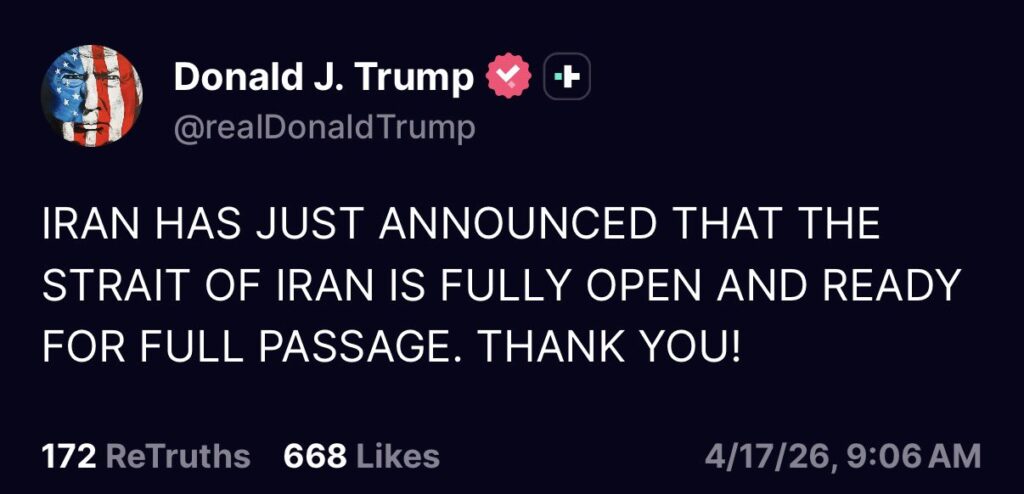
Image: from Abdow Alinoor X @abdow_alinoor
Open Chronicle | With Agencies
Middle East / Global Trade — Iran has announced that the Strait of Hormuz is fully open to commercial traffic for the duration of the current ceasefire, offering a potential easing of one of the world’s most critical energy disruptions.
The declaration came from Iranian Foreign Minister Abbas Araghchi, who said that all commercial vessels are now permitted to transit the waterway under coordinated routes established by Iranian maritime authorities.
A Conditional Reopening
The move aligns with broader ceasefire arrangements in the region, including the temporary truce in Lebanon, and signals Tehran’s willingness to stabilize shipping flows during the pause in hostilities.
However, the reopening comes with significant conditions. The United States continues to enforce a naval blockade on Iranian ports, requiring vessels to obtain clearance from both Iranian and American authorities before entering or leaving the Gulf.
Donald Trump welcomed Iran’s announcement, publicly acknowledging the reopening of the strait. At the same time, he emphasized that U.S. restrictions would remain in place until a broader peace agreement is reached.
Limited Traffic Despite Announcement
Despite the formal reopening, shipping activity through the Strait of Hormuz remains sharply reduced.
Since the escalation of the conflict earlier this year, daily vessel traffic has dropped to minimal levels, with only a handful of ships attempting the crossing. Even before the U.S. blockade was implemented, uncertainty and security risks had already discouraged many operators.
Recent data from US Central Command indicates that numerous vessels have turned back rather than risk transit, highlighting persistent concerns within the shipping industry.
High Risks for Shipowners
The dual-clearance requirement imposed by U.S. forces has added a layer of complexity and risk for shipowners. Companies must now navigate overlapping regulatory demands while assessing the security environment in one of the world’s most sensitive maritime corridors.
Although a small number of tankers have successfully crossed the strait in recent days, most operators remain hesitant.
One vessel, the Shalamar tanker, initially aborted its attempt to enter the Gulf following the collapse of earlier peace talks, before later completing its journey under improved conditions.
Strategic Importance of the Strait
The Strait of Hormuz is a vital artery for global energy markets, handling roughly 20 percent of the world’s oil supply under normal conditions. Any disruption to its flow has immediate consequences for prices, supply chains, and economic stability worldwide.
The current situation underscores how even partial restrictions or uncertainty can significantly reduce traffic, regardless of official declarations.
A Fragile Balance
While Iran’s announcement has raised hopes for a return to normal shipping operations, the continued U.S. blockade and lingering security concerns suggest that full recovery will take time.
The situation remains fluid, with maritime activity dependent not only on official policy but also on the confidence of shipping companies and insurers.
Outlook
The reopening of the Strait of Hormuz marks an important step toward stabilizing global trade routes, but it is far from a complete resolution.
As long as geopolitical tensions persist and military restrictions remain in place, the flow of goods through this critical waterway will continue to reflect a fragile balance between diplomacy and risk.