
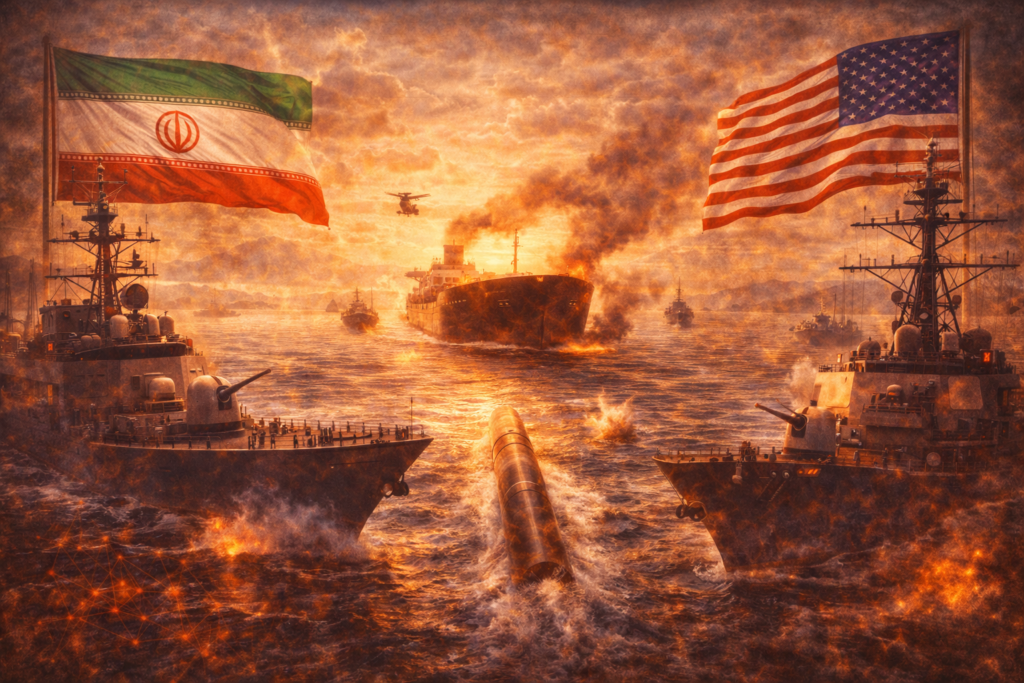
Image Credentials: Image Title: Iran Tightens Grip on Strait of Hormuz as Standoff with United States Deepens Source: (chatgpt.com) Date: April 2026. Attribution: This image was created using AI-generated imagery (chatgpt.com) and does not depict a real-world scene.
Open Chronicle | International Affairs
Iran has reinforced its position in the escalating maritime crisis in the Persian Gulf, insisting it will continue restricting access to the Strait of Hormuz for as long as the United States maintains its naval blockade of Iranian ports.
The renewed warning comes as fragile diplomatic efforts struggle to prevent the collapse of a temporary ceasefire, with tensions rising sharply across one of the world’s most vital energy corridors.
“No Passage Without Reciprocity”
Speaking on state television, Iranian parliamentary Speaker Mohammed Bagher Qalibaf made Tehran’s stance unequivocal.
“Others can’t pass through the Strait of Hormuz while we cannot,” he said, underscoring Iran’s strategy of linking maritime access directly to the lifting of U.S. restrictions.
The statement followed a series of incidents at sea, including Iranian forces opening fire on vessels attempting to transit the strait. According to maritime security reports, at least two India-linked ships were targeted and forced to retreat, prompting renewed caution among global shipping operators.
Shipping Paralysed, Markets on Edge
The immediate effect has been a sharp reduction in maritime traffic. After a brief uptick in movement during the ceasefire window, vessels across the Gulf have largely halted operations, awaiting clearer security guarantees.
The Strait of Hormuz typically handles around one-fifth of global oil flows. Its disruption is already intensifying fears of a prolonged energy shock, with ripple effects across global markets.
Ceasefire Under Pressure
The current ceasefire between Washington and Tehran is set to expire within days, and the situation in the strait is emerging as the most immediate threat to its survival.
Iran briefly signaled openness by allowing limited transit following a truce linked to the Hezbollah conflict in Lebanon. However, that position quickly reversed after U.S. President Donald Trump confirmed that the blockade would remain fully in place until a broader agreement is reached.
Tehran has since framed the blockade as a violation of the ceasefire itself, with the Supreme National Security Council warning it would prevent any “conditional” reopening of the waterway.
A Strategic Lever
For Iran, control over the strait represents one of its most powerful tools. By restricting passage, it can exert pressure not only on Washington but on the global economy.
Iranian officials argue that the U.S. approach risks destabilizing international trade. Deputy Foreign Minister Saeed Khatibzadeh accused Washington of “miscalculations” that could jeopardize both the ceasefire and broader economic stability.
At the same time, the U.S. blockade is designed to squeeze Iran’s already strained economy, limiting its access to international markets and revenue streams.
Diplomacy in Motion, But Fragile
Efforts to de-escalate are ongoing. Pakistan has stepped in as a mediator, attempting to bridge differences and organize a new round of talks.
While Iranian officials acknowledge receiving new proposals, they remain skeptical. Khatibzadeh indicated that Tehran is not yet ready for direct negotiations, citing what he described as Washington’s uncompromising stance.
One key sticking point remains Iran’s enriched uranium stockpile, which Tehran has refused to transfer under current conditions.
A Region on the Brink
The broader conflict, now entering its eighth week, has already caused thousands of casualties across the region, including in Iran, Lebanon, Israel, and Gulf states, alongside losses among U.S. forces.
With maritime tensions intensifying and the ceasefire nearing expiration, the risk of renewed large-scale conflict is growing.
For now, the waters of the Strait of Hormuz remain not just a trade route, but a pressure point where global economics and high-stakes geopolitics converge.
The Grand Strategy Institute
Continue Exploring Strategic Analysis
Return to The Grand Strategy Institute for strategic assessments, long-form analysis and research examining geopolitics, military affairs, international security, emerging technologies and the changing international order.
← Back to The Grand Strategy Institute