
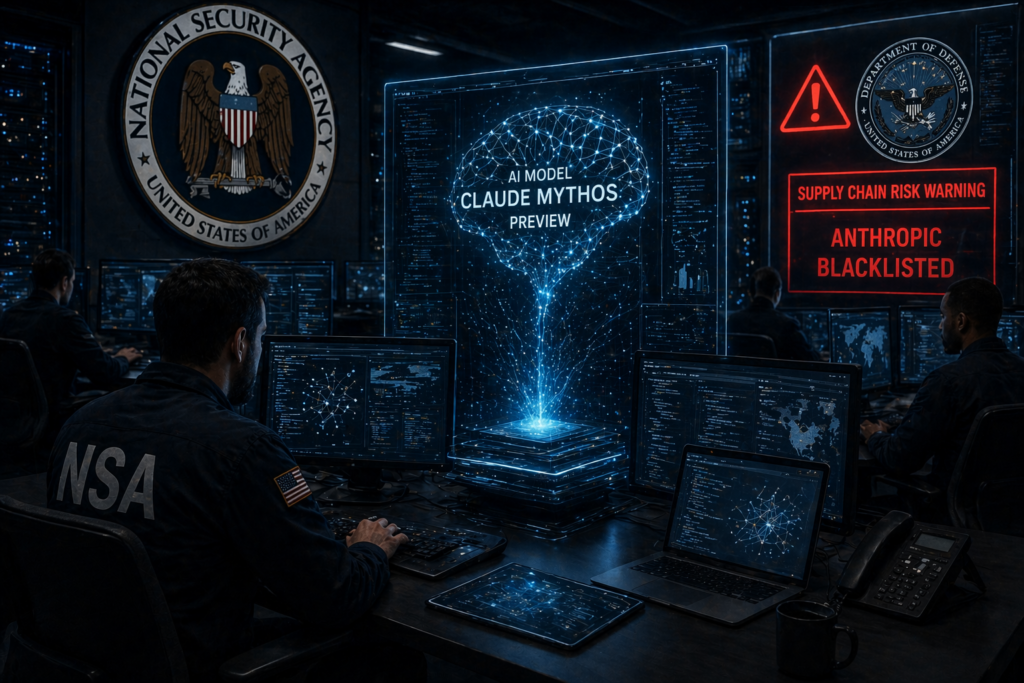
Image Credentials: Image Title: National Security Agency reportedly uses Anthropic AI despite Pentagon warning Source: (chatgpt.com) Date: April 2026. Attribution: This image was created using AI-generated imagery (chatgpt.com) and does not depict a real-world scene.
Open Chronicle | Technology & Security
The National Security Agency is reportedly using advanced artificial intelligence developed by Anthropic, despite a formal supply chain risk warning issued by the United States Department of Defense that effectively blacklisted the company from military contracts.
According to reports, the agency has been working with Anthropic’s restricted model, Claude Mythos Preview, a powerful AI system designed with advanced cyber capabilities. The development highlights growing tensions within the U.S. government over how cutting-edge AI tools should be deployed, particularly in national security contexts.
A tool under scrutiny
Anthropic’s Mythos model has been tightly controlled due to concerns about its potential misuse. The company has limited access to around 40 organizations, citing the system’s ability to identify vulnerabilities and potentially support offensive cyber operations.
Sources suggest that the NSA is among those granted access, although it remains unclear how the agency is deploying the technology. In other environments, the model has been used to scan systems for exploitable weaknesses, a capability that aligns closely with intelligence and cybersecurity missions.
The reach of the tool may extend beyond the NSA. Reports indicate that elements of the broader U.S. intelligence community are also experimenting with the system, while British counterparts have gained access through national AI security initiatives.
Legal battle and policy divide
The situation follows a sharp escalation in tensions between Anthropic and the Pentagon. Earlier this year, the company filed a lawsuit after being cut off from Defense Department partnerships under a rare “supply chain risk” designation.
That classification requires contractors and partners to halt cooperation, effectively excluding Anthropic from military-related work. At the center of the dispute is a fundamental disagreement over how AI should be used.
Defense officials pushed for broader access to Anthropic’s models for all lawful purposes. The company resisted, insisting on restrictions against applications such as mass domestic surveillance and autonomous weapons development. Some officials argue this stance undermines reliability in critical moments, while Anthropic maintains that safeguards are essential.
Quiet use raises questions
The reported use of Mythos by the NSA introduces a complex dynamic. While the Pentagon has formally restricted the company, intelligence agencies appear to be exploring its capabilities independently.
This divergence reflects a broader debate within the U.S. government. Some policymakers see tools like Mythos as essential to maintaining a technological edge, particularly against global competitors. Others remain concerned about oversight, ethics, and long-term risks.
Recent meetings between Anthropic leadership, including CEO Dario Amodei, and senior White House officials suggest efforts are underway to find common ground. Discussions have focused on how federal agencies beyond the Defense Department might engage with the company’s technology under clearer guidelines.
The future of AI in national security
As artificial intelligence becomes central to intelligence gathering and cyber operations, the dispute underscores the challenges of balancing innovation with control.
The reported involvement of the NSA signals that, despite institutional disagreements, demand for advanced AI tools continues to grow. Whether a unified policy emerges or agencies continue to chart separate paths could shape how the United States approaches AI-driven security in the years ahead.