
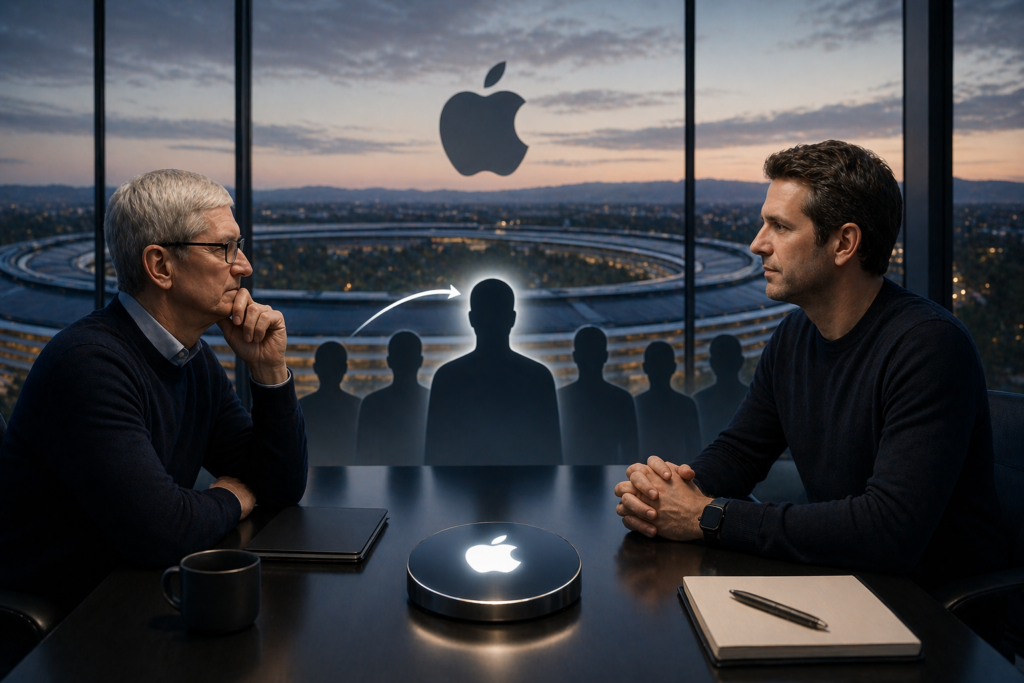
Image Credentials: Image Title: Apple succession debate intensifies as focus turns to post-Tim Cook era Source: (chatgpt.com) Date: April 2026. Attribution: This image was created using AI-generated imagery (chatgpt.com) and does not depict a real-world scene.
Open Chronicle | Business & Technology
As Tim Cook approaches nearly 15 years at the helm of Apple, attention inside and outside the company is increasingly shifting toward one question, who will lead the world’s most valuable tech giant next?
While Cook has not indicated that he plans to step down imminently, discussions about succession have quietly gained momentum. Among the names most frequently mentioned is John Ternus, Apple’s senior vice president of hardware engineering, who has emerged as a leading contender to eventually take over.
A different kind of leadership transition
Unlike the dramatic handover from Steve Jobs to Cook in 2011, the next transition at Apple is expected to be more measured and less disruptive. Cook’s tenure has been defined by operational discipline, steady growth, and an expansion into services, rather than the product-centric revolution associated with Jobs.
This has reshaped expectations for Apple’s next leader. Rather than a visionary founder figure, the company may prioritize continuity, execution, and the ability to manage a vast global operation.
Ternus fits that profile. Having spent years inside Apple’s engineering ranks, he has played a key role in overseeing the development of flagship devices, including iPhones, iPads, and Macs. His deep familiarity with Apple’s product pipeline and culture has made him a trusted figure within the organization.
Internal talent versus external pressure
Apple has historically favored internal candidates for top leadership roles, a strategy that reinforces its tightly controlled culture. Promoting from within ensures continuity in decision-making and preserves the company’s long-standing emphasis on secrecy and integration between hardware and software.
However, the broader tech landscape is evolving rapidly. Artificial intelligence, global supply chain shifts, and intensifying competition are reshaping the industry. Some investors and analysts argue that Apple may eventually need a leader capable of navigating these new pressures with a fresh perspective.
For now, though, there is little indication that the company is looking outside its ranks.
The Cook era, stability, and scale
Under Cook, Apple has transformed into a company defined as much by its ecosystem as by its devices. Services such as subscriptions, payments, and digital platforms have become a major revenue driver, reducing reliance on hardware cycles.
At the same time, Apple has expanded its global footprint while maintaining high profit margins, a balancing act that has reinforced investor confidence. This stability is one reason why there is no immediate urgency to replace Cook.
Still, succession planning remains a critical issue for any company of Apple’s scale. Ensuring a smooth transition is essential to maintaining market confidence and operational continuity.
Looking ahead
The eventual choice of Apple’s next CEO will signal how the company sees its future. A leader like Ternus would suggest a continued focus on product excellence and internal continuity. A different choice could indicate a shift toward new priorities, such as artificial intelligence or service expansion.
For now, Cook remains firmly in charge. But as Apple enters a new phase of technological change and global competition, the question of who comes next is becoming harder to ignore.
Whenever the transition happens, it will mark one of the most closely watched leadership changes in the global business world.