
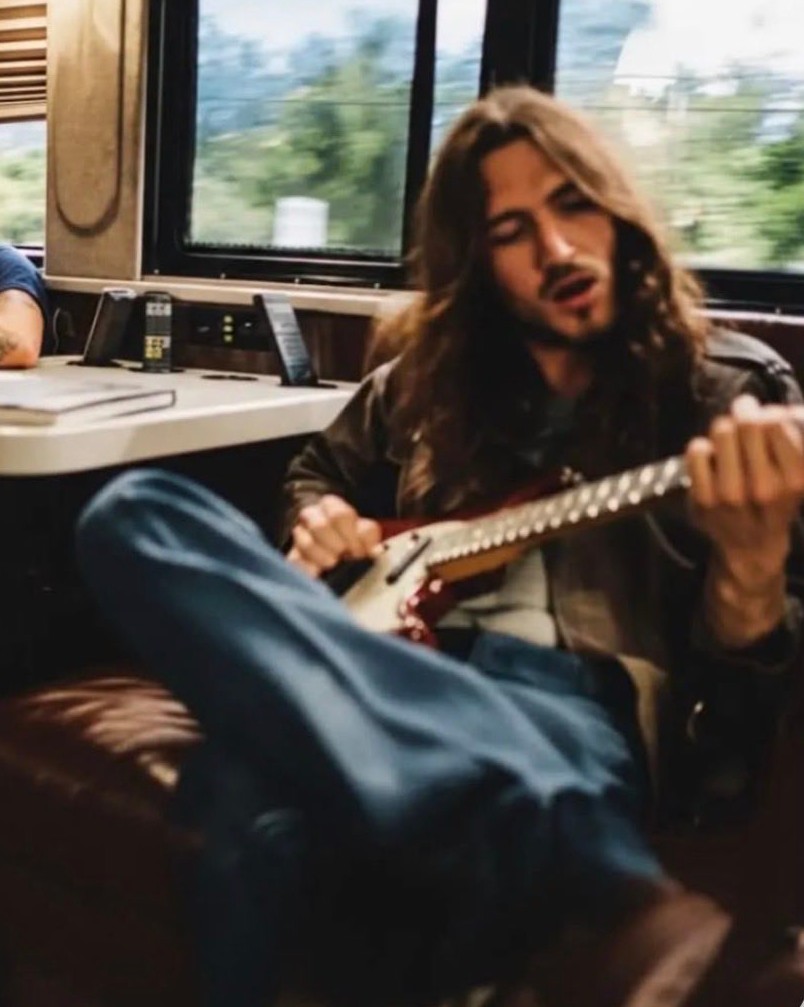
Image: from DAILY JOHN FRUSCIANTE X @bydailyjohn
Jose Carlos Palma
For Open Chronicle | Why It Works Series | Season 1: Space, Sound, and Identity
There’s a persistent belief among guitar players that more notes mean more impact. More speed, more technique, more complexity.
And yet, some of the most memorable moments in modern guitar do the exact opposite.
The work of John Frusciante with the Red Hot Chili Peppers doesn’t stand out because of density; it stands out because of space. Not because of quantity, but because of choice.
The real question isn’t “what is he playing?”
It’s “what is he choosing not to play?”
🎧 The moment
Think of tracks like Scar Tissue or Californication.
They are not built on dense solos or complex phrasing. They rely on fragile lines, isolated notes, and phrases that almost feel unfinished.
And still, they work, almost obsessively well.
🔍 What you’re actually hearing
On the surface, it sounds simple:
- very few notes
- lots of space between phrases
- frequent use of open strings
- clean, almost raw tone
But that simplicity is deceptive.
Frusciante is not filling space; he is shaping it. Every pause has weight. Every note lands with rhythmic intent, not just melodic purpose.
The result is not emptiness. It’s focus.
⚙️ Why it works
1. Space creates tension
Silence makes the listener anticipate. The absence of sound becomes part of the groove.
Most guitarists rush to resolve that tension. Frusciante lets it breathe.
2. Rhythm comes first
What sounds harmonically simple is actually rhythmically rich.
The notes are not there to show knowledge; they serve the pulse. That’s why even the simplest parts feel alive.
3. Repetition builds identity
Instead of constantly changing ideas, he repeats them.
And that repetition gives the listener something to hold onto. Not more information, but a stronger identity.
4. Imperfection creates humanity
There are micro variations, subtle timing shifts, and nuances in attack.
Nothing feels mechanical. And that’s what connects the music to the body, not the machine.
🌍 Cultural context
Frusciante’s approach didn’t emerge in a vacuum.
In the 90s and early 2000s, popular music was split between technical virtuosity and increasingly polished production.
His playing feels almost like a response to that. A return to essence, to the human gesture, to the idea that emotion doesn’t depend on complexity.
It’s minimalism, not as a limitation, but as an intention.
🎯 How to apply it
This only matters if you can use it.
Try three simple ideas:
1. Limit yourself
Play a solo using only 3 or 4 notes. This isn’t about technique, it’s about intention.
2. Force space
After every phrase, stop. Even if it feels uncomfortable. Especially if it feels uncomfortable.
3. Focus on rhythm
Before choosing notes, decide when you will play them. Groove comes first.
🧩 What most guitarists miss
Playing less is not easier.
It’s harder.
Every exposed note carries more responsibility. There’s no speed to hide behind, no density to mask hesitation.
That’s why this approach remains rare, even though it looks simple.
🎸 Conclusion
Frusciante doesn’t sound good despite playing less.
He sounds good because he plays less.
And that might be the hardest idea to accept as a guitarist:
You don’t need to add more.
You need to remove what doesn’t matter.
← Season 1 → | Next Episode →

GuitarWorldX
Lessons, gear, techniques, artists, guitar legends and the stories shaping the world of guitar.
Return to GuitarWorldX ›