
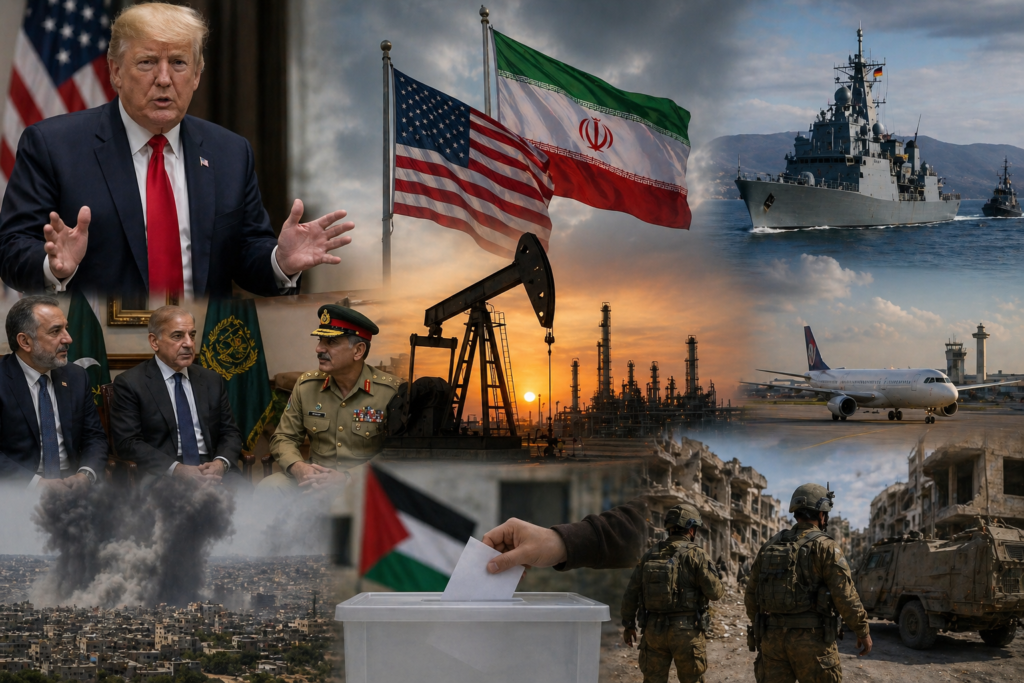
Image Credentials: Image Title: Trump’s Worldview Isn’t an Aberration. It’s a System Source: (chatgpt.com) Date: April 2026. Attribution: This image was created using AI-generated imagery (chatgpt.com) by Open Chronicle and does not depict a real-world scene.
Open Chronicle | World Affairs
Global tensions persist as diplomacy stalls and military readiness grows
A new wave of geopolitical developments is shaping the global landscape, with diplomatic uncertainty, military positioning, and economic pressure all converging as tensions around Iran and the Middle East continue to ripple across the world.
At the center of the latest developments is Donald Trump, who signaled a flexible but assertive approach toward negotiations with Iran. Speaking before departing Florida, Trump said he was prepared to engage with “whoever runs the show” in Tehran, suggesting that internal divisions within Iran’s leadership are complicating diplomatic efforts.
According to Trump, the United States holds a dominant position in the standoff, claiming Iran’s leadership structure is unclear and weakened. His remarks reflect a broader strategy of pressure, as Washington seeks to shape the terms of any future agreement.
In a move that underscores that approach, Trump also canceled a planned trip to Pakistan by senior envoys Steve Witkoff and Jared Kushner. The visit had been intended to facilitate talks with Iranian officials. Trump dismissed the need for such travel, arguing that negotiations could be conducted remotely and that there was little value in lengthy diplomatic missions without clear progress.
Meanwhile, Europe is preparing for potential escalation at sea. Boris Pistorius announced that Germany will deploy naval units to the Mediterranean, positioning them for a possible mission linked to the Strait of Hormuz. The deployment includes a minesweeper and a support vessel, aimed at ensuring readiness should a parliamentary mandate be approved.
The Strait of Hormuz remains a focal point of global concern, as disruptions there continue to affect energy markets and international shipping routes.
Beyond these headline developments, diplomatic activity continues across multiple fronts. Abbas Araghchi has been actively engaged in regional talks, meeting Pakistani officials, including Asim Munir and Shehbaz Sharif, in efforts to revive stalled negotiations. Iran has also resumed limited international flights from Tehran, signaling a cautious return to normalcy amid ongoing tensions.
Elsewhere, instability persists. Fighting in Mali has intensified following coordinated attacks, while Israeli military activity in southern Lebanon continues despite a ceasefire extension. In the Palestinian territories, local elections have begun in parts of Gaza and the West Bank, offering a rare moment of civic participation amid prolonged conflict.
Economic pressures are also mounting. China has warned against new U.S. export control measures targeting advanced technology, raising concerns about further disruption to global supply chains. In Europe, rising fuel costs linked to the Hormuz crisis have prompted International Airlines Group, parent of British Airways, to caution that ticket prices may increase.
Meanwhile, Russia has signaled a potential economic response to European policies. Dmitry Medvedev suggested imposing tariffs on exports to the European Union, highlighting the continued economic dimension of geopolitical rivalry.
Taken together, these developments illustrate a world navigating a fragile balance. Diplomatic channels remain open, but progress is uneven. Military preparations are advancing, even as leaders speak of negotiation. The coming days may prove critical in determining whether the current trajectory leads toward de-escalation or deeper confrontation.